





Table of Contents
📌 Key Takeaways
- Fintech apps go beyond payments, covering banking, wallets, lending, trading, investing, insurance, and wealth management.
- Security and compliance must be built in from the start, including KYC/AML, encryption, secure APIs, fraud detection, and data protection.
- Development costs vary widely, from around $25,000 for a basic MVP to $300,000+ for complex banking or trading ecosystems.
- Technology and integrations shape complexity, with cloud infrastructure, payment providers, KYC services, banking APIs, and real-time data often requiring significant engineering.
- Future fintech growth will be driven by AI, Open Finance, real-time payments, embedded finance, and stronger mobile security.
Fintech has moved far beyond mobile banking and digital payments. Today, financial technology applications support payments, lending, investing, insurance, wealth management, trading, digital wallets, personal finance, and business banking. The scale of adoption is also significant: the World Bank’s Global Findex 2025 reports that 79% of adults globally own a financial account, compared with 74% in 2021, while 86% of adults own a mobile phone.
This growth creates an opportunity for startups, banks, financial institutions, and enterprises to build digital financial products. At the same time, fintech applications operate in a highly regulated environment where security, identity verification, data protection, payment standards, and transaction monitoring must be considered from the beginning.
This guide explains the major fintech app features, development process, technology choices, estimated costs, security requirements, and compliance considerations, with particular attention to the UAE market.
What is Fintech App Development?
Fintech app development involves designing and building software that delivers financial products or services through mobile, web, or connected digital platforms. Depending on the business model, an application may allow users to transfer money, manage bank accounts, invest, trade securities, obtain loans, make payments, purchase insurance, or monitor personal finances.
The complexity varies considerably. A simple budgeting application may primarily require account aggregation and analytics, while a regulated payment or banking platform may need identity verification, transaction monitoring, fraud controls, payment integrations, audit trails, and regulatory reporting.
The global opportunity is supported by increasing digital access. The World Bank reports that nearly 80% of adults worldwide now have a financial account, although around 1.3 billion adults remain without access to financial services.
Ready to Build a Secure Fintech App?
From features and cost to compliance and security — we handle it all. Let our fintech experts turn your idea into a scalable, regulation-ready mobile app.
What Are the Different Types of Fintech Apps?
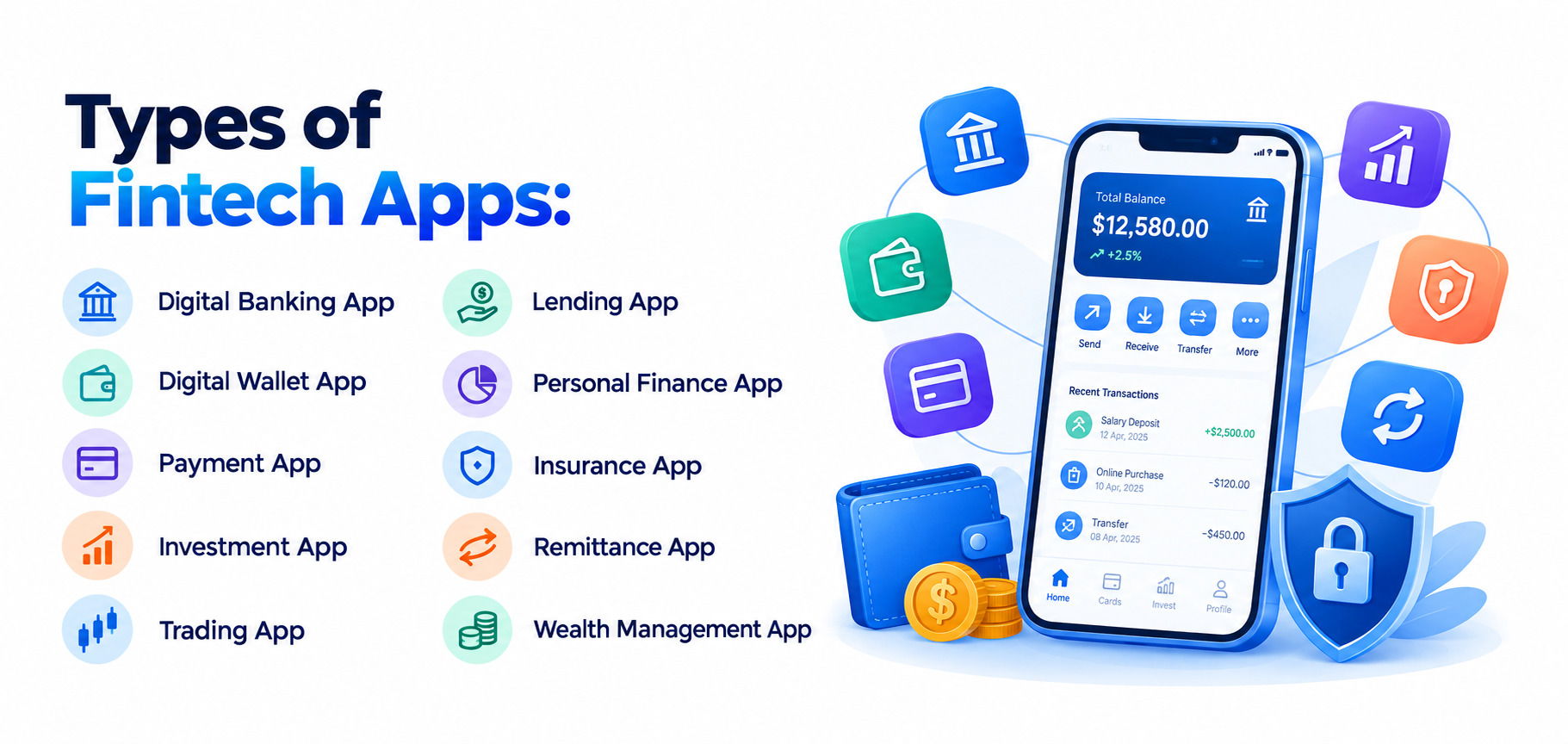
1. Digital Banking App
Supports core banking activities such as account management, money transfers, card controls, and statements. Its high complexity comes from banking integrations, authentication, compliance, and transaction security.
2. Digital Wallet App
eWallet App Development enables businesses to create applications that allow users to store funds, check balances, make payments, and transfer money. These solutions require secure payment integrations, identity verification, transaction monitoring, reconciliation, and safeguards against unauthorised activity.
3. Payment App
Designed for merchant payments, peer-to-peer transfers, payment links, and transaction management. The development involves payment gateway integrations, fraud prevention, and strong security controls.
4. Investment App
Allows users to manage portfolios, explore funds, monitor market data, and track investments. Its high complexity is driven by financial data integrations, portfolio calculations, and regulatory requirements.
5. Trading App
Trading Software Development involves building platforms that support order placement, real-time market feeds, price charts, watchlists, portfolio tracking, and trading history. These systems require reliable infrastructure, accurate financial calculations, low-latency processing, strong security controls, and dependable market-data integrations.
6. Lending App
Helps users apply for loans, complete credit assessments, review offers, and manage repayments. The development requires secure financial data handling, credit workflows, risk assessment, and compliance features.
7. Personal Finance App
Helps users monitor spending, create budgets, track expenses, and understand their financial habits. Its medium complexity generally comes from account aggregation, transaction categorisation, and analytics.
8. Insurance App
Allows customers to manage policies, submit claims, make payments, and access insurance-related documents. Its high complexity comes from policy management, claims workflows, third-party integrations, and regulatory requirements.
9. Remittance App
Enables international money transfers with currency exchange, beneficiary management, transaction tracking, and transfer controls. Cross-border payments are more complex due to regulatory compliance, foreign exchange handling, and integrations with multiple payment networks.
10. Wealth Management App
Provides portfolio management, investment advisory, financial reporting, and performance tracking. Its very high complexity involves sophisticated financial workflows, market data, risk management, and personalised investment services.
Why Businesses Are Investing in Fintech Applications?
Digital financial services combine convenience with automation. Customers can open accounts, complete identity verification, transfer money, receive notifications, and monitor transactions without visiting a physical branch.
The opportunity is particularly relevant for mobile-first markets. According to the Global Findex 2025, 68% of adults globally own a smartphone, creating a large potential channel for digitally delivered financial services.
For businesses, the benefits can include:
- 24/7 access to financial services
- Faster transaction processing
- Reduced dependence on physical branches
- Automated customer onboarding
- Personalised financial experiences
- Real-time notifications
- Lower operational overhead
- Better transaction visibility
- Easier integration with third-party financial services
- New digital revenue models
However, fintech should not be approached like a conventional consumer application. A feature that appears simple from a user perspective may require substantial backend controls, compliance workflows, reconciliation logic, and security infrastructure.
What Are the Benefits of Fintech App Development?
Fintech app development helps businesses deliver faster, more accessible, and more convenient financial services through digital platforms. Beyond improving the customer experience, a well-designed fintech app can streamline operations, support new revenue opportunities, and provide better visibility into financial activity.
1. Improved Customer Experience:
Simplifies payments, account management, transfers, and other financial tasks through convenient digital experiences.
2. Greater Accessibility:
Allows customers to access financial services anytime through mobile and web platforms without relying entirely on physical branches.
3. Faster Transactions:
Digital workflows and automated processes can reduce manual steps and help customers complete financial transactions more efficiently.
4. Operational efficiency:
Automation can streamline processes such as onboarding, verification, payments, reconciliation, reporting, and customer support.
5. Better financial insights:
Transaction data and analytics can help businesses understand customer behavior, monitor financial activity, and make more informed decisions.
6. Enhanced security:
Modern authentication, encryption, fraud monitoring, and transaction controls can help protect sensitive financial data and reduce security risks.
7. Scalable business growth:
Cloud infrastructure, APIs, and modular architectures allow fintech platforms to expand services, users, and integrations as the business grows.
What Are the Essential Features of a Fintech App?
The right feature set depends on the type of financial product, target users, jurisdiction, and regulatory model. A consumer wallet, for example, does not need exactly the same architecture as a securities trading platform.
1. User Registration and Account Management
A smooth registration process should enable secure onboarding through mobile or email verification, OTPs, biometrics, and passwordless login. It should also give users control over their profiles, devices, active sessions, account recovery, and communication preferences.
2. KYC and Identity Verification
KYC functionality helps verify customer identities and assess risk before granting access to financial services. Depending on the market, it can include ID verification, facial recognition, liveness checks, sanctions screening, risk scoring, and manual review.
3. Account and Wallet Management
A central dashboard gives users a clear view of their balances, linked accounts, beneficiaries, transactions, and account limits. Wallet-based products can also support multiple currencies, downloadable statements, and financial reports.
4. Payments and Transfers
Payment functionality enables users to send and receive money through bank transfers, cards, QR codes, payment links, or international transfers. The backend should handle transaction states, reconciliation, failed payments, reversals, settlement, and duplicate transaction prevention.
8. Transaction History and Statements
Users should have access to detailed records of their financial activity in an easy-to-understand format. Transaction details can include amounts, currencies, dates, references, fees, exchange rates, payment status, and downloadable statements.
9. Notifications and Alerts
Real-time notifications keep users informed about payments, transfers, logins, balance changes, and suspicious activity. Alerts can also cover failed transactions, card usage, and investment price movements based on the application’s purpose.
10. Analytics and Financial Insights
Analytics can turn transaction and account data into useful insights such as spending patterns, cash flow, budgets, investment performance, and financial goals. Advanced applications can also use machine learning for anomaly detection, recommendations, or risk analysis where it serves a clear business purpose.
What Advanced Features Can Enhance a Fintech App?
As the product matures, additional capabilities can improve automation and customer experience.
1. AI Financial Assistant
An AI-powered assistant can help users understand transactions, answer financial questions, and provide personalised insights. It can also automate routine support interactions and guide users through common financial tasks.
2. Fraud Detection
Fraud detection systems analyse transaction patterns and user behaviour to identify potentially suspicious activity. They can trigger alerts or additional verification when transactions appear unusual or high-risk.
4. Automated Risk Scoring
Automated risk scoring analyses customer, transaction, or application data to support faster and more consistent financial decisions. It can help assess creditworthiness, identify transaction risks, and detect potential fraud.
5. Open Banking Integration
Open banking allows applications to securely connect with financial institutions and access permitted account or transaction data. This can support account aggregation, financial insights, payment initiation, and personalised services.
6. Robo-Advisory
Robo-advisory uses automated systems to provide investment recommendations based on user goals, risk profiles, and financial information. It can make portfolio guidance accessible while reducing manual advisory work.
7. Real-Time Payments
Real-time payment capabilities allow transactions to be processed and reflected quickly, improving the user experience. They are particularly valuable for payment, wallet, banking, and peer-to-peer financial applications.
8. Multi-Currency Wallets
Multi-currency wallets allow users to hold, receive, exchange, and transfer funds in different countries. This is particularly useful for international customers, travellers, businesses, and cross-border financial services.
9. Automated Reconciliation
Automated reconciliation matches transactions across payment systems, bank records, and internal databases. It reduces manual operational work while helping businesses identify discrepancies and maintain accurate financial records.
10. Voice Payments and Support
Voice functionality provides an alternative way for users to interact with financial applications and access support. Depending on the use case, it can assist with account queries, transaction information, or selected payment actions.
11. Predictive Analytics
Predictive analytics uses historical and real-time data to identify patterns and estimate future financial behaviour. Businesses can use these insights for forecasting, customer segmentation, risk management, and personalised financial experiences.
Get a Clear Estimate for Your Fintech App
No guesswork. Share your idea and receive a transparent breakdown of features, timeline, and development cost.
What Are the Steps in Fintech App Development?
A successful fintech app development process needs product, technology, security, compliance, and operational planning to work together. Treating compliance as a final-stage checklist can create expensive architectural changes later.
Step 1: Define the Financial Product
Start by clearly defining what the application will offer, who it will serve, where it will operate, and which financial activities it will support. These decisions determine the required architecture, integrations, compliance obligations, and overall development budget.
Step 2: Map Regulatory Requirements
Identify the licensing, KYC/AML, consumer protection, data protection, security, reporting, and other regulatory requirements that apply to the product and target market. For UAE-based solutions, the applicable Central Bank of the UAE requirements should be assessed according to the financial service being provided.
Step 3: Design the UX and Architecture
Design clear user journeys for onboarding, KYC, payments, authentication, transaction confirmation, error handling, and security interactions, while defining the audit logging and infrastructure required to support the product.
Step 4: Build the MVP
Develop the minimum viable version of the application around the core financial service rather than simply reducing the number of screens. A wallet MVP, for example, may include registration, identity verification, wallet creation, payments, transfers, transaction history, notifications, support, administration, and security monitoring.
Step 5: Integrate Financial Services
Connect the application with the external services required for its financial workflows, such as banks, payment gateways, KYC providers, AML screening systems, credit bureaus, market-data providers, and Open Finance APIs. The required integrations will depend on the product model, target market, and service offered.
Step 6: Test Security and Financial Logic
Testing should cover both conventional application functionality and financial transaction behaviour, including authentication, authorisation, API security, encryption, payment flows, transaction limits, fraud scenarios, and data protection. Teams should also test edge cases such as duplicate transactions, failed payments, race conditions, vulnerabilities, and recovery procedures.
Step 7: Launch and Monitor
After launch, continuously monitor application performance, security, transactions, fraud risks, infrastructure, and compliance rather than treating testing as a one-time activity. Regular patching, vulnerability management, incident response, log analysis, user feedback, and regulatory reviews help maintain a reliable financial product.
What Technologies Power Fintech Apps?
The technology stack should be selected according to transaction volume, regulatory requirements, integrations, latency, security, and expected growth rather than popularity alone.
1. Frontend
Frontend technologies determine how users interact with a financial application. Android App Development supports fintech products across a broad range of devices and screen sizes, making compatibility, secure storage, biometric authentication, and performance optimisation important considerations during development.
iOS App Development focuses on creating secure and reliable financial experiences for Apple users. Depending on the product requirements, the application may include biometric authentication, protected payment workflows, secure session management, and integration with backend financial services.
2. Backend
Backend technologies handle business logic, APIs, authentication, authorisation, transaction processing, and integrations. Common choices include Node.js, Java, Python, .NET, and Go, depending on the application’s scalability and security requirements.
3. Databases
Databases store and manage application and transaction data reliably. PostgreSQL and MySQL suit structured financial data, MongoDB supports flexible data models, while Redis enables fast caching and real-time data access.
4. Cloud Infrastructure
Cloud platforms such as AWS, Microsoft Azure, and Google Cloud provide scalable computing, managed databases, encryption, identity management, monitoring, backup, disaster recovery, and container infrastructure. These technologies help financial applications maintain security, availability, and performance as transaction volumes and user demand grow.
5. Blockchain
Blockchain App Development can support selected fintech use cases such as digital asset management, tokenisation, smart contracts, transaction tracking, and decentralised financial services. The technology should be adopted only when its security model, governance requirements, transaction structure, and regulatory implications align with the product’s purpose.
How Do You Secure a Fintech App?
Fintech app security needs to protect both the application and the financial infrastructure behind it. Security controls should cover the device, application, API, cloud environment, databases, third-party services, and operational processes.
OWASP’s Mobile Application Security Verification Standard provides security controls covering areas such as secure storage, cryptography, authentication, network communication, platform interaction, code quality, resilience, and privacy.
1. Authentication and Authorisation
Strong authentication verifies user identity, while authorisation determines which actions and financial services each user can access. Controls such as MFA, biometrics, device binding, short-lived tokens, role-based access, and step-up authentication add protection for sensitive operations.
2. Encryption
Encryption protects sensitive financial and personal data both during transmission and while stored. Applications should secure account details, payment information, identity documents, transaction records, credentials, and API secrets, with encryption keys managed separately where practical.
3. Fraud Detection
Fraud detection identifies unusual activity by analysing signals such as device information, login patterns, transactions amounts, frequency, location, beneficiary changes, and failed authentication attempts. High-risk behaviour can trigger additional verification, transaction restrictions, or manual review.
4. API Security
APIs should use strong authentication and authorisation to prevent unauthorised access to financial services and data. Rate limiting, input validation, secure tokens, logging, and monitoring help reduce abuse and protect critical endpoints.
5. Device Security
Mobile applications should account for risks originating from compromised or modified devices. Device binding, secure storage, biometric authentication, and root/jailbreak detection where appropriate can help strengthen protection.
6. Payment Security
Payment workflows should minimise exposure of sensitive payment information through controls such as tokenisation and transaction limits. Additional verification can be required for high-value, unusual, or otherwise sensitive transactions.
7. Infrastructure Security
Cloud and server infrastructure should use network segmentation, access controls, continuous monitoring, secure configurations, and backup mechanisms. These measures help protect application environments and limit the impact of infrastructure-level attacks.
8. Code Security
Security testing should be integrated throughout development rather than performed only before launch. SAST, DAST, dependency scanning, code reviews, and regular vulnerability testing can identify weaknesses before they reach production.
9. Operational Security
Operational controls help teams detect, investigate, and respond to security incidents. Detailed audit logs, monitoring, alerting, access reviews, and documented incident-response procedures provide visibility and accountability.
10. Privacy
Fintech applications should collect only the personal and financial data necessary for their intended functions. Strong access controls, appropriate retention policies, and controlled data sharing help protect user privacy and reduce unnecessary exposure.
What Are the UAE Fintech Regulations?
The UAE is developing a broad regulatory framework for digital financial services. The exact requirements depend on the financial activity and the regulatory authority involved.
The CBUAE’s current framework covers areas such as payment systems, digital banking operations, digital money, payment tokenisation, stored-value facilities, and related digital financial services.
The UAE’s Open Finance Regulation, issued in 2025, establishes requirements for licensing, supervision, and operation of an Open Finance Framework, including an API Hub, Trust Framework, and common infrastructure for data sharing and transaction initiation.
For businesses planning fintech app development in UAE, the regulatory assessment should therefore happen before architecture and feature development are finalised.
Important Areas to Review
| Area | Why it matters |
| CBUAE licensing | Required for applicable regulated financial activities |
| KYC/AML | Customer identification and financial-crime controls |
| Data protection | Responsible handling of personal information |
| Payment regulation | Applicable to relevant payment services |
| PCI DSS | Relevant to cardholder-data environments |
| Consumer protection | Transparent financial products and communication |
| Cybersecurity | Protection of financial systems and information |
| Outsourcing | Third-party and cloud-provider risk |
| Auditability | Evidence of transactions and control activities |
| Incident management | Detection and response to security events |
Regulations can change, and licensing obligations should be confirmed with qualified legal or regulatory advisers before launch.
How Much Does It Cost to Develop a Fintech App?
The fintech app development cost depends heavily on the application’s financial functionality, security requirements, integrations, geographic coverage, and regulatory scope.
A simple personal finance application may require significantly less investment than a regulated digital banking or trading platform.
Estimated Fintech App Development Cost
| App complexity | Estimated cost | Typical timeline |
| Basic fintech MVP | $25,000–$50,000 | 3–5 months |
| Medium-complexity app | $50,000–$100,000 | 5–8 months |
| Advanced fintech platform | $100,000–$200,000+ | 8–12+ months |
| Banking/trading ecosystem | $150,000–$300,000+ | 10–18+ months |
These are planning ranges rather than fixed market prices. Licensing, third-party provider fees, compliance consulting, security audits, infrastructure, and ongoing maintenance can sit outside the software development budget.
What Affects Fintech App Development Cost?
The financial app development cost is affected by several variables beyond the number of screens.
1. Product Complexity
A budgeting application may have relatively straightforward functionality. A trading application requires market feeds, order management, portfolio calculations, risk controls, and potentially extremely low-latency infrastructure.
2. Platform Coverage
Building for iOS, Android, and the web can increase development and testing requirements. Cross-platform frameworks may reduce duplication for certain products, although regulated financial systems still require platform-specific testing.
3. Third-Party Integrations
KYC, AML, payment, banking, market-data, messaging, analytics, and identity services can significantly affect both development and operating costs.
4. Compliance Scope
The more regulated the product, the greater the need for documentation, controls, testing, monitoring, auditability, and specialist review.
5. Security Requirements
Applications handling financial information generally require stronger security engineering than conventional consumer apps.
How Long Does Fintech App Development Take?
A realistic fintech app development timeline depends on the scope and regulatory requirements.
| Development phase | Approximate duration |
| Discovery and requirements | 2–4 weeks |
| Regulatory and technical planning | 2–5 weeks |
| UX/UI design | 4–8 weeks |
| Backend development | 8–16 weeks |
| Mobile/web development | 8–16 weeks |
| Integrations | 4–12 weeks |
| Security and compliance testing | 3–8 weeks |
| Deployment | 1–3 weeks |
Some activities can happen in parallel, so the total project duration is not simply the sum of every phase.
A focused MVP may take 3–5 months, while a multi-service financial platform can require 9–18 months or more.
What Are the Key Challenges in Fintech App Development?
Building a financial product introduces challenges that conventional applications may not face.
1. Data Accuracy
Financial information must remain accurate across transactions, balances, statements, and external integrations.
2. Transaction Reliability
A failed network request should not accidentally create duplicate payments or inconsistent balances.
3. Regulatory Change
Financial regulations evolve, meaning compliance cannot be treated as a one-time project milestone.
4. Third-Party Risk
A fintech ecosystem may depend on multiple providers. Problems with one provider can affect onboarding, payments, identity verification, or market data.
5. Security Threats
Attackers may target credentials, APIs, mobile applications, payment information, or administrative systems.
6. Scalability
A platform must remain reliable during sudden transaction spikes without compromising financial integrity.
Why Choose Aarmeh for Fintech App Development?
Choosing the right Mobile App Development Company is important when building a fintech product that must support secure transactions, reliable performance, intuitive user experiences, and regulatory requirements. Aarmeh combines mobile engineering expertise with an understanding of financial workflows, third-party integrations, data protection, and security requirements. .
1. Financial Workflows
Aarmeh designs applications around real financial processes, including onboarding, payments, transfers, lending, investments, and transaction management. This helps ensure that each feature supports business operations and delivers a seamless user experience.
2. UAE Regulatory Requirements
Fintech products must align with the regulations applicable to their services and target market. Aarmeh considers relevant compliance requirements during planning and development to help businesses build solutions with licensing, reporting, and regulatory needs in mind.
3. Payment Infrastructure
Aarmeh develops payment-enabled applications with integrations for gateways, banks, card services, and other payment platforms. The focus remains on secure processing, transaction reliability, payment status management, and smooth settlement workflows.
4. KYC and AML Processes
Identity verification and financial crime prevention are essential for many fintech products. Aarmeh can integrate KYC, AML screening, sanctions checks, and risk assessment services to support secure customer onboarding and ongoing monitoring.
5. API Security
Financial applications depend on APIs to connect mobile interfaces, backend systems, banks, and third-party providers. Aarmeh applies secure authentication, access controls, encryption, validation, and monitoring practices to help protect sensitive financial data.
6. Cloud Architecture
A scalable cloud architecture helps fintech applications manage changing transaction volumes and business requirements. Aarmeh builds cloud-based systems with appropriate infrastructure, database design, backups, monitoring, and deployment practices to support reliability and growth.
7. Mobile Security
Mobile financial applications require strong protection for user accounts, devices, sessions, and transactions. Aarmeh considers secure storage, authentication, session controls, application hardening, and protected communication when developing mobile experiences.
8. Data Protection
Fintech platforms handle sensitive information such as identity details, account records, transaction data, and financial documents. Aarmeh incorporates data protection measures such as encryption, access restrictions, secure storage, and controlled data handling throughout the application.
9. Transaction Reconciliation
Accurate reconciliation helps businesses match internal records with bank, gateway, and payment-provider transactions. Aarmeh can support automated reconciliation workflows that identify discrepancies, track settlement status, and reduce manual financial operations.
10. Post-Launch Monitoring
Fintech applications require continuous attention after deployment to maintain performance, security, and reliability. Aarmeh supports ongoing monitoring, issue resolution, infrastructure improvements, security updates, and feature enhancements as the product evolves.
By combining financial domain understanding, secure engineering practices, and scalable technology, Aarmeh helps businesses develop fintech applications that are reliable, user-friendly, and prepared for long-term growth.
What Are the Future Trends in Fintech App Development?
The next generation of fintech application development is likely to combine financial infrastructure with AI, real-time payments, open finance, automation, and stronger security.
1. AI-Powered Financial Experiences
AI App Development can introduce capabilities such as financial insights, automated customer support, fraud detection, document processing, risk analysis, and personalised recommendations. However, AI features used in financial decision-making should include data-quality controls, explainability, bias monitoring, security testing, appropriate governance, and human oversight.
2. Open Finance
Open Finance enables secure connections between financial applications, banks, and authorised service providers, allowing users to share data and initiate transactions through regulated systems. In the UAE, the 2025 Open Finance Regulation supports a structured framework for secure data sharing and transaction initiation.
3. Real-Time Payments
Real-time payment infrastructure allows fintech applications to process transfers quickly and provide users with faster, more responsive payment experiences. It can support instant transfers, immediate payment confirmations, improved cash flow, and better transaction tracking.
4. Embedded Finance
eCommerce App Development can incorporate embedded financial services such as digital payments, instalment options, lending, insurance, or customer wallets directly into online shopping experiences. This allows users to access relevant financial features without leaving the ecommerce platform while helping businesses create more connected customer journeys.
5. Stronger Mobile Security
As more financial activities move to mobile devices, applications must protect sensitive data through secure storage, encryption, strong authentication, privacy controls, network protection, and anti-tampering measures. OWASP MASVS provides a useful security baseline for developing and assessing mobile financial applications.
Conclusion
Fintech development is not simply about creating a mobile interface for financial services. A successful product needs reliable transaction architecture, intuitive UX, secure APIs, regulatory planning, identity verification, financial integrations, monitoring, and continuous security improvements.
The fintech app development process should therefore begin with the financial product and regulatory model, followed by architecture, UX, development, integrations, testing, and controlled deployment.
For businesses targeting the UAE, this becomes even more important because payment services, digital money, Open Finance, and other financial activities can fall under specific regulatory frameworks. The CBUAE’s current regulations demonstrate how closely innovation, licensing, risk management, and consumer protection are connected.
The best fintech products are not necessarily those with the most features. They are the ones that make financial activity simple for users while keeping the underlying system secure, auditable, compliant, and reliable.
Absolutely. You can add the following FAQ section toward the end of the blog, before the conclusion or immediately after it.
Frequently Asked Questions (FAQs)
Q. How much does it cost to develop a fintech app?
The cost can range from around $25,000 for a basic MVP to $200,000+ for an advanced financial platform. Banking, trading, payment processing, KYC/AML, third-party integrations, security requirements, and regulatory scope can significantly increase the budget.
Q. How long does it take to build a fintech app?
A focused fintech MVP can take approximately 3–5 months, while a medium or advanced platform may require 5–12 months or longer. Banking, trading, and highly regulated applications can take 10–18 months or more, depending on integrations and compliance requirements.
Q. What are the most important fintech app features?
Common features include user registration, biometric or multi-factor authentication, KYC verification, account and wallet management, payments, transfers, transaction history, notifications, analytics, customer support, and an administrative dashboard. The exact feature set depends on the financial service being offered.
Q. What security features should a fintech app have?
Important security controls include multi-factor authentication, biometric authentication, encryption, secure APIs, tokenisation, role-based access control, device security, fraud detection, transaction monitoring, audit logs, rate limiting, vulnerability scanning, and penetration testing.
Q. What regulations apply to fintech apps?
Fintech regulations depend on the application’s services, location, business model, and licensing structure. Requirements can involve KYC, AML, data protection, payment regulations, consumer protection, cybersecurity, PCI DSS, and regulatory reporting. In the UAE, applicable businesses may need to comply with requirements established by the Central Bank of the UAE and other relevant authorities.
Q. What technology is used to build fintech applications?
Fintech applications can be built using technologies such as Swift, Kotlin, Flutter, React Native, React.js, Node.js, Java, Python, .NET, PostgreSQL, MongoDB, AWS, Azure, and Google Cloud. The technology stack should be selected based on security, scalability, performance, integration, and regulatory requirements.
Q. Can a fintech app integrate with banks and payment providers?
Yes. Fintech applications can integrate with banks, payment gateways, card networks, KYC providers, AML screening platforms, Open Finance APIs, market-data providers, and other financial services. These integrations allow applications to offer financial functionality without building every infrastructure component from scratch.
Q. What is the difference between fintech and banking app development?
Banking applications are generally built around a bank’s core banking infrastructure and may provide services such as accounts, cards, transfers, loans, and statements. Fintech applications cover a broader range of financial services, including payments, wallets, investments, lending, insurance, personal finance, and trading.
Q. How can I choose the right fintech app development company?
Look for fintech app developers with experience in financial workflows, secure API architecture, payment integrations, KYC/AML systems, cloud infrastructure, mobile security, compliance requirements, and financial data protection. Previous experience with similar financial products is also useful when evaluating a development partner.
Q. Can AI be integrated into a fintech application?
Yes. AI can support fraud detection, customer service, document processing, financial insights, risk analysis, and personalised recommendations. However, AI features used in financial decision-making should include appropriate governance, testing, monitoring, data controls, and human oversight.





 Book a call




 CLUTCH VERIFIED
 Top App Developer UAE
 100% NDA Protected
 IN THE HEART OF UAE