





Table of Contents
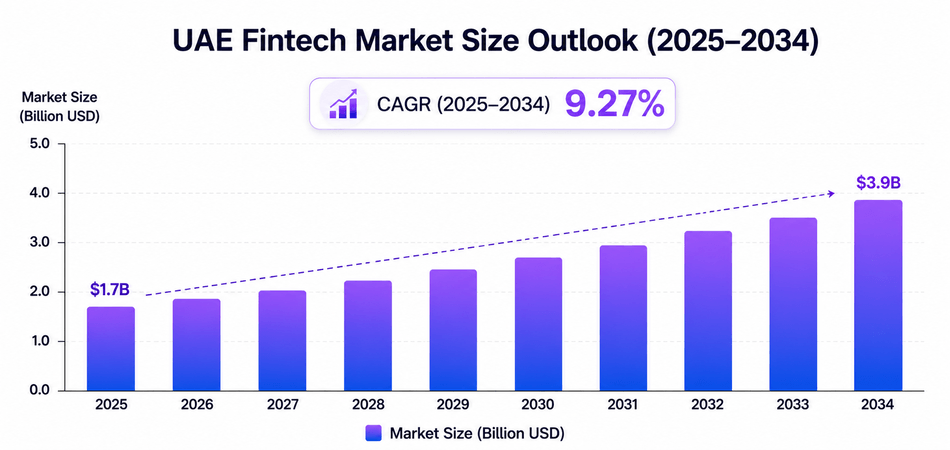
If we look at the fintech market in the Middle East, especially the UAE and Saudi Arabia, it is growing like anything. With a predicted expansion from $1.7 Billion in 2025 to almost $3.9 Billion by 2034, displaying a compound annual growth rate (CAGR) of 9.27%. This allows the use of digital wallets, internet-based payments, “Buy Now, Pay Later” solutions and more to generate substantial revenue. And in this region, there are platforms like Pyypl that have become successful.
So, to understand this change, benefit from this significantly, and jump on the bandwagon created by Pyypl, it is integral to know the cost to build a fintech app like Pyypl.
Market Overview of FinTech Application In The Middle East
The market size of the Middle East FinTech segment was valued at $1.7 Billion in the year 2025. However, the estimates suggest that the market size will be around $3.9 Billion by the end of 2034. The CAGR for the period 2026 to 2034 is 9.27%. Another data point into the Middle East market suggests this is driven by the rising consumer demand for digital wallets, rapid technological advancements, improved investments into the startup economy, and government support, which is driving up the trade.
What Is The Cost To Build A Fintech App Like Pyypl
When building a fintech mobile application like Pyypl, it is not only essential to know about the features but also important to know what the cost is for each stage. That is why it is essential for an e-wallet app development company UAE to give entrepreneurs like you a brief idea about the cost, which consists of:
| Development Stage | Estimated Cost (AED) | Estimated Cost (SAR) | Estimated Cost (USD) | Estimated Timeline |
| Market Research & Planning | 18,400 – 55,000 AED | 18,800 – 56,300 SAR | $5,000 – $15,000 | 3 – 6 Weeks |
| UI/UX Design | 18,400 – 73,500 AED | 18,800 – 75,200 SAR | $5,000 – $20,000 | 3 – 6 Weeks |
| Frontend Development | 73,500 – 146,900 AED | 75,200 – 150,400 SAR | $20,000 – $40,000 | 6 – 12 Weeks |
| Backend Development | 73,500 – 183,600 AED | 75,200 – 187,900 SAR | $20,000 – $50,000 | 8 – 16 Weeks |
| Testing & Quality Assurance | 18,400 – 55,000 AED | 18,800 – 56,300 SAR | $5,000 – $15,000 | 3 – 6 Weeks |
| Deployment & Launch | 18,400 – 36,700 AED | 18,800 – 37,600 SAR | $5,000 – $10,000 | 3 – 5 Weeks |
| Maintenance & Updates | 15 – 20% of the total development cost | 15 – 20% of the total development cost | 15 – 20% of the total development cost | Ongoing Process |
| Total | 220,600 – 550,700+ AED | 225,600 – 563,700+ SAR | $60,000 – $150,000+ |
As each stage of development has its own requirements, keeping in mind the cost aspect definitely gives you an edge. Therefore, if we look at the app development cost of a fintech platform like Pyypl, it basically comes down to $60,000 – $150,000+. Hence, this will help you to build an estimated budget under which you can deploy investment.
Multiple Types of FinTech Applications & Their Estimated Cost
Fintech mobile applications operating in the UAE and other parts of the Middle East region have been diverse and cater to multiple financial needs. From a wide variety of lists, some of which include:
| Fintech Application Type | Estimated Cost (USD) |
| Payment Apps | $40,000 – $150,000+ |
| Digital Banking Apps | $80,000 – $300,000+ |
| Personal Finance & Budgeting Apps | $50,000 – $180,000+ |
| Investment & Trading Apps | $100,000 – $400,000+ |
| Insurtech Apps | $60,000 – $250,000+ |
| Cryptocurrency Wallet & Exchange Apps | $120,000 – $400,000+ |
| RegTech Apps | $70,000 – $250,000+ |
| Buy Now Pay Later
Apps (BNPL) |
$70,000 – $250,000+ |
Within the finance sector, there are plenty of applications which can be developed, but according to the market demand. So, if you are planning to manufacture a fintech platform like digital banking, an insurtech application, or a simple BNPL platform, getting to know about the cost structure is necessary, which saves your cash, and cash is king.
Suggested Read: Cost To Build A BNPL App Like Tamara
Why Is The Middle East A Hotspot For Fintech Applications?
A strong growth in the Middle East region, led by the UAE and Saudi Arabia, has really got the entrepreneurial segment excited. As the aspects of growth are far too many, it is important to understand the origin of this change, which includes:
Government Support
- The UAE, Saudi Arabia, and Bahrain have implemented supportive rules for fintech.
- Regulatory sandboxes allow new startups to test financial products securely.
- Governments offer funding and incentives for fintech startups.
- National visions like ADGM from UAE, Saudi Arabia’s Vision 2030, and others in the Middle East promote digital finance growth.
High Smartphone Usage
- Fintech regulations have been rolled out by the UAE, Saudi Arabia, and Bahrain to be conducive.
- Startups can safely experiment with financial products within regulatory testing grounds.
- State authorities extend financial support and inducements to new fintech companies.
- Initiatives like Saudi Vision 2030 promote the development of the digital finance sector.
Financial Inclusion
- Large parts of the population still don’t know about the services that banks and finance-related businesses provide.
- Digital finance becomes accessible to groups that were skipped over by fintech applications.
- Mobile platforms or digital wallets reduce the dependency on physical bank branches.
- Easier sign-up processes bring in people currently outside the banking system.
Strong Investment In Startups
- Significant capital is being directed towards fintech businesses by venture capitalists.
- Government-backed funds support innovation in fintech.
- Foreign investors are beginning to participate in the regional fintech arena.
- Startup growth and scale are supported by incubators and accelerators.
Significant Rise in Digital Payments
- The rise of online shopping is boosting the use of digital payments.
- Users are looking for payment methods that are quicker and smoother.
- Conventional ways of paying are being superseded by digital wallets.
- A secure online payment infrastructure is necessary for recurring service payments.
Factors Affecting Fintech App Development Cost
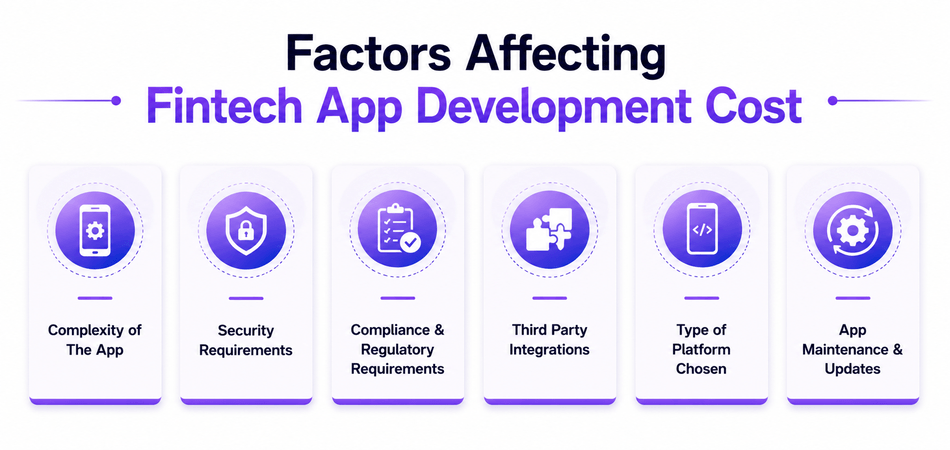
There are various internal and external factors that affect the fintech app development cost. Be it the complexity of the cost, the input cost, the location of the development team, or many others lead to such a change. Some of the many factors include:
Complexity of The App
A straightforward digital wallet application with core payment capabilities will cost much less than a complete neobank or investment system. The more advanced features, integrations, and operational flows directly translate to increased necessary development time and specialised technical skill.
- Number of features and functionalities.
- Multi-currency and multi-language support.
- Analytics and automation based on AI.
- Cross-platform compatibility.
Security Requirements
Fintech platforms demand robust encryption, secure sign-in procedures, fraud detection mechanisms, and regular security audits. Establishing top-tier security measures significantly increases the development expensive but following GDPR, PCS-DSS, and local banking standards can be a task of the century.
- Multi-factor authentication.
- Biometric login systems.
- Fraud detection and prevention.
- Secure payment gateways.
Compliance & Regulatory Requirements
In the Middle Eastern market, enterprises often must satisfy mandates related to AML (Anti-Money Laundering), KYC (Customer Identification), PCI DSS standards, and data privacy. Securing licenses and ensuring regulatory compliance can improve both development time and cost.
- AML Compliance tools.
- PCI DSS certification.
- Financial authority approvals.
- Legal and consultation costs.
Third Party Integrations
A majority of fintech applications rely significantly on integrations like payment gateways, banking APIs, card issuers, and cloud services. Integrating these systems demands extra development effort, testing, and ongoing maintenance. The more external services your app connects with, the higher the development cost.
- Payment gateway integration.
- Banking API connectivity.
- SMS and email services.
- Cloud infrastructure services.
Type of Platform Chosen
The decision regarding development approach – whether targeting Android, iOS, or going for cross-platform leads to a significant change in the development cost. Creating separate native applications for both Android and iOS involves a greater cost than utilising frameworks supporting multiple platforms, such as Flutter or React Native.
- Android app development.
- iOS app development.
- Cross-platform frameworks.
- Platform-specific features.
App Maintenance & Updates
Ongoing maintenance, security features, adding new functionalities, and monitoring server performance are all necessary to ensure seamless operation. Maintenance costs are typically calculated yearly as a fraction of the overall initial development expense, which is better explained by a mobile app development company in UAE, just like Aarmeh.
- Bug fixing and updates.
- Security patch and implementation.
- Complete performance optimisation.
- Customer support systems.
How You Can Monetise Your Fintech Application?
When it comes to earnings, there are various ways in which you can monetise your fintech application. Some are related to transaction fees, subscription plans, interchange fees, advertising revenue, and many more. Therefore, scalable income is possible through methods like:
Transaction Fees
Transaction fees represent a very typical income structure for fintech platforms. These apps may levy a minor charge on customers for facilitating transactions like sending funds, settling bills, cash withdrawals, currency conversion, or payments to vendors. So, to manage this workflow and cater to the right monetisation method, going for fintech mobile app development in the Middle East is the right option.
Subscription Plans
A good number of fintech platforms feature enhanced subscription tiers that give users access to advanced financial tools and exclusive features. This method allows businesses to secure predictable monthly or annual income while boosting client retention.
Interchange Fees
Revenue from interchange is generated when users use debit cards, prepaid cards, or digital cards issued by the fintech platform. A small percentage of each transaction is shared with the fintech company through payment networks or banking partners. Therefore, to integrate such features, it is important to partner with a fintech app development company.
Currency Exchange Margins
Fintech applications specialise in international transfers and multi-currency wallets, often earning money through foreign exchange margins. For converting currencies for users, the platform will add a small markup to the exchange rate. Therefore, working with a mobile app development company in UAE will help you earn money from such sources.
Investment & Wealth Management Fees
Apps focused on investing can earn by charging management fees, brokerage commissions, or consultation charges. Platforms offering robo-advisory services or portfolio management services commonly use this method to earn. So, if you don’t know how to earn from an investment and wealth management fintech platform, then taking help from a mobile app development company in Dubai is the answer.
Aarmeh: Your Fintech App Development Company In Dubai
Aarmeh enables businesses in the UAE and Middle East to develop secure and scalable fintech platforms customised for the fast-expanding Middle Eastern market. From digital wallets and BNPL platforms to investment and banking apps, our team delivers end-to-end fintech app development solutions with smooth user experiences and strong compliance standards. As digital finance gains traction throughout the UAE, our fintech app development company in Dubai, Aarmeh, helps startups, established corporations, and government agencies in deploying forward-thinking platforms that satisfy changing client and governing body requirements.
- 1400+ Mobile Apps Developed From Scratch
- 800+ Happy Clients
- 750+ Websites Developed
- 200+ Developers
- 50+ AI Solutions
- 869M+ Raised Through Developed Apps
Ready to launch your fintech app in the UAE market or even in the broader Middle East region? So, partner with Aarmeh to build, grow, and reach masses in an instant.
The Final Word
The Middle East is proving to be a rapidly expanding hub for fintech businesses, fueled by widespread digital payment demand, favourable regulatory frameworks, and growing customer appetite for reliable money services. Creating a fintech application, first, it is important to know the cost to build a fintech app like Pyypl, which has been a success in the region. The cost for this generally falls in the region of $60,000 to $150,000+, contingent upon many factors which keep on changing. But one thing is constant! The success that you and your platform will get from Aarmeh.
FAQs
Q1) How much does it cost to build a fintech app like Pyypl?
Ans) The cost to build a fintech app like Pyypl typically ranges between $60,000 to $150,000+, depending on app complexity, security features, third-party integrations, and compliance requirements. Advanced fintech platforms with AI, multi-currency support, and investment features may cost even more.
Q2) Why is the Middle East becoming a major fintech hub?
Ans) The Middle East, particularly the UAE and Saudi Arabia, is observing swift fintech expansion, driven by robust governmental backing, growing smartphone usage, acceptance in digital payments, venture capital for startups, and efforts toward financial accessibility.
Q3) How much does a digital banking app cost?
Ans) Generally, the cost to build a digital banking application will fall between $80,000 to $300,000+. This cost margin is affected by the complexity of the application, the location of the development team, the technology used during development, and more.
Q4) How long does it generally take to build a fintech application?
Ans) Fintech app development typically takes between 6 to 9 months, which depends on the set of features to be used, choice of platform, team size, and more.
Q5) Which is the best mobile app development company in Dubai?
Ans) The best mobile app development company in Dubai is Aarmeh. After managing and fulfilling the needs of 800+ clients by developing 1400+ mobile applications from scratch, which helped raise a total of 869M+ from developed applications, it is fair to say that Aarmeh is the best in the segment.





 Book a call




 CLUTCH VERIFIED
 Top App Developer UAE
 100% NDA Protected
 IN THE HEART OF UAE