





Table of Contents
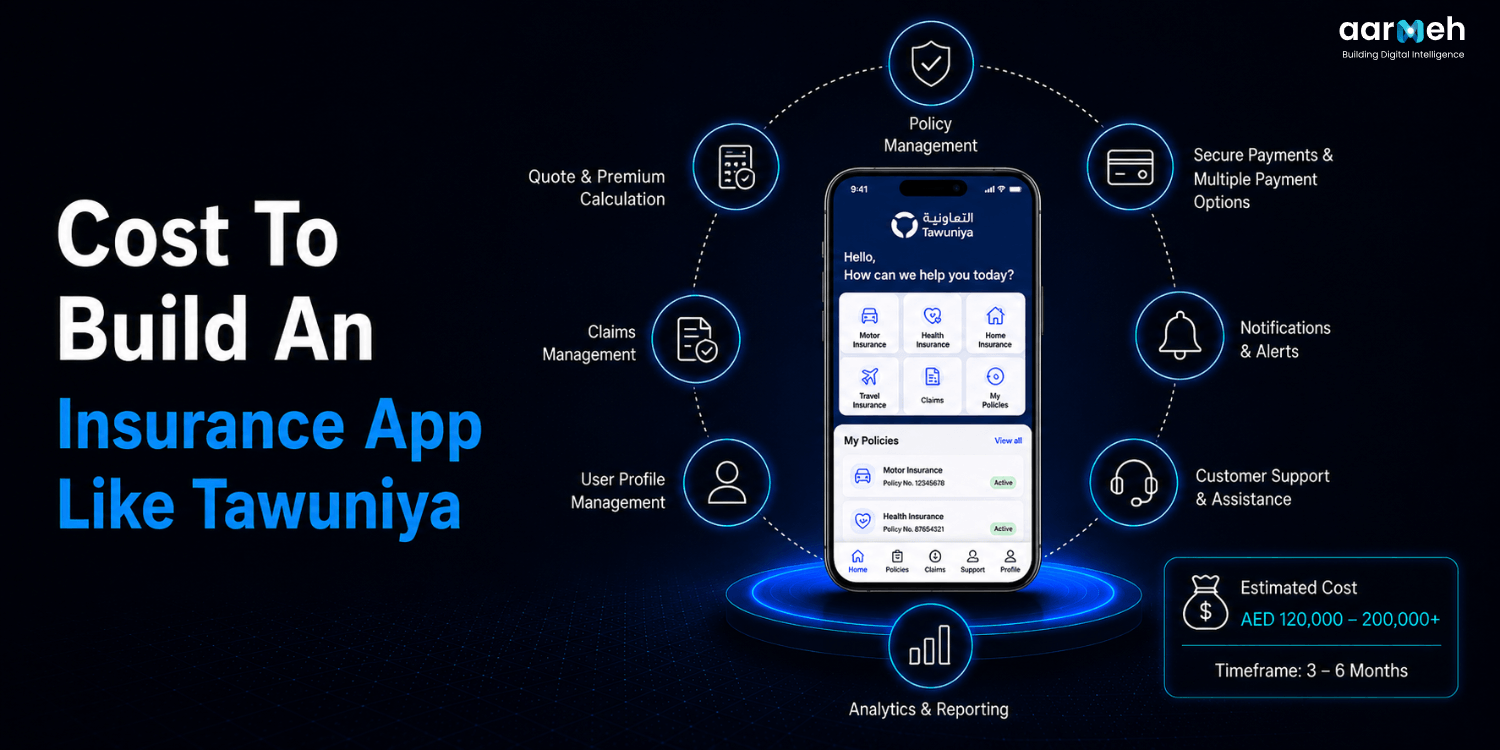
Insurance mobile apps are growing into a vital aspect of this shift, particularly in the UAE region, where firms and entrepreneurs are focusing on providing seamless client experiences, faster claim processing, and automated policy management. This has been effectively mastered by platforms like Tawuniya, which have illustrated how modern tech can streamline insurance offerings through intelligence-based utilities, electronic settlements, claim monitoring, and intuitive designs. And on the back of this, other insurance platforms can be developed with proper know-how and understanding of the cost at each stage of development. Thus, it is important to know the insurance app development cost, which will be provided in this blog.
Understanding The Insurance Market of The Middle East
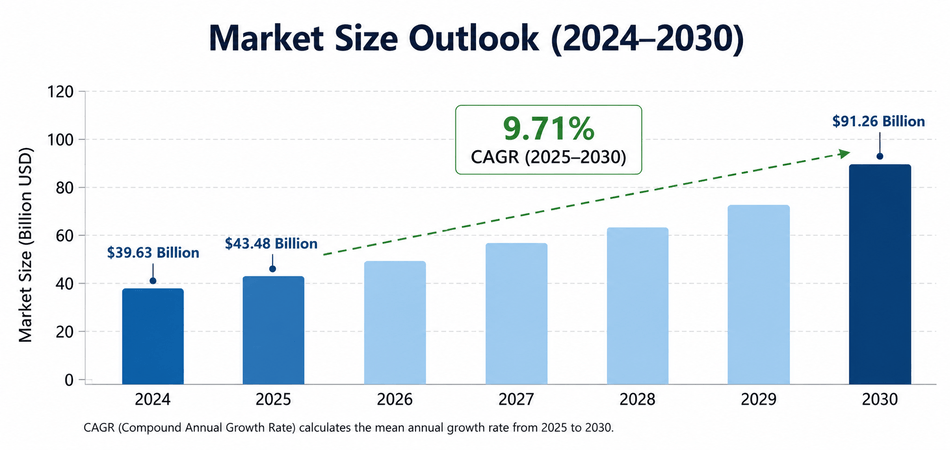
To understand the level of opportunity in the insurance space, it is important to take a deep dive into the numbers. The insurance market segment in the Middle East in 2024 was valued at $39.63 Billion. However, the market size of this space has reached $43.48 Billion in 2025 and is expected to reach the mark of $91.26 Billion of 2033. This shows a CAGR growth of 9.71%.
According to the Gulf Insurance Federation, this dramatic rise has been marked by the adoption of technologies from the shift of commodity-driven markets.
Countless Reasons For The Growth of Insurance Platforms In UAE
When we look at the landscape of insurance applications in the UAE market, you will be surprised to know that some of them are so common but have a significant impact. It is not just the health insurance app development expenses that are covered, but also a set of other factors, which consist of:
Increased Smartphone Usage
One of the reasons for the rapid growth of this segment is the increased usage of mobile phones and the rising penetration of the internet, even in the remotest of places. Due to this change, claims from mobile devices, instead of visiting a branch physically, payments, and now managing policies have become easier than ever.
Faster Claim Processing
Just by submitting your documents, details, and photos digitally, users can now file for insurance claims. This seamless process, where the user is not physically exhausted and doesn’t have to hassle, brings a sense of satisfaction. Hence, their time is not wasted at all.
Better Customer Experience
User-friendly experiences that improve customer experiences and make the insurance platforms smooth are the aim of modern developers. No one is looking for a laggy experience that takes time like no other application. Therefore, to get the best result when you aim to provide a seamless experience on all fronts, you can approach a mobile app development company in Dubai like Aarmeh.
Reduced Operational Costs
Insurers may lower both administrative and operational expenses through the use of automation and digital processes. Things like policy renewals, alerts, and paperwork confirmation can be managed automatically within the application. When such things are in your favour, then you don’t have to worry about the health insurance app development cost.
Improved Customer Retention
Insurance applications help firms in maintaining ties with clientele through routine alerts and tailored offerings. Pushes for renewal, status reports on claims, and rewards schemes incentivize users to keep engaging with the service. Steady online interaction fosters enduring bonds with customers.
Cost To Build Insurance App Like Tawuniya
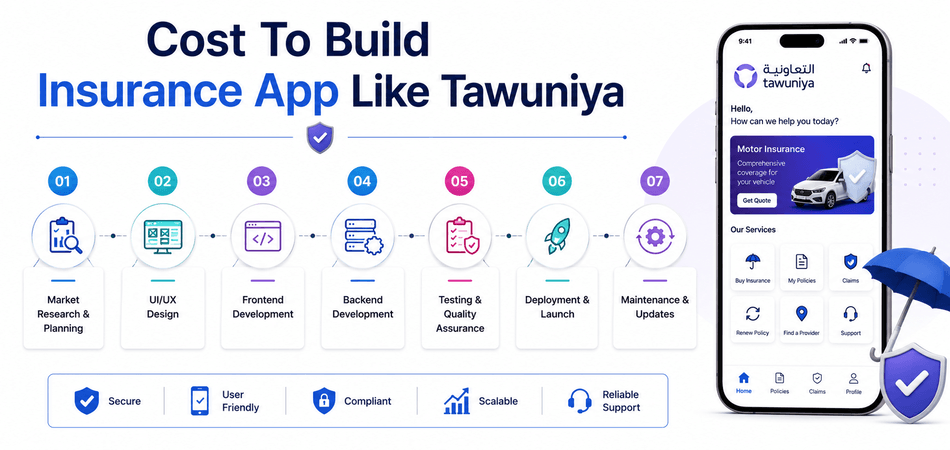
Developing an insurance mobile platform like Tawuniya has its own cost, which every entrepreneur trying to follow this path must know. In the stage of research and development, many individuals don’t get to know the cost aspect of the application or skip it altogether. Hence, the cost to build app like Tawuniya is as follows:
| Development Stage | Estimated Cost | Estimated Timeline |
| Market Research & Planning | $3,000 – $10,000 | 2 – 4 Weeks |
| UI/UX Design | $10,000 – $20,000 | 3 – 6 Weeks |
| Frontend Development | $20,000 – $50,000+ | 4 – 8 Weeks |
| Backend Development | $20,000 – $60,000+ | 6 – 10 Weeks |
| Testing & Quality Assurance | $5,000 – $15,000 | 3 – 6 Weeks |
| Deployment & Launch | $2,000 – $5,000 | 2 – 4 Weeks |
| Maintenance & Updates | 15 – 20% of the total development cost | Ongoing |
| Total | $70,000 – $160,000+ |
Developing an insurance application for Android, iOS, or both is a task that can be done by almost every expert. However, the difference is who is transparent when it comes to the cost of cost to build insurance app.
Thus, being transparent about every stage of development and offering quality is what the best mobile app development company in Dubai, like Aarmeh, does.
Factors Affecting The Overall Cost of An Insurance Platform
To build a mobile application like Tawuniya, you need to be very careful about the factors that affect its cost. When you read through these factors, they will make sense in one way or the other. Thus, it is important to know the factors that affect the insurance app development timeline and cost, which include:
App Platform Selection
You have the option to manufacture applications for Android, iOS, web environments, or a combination of these. Developing distinct native applications for both Android and iOS typically requires higher expenses since developers must build and maintain two separate sets of code. On the other hand, development through Flutter or React Native helps in managing the cost and timeline.
- Native applications offer superior performance and user engagement.
- Cross-platform apps reduce development costs.
- Supporting various platforms escalates the workload for testing and upkeep.
UI/UX Design Complexity
Today’s consumers expect insurance applications to possess a neat, straightforward, and easily navigable structure. A thoughtfully crafted interface provides policy purchasing, claim submission, and retrieval of key details for users without any difficulty. This is where a mobile app development company in UAE is beneficial by utilizing conventional elements, animations, and engaging design.
- Engaging control panels elevate design complexity.
- User-friendly navigation improves customer retention.
- Responsive designs require additional optimization.
Features & Functionalities
An elementary insurance application featuring sign-in, policy review, and transaction capabilities will be significantly less expensive than a sophisticated application equipped with AI assistants, remote medical services, data analysis, and immediate claim monitoring. Each added function necessitates supplementary programming, validation, integration, and ongoing support.
- Basic features reduce initial development cost.
- Advanced development expertise is required when it comes to AI-powered tools.
- Tracking claims instantly raises the complexity of the back-end systems.
Security & Compliance Requirements
Insurance submissions involve fragile client details like personal markers, financial figures, and health histories. Therefore, safeguarding this data becomes a significant expense. D
Developers need to position robust security protocols to shield user information and prevent digital attacks.
- Encrypting data elevates security expenses.
- Compliance requirements vary by region.
- Dual-factor verification strengthens account protection.
Third Party Integrations
These connections might involve payment processors, customer relationship management tools, texting services, data analysis systems, location interfaces, or health repositories. While using third-party integrations, you can save development insurance app development expenses, but incorporating and sustaining them still demands specialized knowledge and continuous spending.
- Payment gateway integration adds extra cost.
- Third-party interfaces might demand ongoing payments.
- CRM integration improves customer management.
Technology Stack Used
The technology stack selected during creation also impacts the total undertaking budget. Opting for current and adaptable technologies boosts application effectiveness, security, and potential for future growth. However, refined tech might require developers with high-level competence, leading to higher per-hour development charges.
- Modern frameworks improve scalability.
- Advanced technologies require skilled developers.
- Cloud platforms add infrastructure costs.
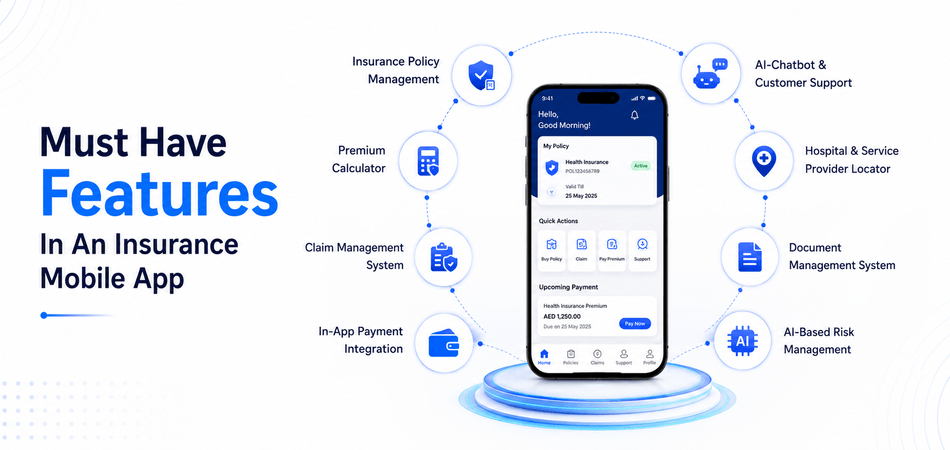
Must-Have Features of Insurance Mobile Apps
Various aspects make an insurance software like Tawuniya a success. But one of the most important, the features is necessary to stand out from the crowd and yet offer feasible solutions. Thus, some of the must-have features of insurance mobile apps include:
Insurance Policy Management
App users must have the ability to look through offered insurance packages, contrast different scopes of coverage, acquire new policies, and extend current ones right within the application. This capability streamlines acquiring insurance and gives patrons full clarity on their policies, the charges due, and what their coverage encompasses.
- Viewing and comparing policies.
- Getting policies digitally.
- Capability for policy extension.
Premium Calculator
The tool computes projected premium figures using inputs like age, geographical area, wellness status, specifics about a vehicle, or desired coverage levels. This function aids patrons in making sound choices by ensuring openness and assisting individuals in selecting plans that align with their finances and needs.
- Immediate calculation of premiums.
- Personalized coverage assessments.
- Pricing influenced by health factors.
Claim Management System
This lets individuals file insurance claims electronically, removing the need to visit physical branches or fill out extensive forms. Users can upload necessary paperwork, pictures, or medical records instantly via the app and monitor their claim progress live.
- Filing claims via digital means.
- Ability to upload files and visuals.
- Alerts for claim confirmation.
In-App Payment Integration
Seamless connection for payments permits users to settle insurance fees, refresh policy terms, and finalize purchases directly inside the program. A straightforward payment experience boosts ease of use and builds greater confidence among patrons.
- Acceptance of major card payments.
- Support for local payment methods and digital wallets.
- Incorporation of a protected transaction system.
AI-Chatbot & Customer Support
AI-driven conversational agents offer immediate help to users by addressing typical queries and directing clients through standard insurance procedures. This functionality lessens the burden on customer service teams whilst enhancing reply speeds. Moreover, numerous insurance applications incorporate real-time chat or telephone assistance for resolving intricate client problems.
- Continuous customer availability.
- Real-time messaging integration.
- Quicker customer feedback.
Hospital & Service Provider Locator
Medical insurance software frequently incorporates location-aware functionalities that assist users in locating nearby medical facilities, drugstores, or service centers within their covered network.
- Location services via GPS.
- Search for local medical facilities.
- Included network provider catalogs.
Document Management System
Insurance mobile programs create and maintain a significant volume of paperwork, such as contracts, billing statements, payment proofs, and claim submissions. A system for managing these documents enables users to view and keep all significant files electronically.
- Electronic record keeping.
- Ability to download and share PDFs.
- Convenient access to data.
AI-Based Risk Assessment
AI is able to examine user actions, health background, driving trends, monetary facts, and other inputs to evaluate insurance risks with greater precision. This assists insurers in providing customised premium rates and minimizing dishonest actions. Putting AI solutions in place demands advanced calculations, ML frameworks, data handling facilities, and ongoing fine-tuning.
- Automated risk management.
- Fraud detection and prevention.
- Machine learning model integration.
Aarmeh: Your Mobile App Development Company In UAE
In the process of developing an insurance application or forming an insurtech platform in the UAE, many entrepreneurs are likely to feel lost or confused. The varied and in-depth stages, necessary features to be included, which platforms to choose for a release, dealing with development challenges, and, on top of these, managing and following a budget can be a challenging and time-consuming process for you.
But not anymore!
Operating under the influence of a mobile app development company in UAE, Aarmeh has all the ingredients to help you out because we have:
1400+ Mobile Apps Developed From Scratch
800+ Happy Clients
750+ Websites Developed
200+ Developers
50+ AI Solutions
869M+ Raised Through Developed Apps
So, take action now, as the opportunity is immense and you have time to do so. Connect with us, connect with Aarmeh!
The Final Word
A number of elements are fueling the rise in popularity of insurance platforms within the UAE, such as greater reliance on smartphones, quicker digital handling of claims, better client journeys, lower running expenses, and more robust customer loyalty approaches. Contemporary insurance applications enable individuals to handle their coverage, submit payments, lodge claims, and obtain assistance services straight from their mobile gadgets. The insurance app development cost for developing an app like Tawuniya falls within the $70,000 to $160,000+ bracket, varying based on the intricacy of the app, the chosen platform, implemented functionalities, necessary security measures, integrations with external systems, and the underlying technology framework employed.
FAQs
Q1) How much does it cost to build insurance app like Tawuniya?
Ans) The projected expense falls within the $70,000 to $160,000+ bracket. These rely upon the application’s complexity, incorporated functionalities, choice of platform, necessary integrations, and security compliances to make the platform safe and sound.
Q2) How long does it take to develop an insurance mobile application?
Ans) Developing an insurance application might require 6 to 9 months or more, varying based on the features included, the extent of testing needed, and the overall development brief.
Q3) What are the must-have features insurance mobile apps?
Ans) Some of the must-have features insurance mobile apps should have include:
- Insurance Policy Management
- Premium Calculator
- Claim Management System
- In-App Payment Integration
- AI-Chatbot & Customer Support
- Hospital & Service Provider Locator
- Document Management System
- AI-Based Risk Management
Q4) Why are insurance companies in the UAE investing in mobile applications?
Ans) Mobile applications offer greater customer ease, lower overheads, smoother claims handling, improved interaction, and improved client loyalty.
Q5) Which is the best mobile app development company in Dubai?
Ans) The best mobile app development company in Dubai is Aarmeh. After helping 800+ clients and making them happy, we have developed 1400+ mobile applications from scratch, which have helped raise 896M+



 Book a call




 CLUTCH VERIFIED
 Top App Developer UAE
 100% NDA Protected
 IN THE HEART OF UAE