





Table of Contents
📌 Key Takeaways
- Dubai businesses are investing in custom software development to streamline operations, improve customer experiences, and support digital transformation across industries.
- Industries such as fintech, healthcare, logistics, real estate, retail, and government benefit from software tailored to their workflows, integration needs, and regulatory requirements.
- Custom software helps businesses improve operational efficiency, integrate existing systems, strengthen security, and scale functionality as their requirements evolve.
- Software development costs in the Dubai & UAE can range from AED 40,000 for a basic application to AED 500,000 or more for complex enterprise platforms, depending on features, integrations, security, and maintenance needs.
- Choosing the right software development partner involves evaluating technical expertise, industry experience, project transparency, security practices, pricing, and ongoing support to ensure long-term value.
A retail group in Dubai runs its stock on one system, its payments on another, and its customer data in a spreadsheet someone emailed in 2021. Nobody planned it that way. It simply grew, one sensible shortcut at a time, until a simple question like “how much stock do we have in Sharjah?” took three people and an afternoon.
That is usually the moment a business starts looking at custom software. Not because it wants something shiny, but because the patchwork has stopped working. For many local businesses, custom software development in Dubai can replace disconnected tools with workflows built around how teams actually operate.
If you are at that point, this guide covers what Dubai businesses actually build, where it pays off, what it costs in dirhams, and how to avoid the mistakes that make projects overrun. Where a technical term shows up for the first time, we explain it right there.
Businesses comparing custom software development companies in Dubai & UAE should look beyond initial pricing and assess technical expertise, industry experience, project transparency, and long-term support to find a partner that can deliver reliable software aligned with their business goals.
How Is Market Growth Driving Demand for Custom Software Development in Dubai?
Start with the numbers, because they explain a lot. Grand View Research puts the UAE software market at about USD 5.7 billion in 2024 and expects it to roughly double to USD 11.4 billion by 2030. Enterprise software, the slice built for large organisations, is on a steeper path.
The growing demand for digital services has created opportunities for software development companies in UAE to support businesses across finance, healthcare, logistics, real estate, and retail. Companies are investing in software that streamlines operations, improves customer experiences, and supports expansion across the region.
|
Market Indicator |
Value |
Outlook |
| UAE software market (2024) | ~USD 5.71 billion | ~USD 11.37 billion by 2030 (≈12% CAGR) |
| UAE enterprise software market (2025) | ~USD 4.02 billion | ~USD 11.04 billion by 2033 (≈13.5% CAGR) |
| UAE IT services market (2025) | ~USD 20.24 billion | ~USD 37.69 billion by 2030 (≈13.2% CAGR) |
| UAE fintech market (2025) | ~USD 46.67 billion | ~USD 90.06 billion by 2031 |
Two things sit behind that growth. One is policy: federal and emirate-level digital strategies keep pushing government services and regulated industries online. The other is competition. When a neighbouring business launches a better app, you either respond or lose customers.
For anyone comparing software companies in UAE, this also means the market is crowded. That is good for choice and bad for clarity, which is why the later sections spend time on how to evaluate a partner.
What Types of Solutions Can Custom Software Development in Dubai Deliver for Businesses?
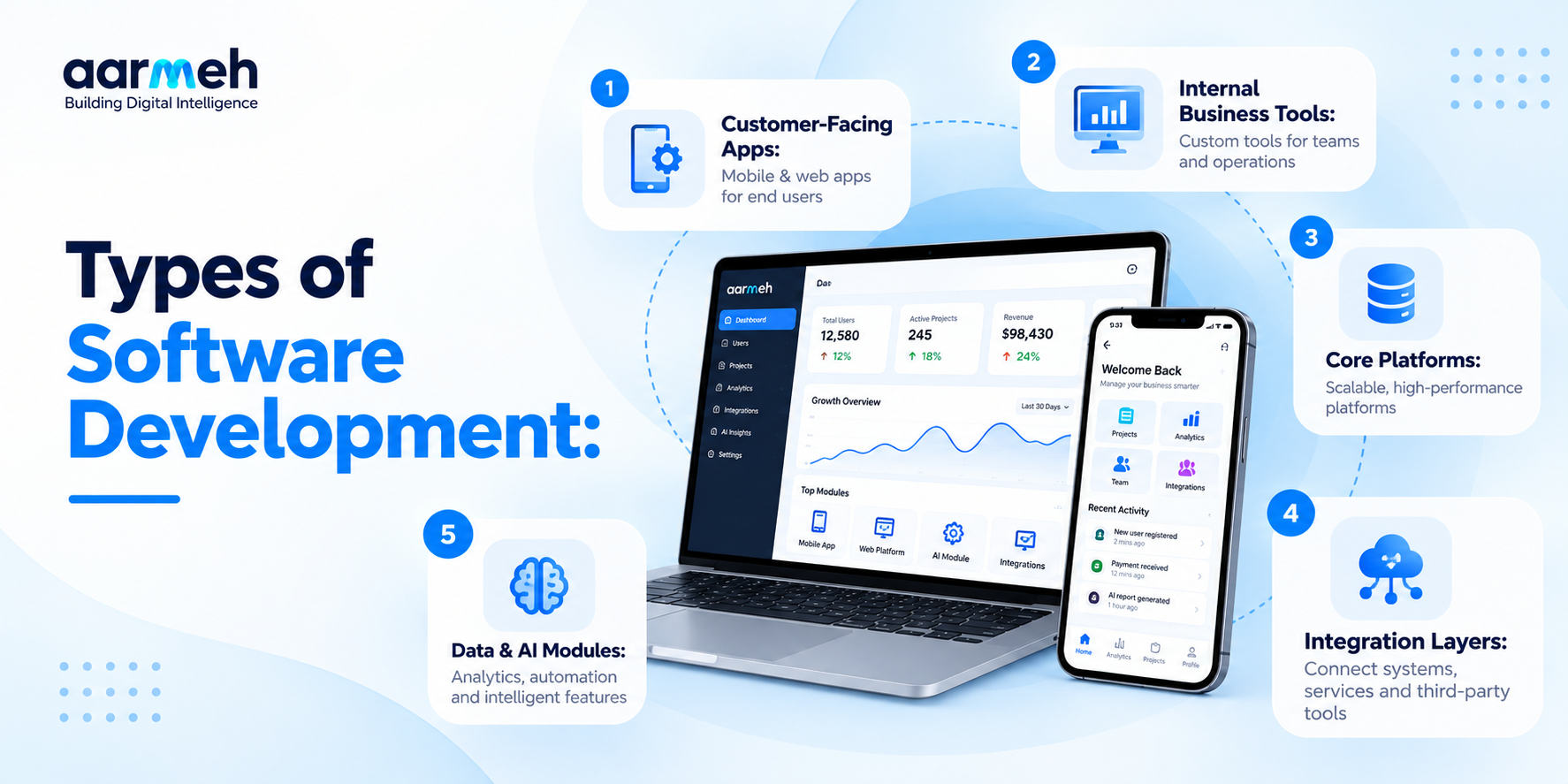
“Software” covers a wide range of solutions, each designed to address different business needs. Here’s how they break down in practice.
Most real projects mix two or three of these. A hospital group, for example, might need a patient app, an internal scheduling tool and an integration with the emirate’s health information exchange, all in the same programme. These components can be connected to share data securely and support coordinated operations.
1. Customer-Facing Apps:
These handle booking, ordering, payments and self-service for the people buying from you. Retail, hospitality and mobility businesses lean on them most, since the app is often the first thing a customer touches.
2. Internal Business Tools:
Approvals, reporting and staff scheduling move off emails and spreadsheets into one controlled system. Any mid-to-large company benefits, because the time saved shows up across every team that uses it.
3. Core Platforms:
This is the heavy machinery: banking engines, insurance claims, patient records and fleet systems that the whole business runs on. Banks, insurers, hospitals and logistics firms build these, and they have to keep working under pressure and audit.
4. Integration Layers:
These connect older systems to newer ones so data stops getting retyped by hand. Companies with a legacy ERP or CRM usually need this before anything else will work properly.
5. Data & AI Modules:
Forecasting, fraud checks and document reading sit on top of existing software and make it smarter. Finance, healthcare and supply chain teams use them to catch problems earlier and cut manual review.
Most real projects mix two or three of these. A hospital group, for example, might need a patient app, an internal scheduling tool and an integration with the emirate’s health information exchange, all in the same programme.
A custom software development company can combine customer-facing applications, internal tools and system integrations into a solution that reflects a business’s specific workflows and operational needs.
The boundary between ordinary business software and enterprise software development is mostly about scale and consequences. Once a system serves thousands of users, touches payments, or has to survive an audit, the engineering effort shifts from “does it work?” to “does it keep working when everything goes wrong?”
An IT software development company should account for system reliability, integration requirements and ongoing maintenance when planning applications that support essential business operations.
A software developer contributes to this work by writing and reviewing code, integrating systems, resolving defects and improving application performance.
Choosing suitable software development methods helps teams organise tasks, validate functionality and respond to changing requirements without losing sight of delivery goals.
How Does Custom Software Development in Dubai Support Different Industries?
Custom software development in Dubai is particularly relevant to industries such as fintech, healthcare, logistics, real estate and retail, where specific workflows, compliance requirements and system integrations often exceed the capabilities of off-the-shelf platforms.
Fintech & Payments
The UAE is a payments-heavy market. Mordor Intelligence reports that digital payments made up around 57% of the UAE fintech market in 2025, and that Dubai held close to 60% of the total, with Abu Dhabi growing faster from a smaller base.
A fintech software development company in this region does not develop an app. It is building ledgers, KYC (identity verification) flows, fraud rules and reporting that the Central Bank, DFSA or FSRA can inspect. Skip that groundwork and the product might look finished and still be unlaunchable.
Healthcare
Dubai’s NABIDH health information exchange alone connects roughly 1,500 facilities and holds records for about 9.5 million patients, according to published figures. Abu Dhabi runs its own exchange, Malaffi. Any new clinical system has to talk to these without exposing data it should not.
That is why a healthcare software development company needs to understand interoperability and patient consent before it writes a line of interface code. For a provider, a custom healthcare software development company can build things like appointment engines, e-prescription flows, remote monitoring dashboards and insurance claim tools shaped around how that specific hospital works, not around a template.
Logistics & Supply Chain
The UAE moves goods for a whole region. The government has committed around AED 30 billion to logistics infrastructure, which pulls software demand along with it: route planning, warehouse systems, customs documentation, driver apps, live tracking.
A logistics software development company earns its fee at the handover points, where cargo moves from one party to another and somebody’s data usually goes missing. Operators that have adopted AI-based route and load planning report fuel savings in the low double digits, though results vary a lot by fleet and route, so treat any single percentage with caution.
Real Estate, Retail & Government
Smaller in headline value but just as active. Property portals, tenant and lease management, omnichannel retail and citizen-facing services all follow the same pattern: a standard product covers 70% of the need, and the remaining 30% is where the competitive edge sits.
A custom software application development company can tailor property management systems, retail platforms and public-service applications to specific user needs, operational workflows and integration requirements.
Building for a Regulated UAE Industry? Build It Launch-Ready.
From DFSA fintech rules to NABIDH and Malaffi healthcare integrations, we engineer compliance from day one.
What Are the Key Benefits of Custom Software Development in Dubai for Businesses?
Custom software development helps businesses create solutions around their specific workflows, operational challenges, and long-term goals. Unlike off-the-shelf products, these solutions can be adapted as business requirements evolve. For local organisations, custom software development in Dubai can support operational efficiency, scalability, system integration, stronger access controls and greater flexibility as business requirements change.
1. Tailored to Business Requirements
Custom software aligns with existing processes, team responsibilities, and operational needs. Businesses can choose the features they need instead of adjusting their workflows to fit a generic product.
2. Improved Operational Efficiency
Automating repetitive tasks, connecting disconnected systems, and reducing manual data entry helps teams save time and minimise errors. This allows employees to focus on higher-value activities.
3. Scalability & Flexibility
As a business grows, its software can accommodate additional users, new features, higher transaction volumes, and changing requirements. This flexibility reduces the need to replace the entire system as operations expand.
4. Better Integration with Existing Systems
Custom solutions can connect with existing CRMs, ERPs, payment gateways, analytics platforms, and third-party APIs. This creates a more connected technology environment and improves data flow across departments.
5. Enhanced Security & Control
Businesses can implement security measures based on their data sensitivity, industry requirements, and internal policies. Access controls, encryption, audit logs, and compliance-related features can be incorporated into the software architecture.
6. Greater Control Over Features & Updates
Businesses have greater influence over the product roadmap, functionality, and update schedule. New capabilities can be introduced according to user feedback, market changes, and evolving business priorities.
7. Long-Term Cost Efficiency
Custom software may require a higher initial investment than ready-made alternatives. However, it can reduce recurring licensing fees, reliance on multiple tools, and expenses associated with workarounds or unnecessary features over time.
The custom software development services selected for a project should match its current priorities, from core functionality and integrations to future upgrades and ongoing support.
What Technology Stack Supports Custom Software Development in Dubai?
When planning custom software development in Dubai, businesses should also consider cloud hosting and data residency. Several regulated sectors in the UAE prefer or require data to stay in-country, making hosting location an important architectural decision.
| Layer | Common Choices |
| Web frontend | React, Angular, Next.js |
| Mobile | Flutter, React Native, Swift, Kotlin |
| Backend | Node.js, Python, .NET, Java |
| Databases | PostgreSQL, MySQL, MongoDB, Redis |
| Cloud | AWS (UAE region), Microsoft Azure (UAE North), Google Cloud, local providers |
| Integration | REST APIs, GraphQL, message queues |
| AI/ML | Python, TensorFlow, PyTorch, hosted LLM APIs |
| DevOps | Docker, Kubernetes, CI/CD pipelines |
A practical note on cloud hosting. Several regulated sectors in the UAE prefer or require data to stay in-country, so hosting location is a design decision, not a footnote.
Modern software development methods also influence how teams test features, manage code changes and respond to evolving requirements throughout a project’s lifecycle.
What Are the Key Stages of Custom Software Development in Dubai?
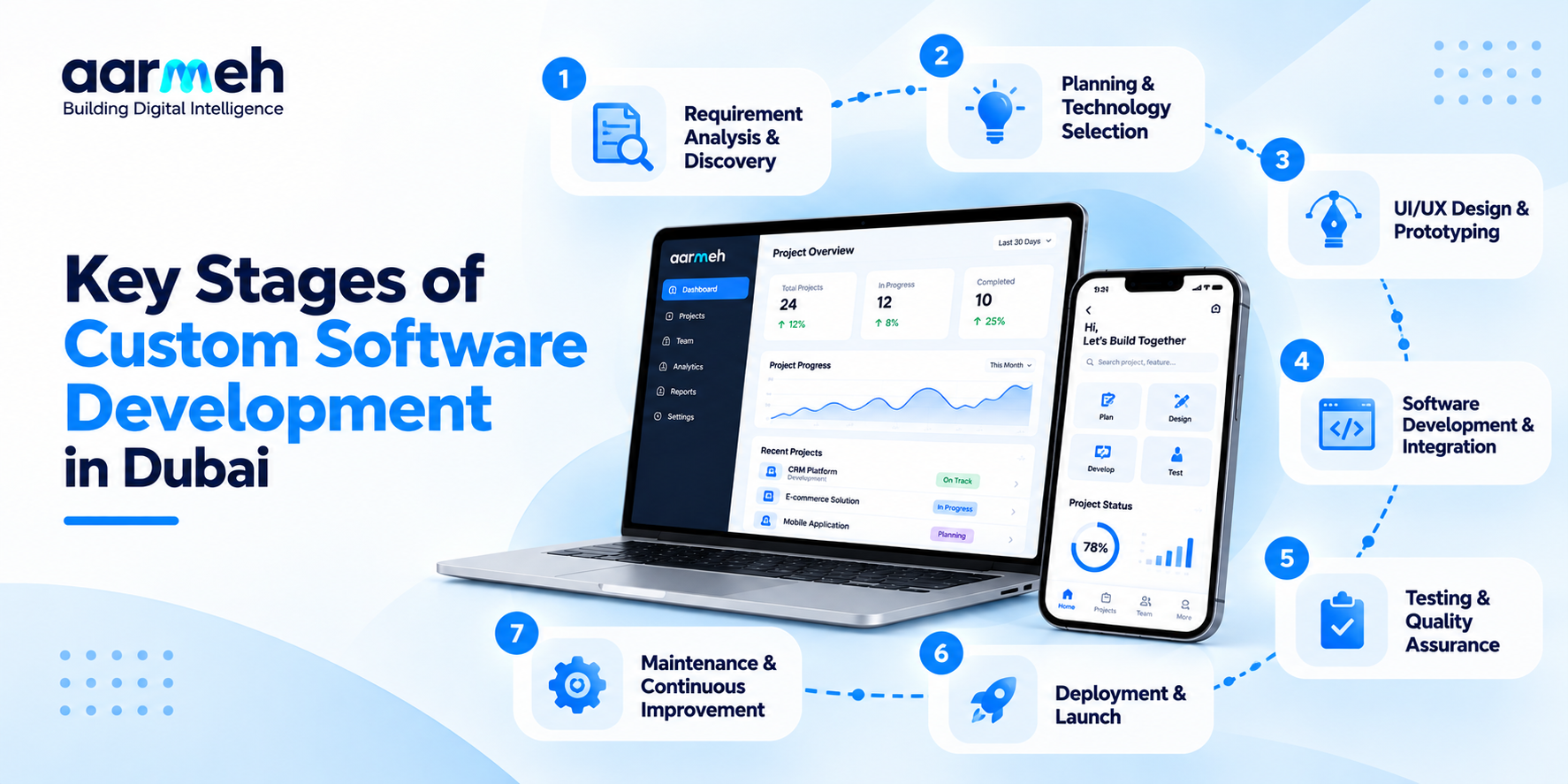
The software development life cycle typically covers requirements analysis, planning, design, implementation, testing, deployment and maintenance, providing a framework for managing the product from concept to ongoing support.
1. Requirement Analysis & Discovery
The process begins with understanding your business goals, target users, existing challenges and project requirements. The development team identifies essential features, technical constraints, budget expectations and success metrics to create a clear project scope.
2. Planning & Technology Selection
Once the requirements are clear, the team defines the project timeline, budget, milestones and resource allocation. Developers select suitable software development technologies, programming languages, frameworks and infrastructure based on the product’s complexity, security needs and scalability goals.
3. UI/UX Design & Prototyping
Designers create wireframes, user journeys and interactive prototypes to demonstrate how the software will look and function. Feedback at this stage helps refine navigation, accessibility and usability before development begins.
4. Software Development & Integration
Developers build the frontend, backend, databases and core functionality according to the approved specifications. They also integrate required third-party services, APIs, payment gateways and other business systems to ensure the software works as intended.
5. Testing & Quality Assurance
The QA team tests the application for functionality, performance, security, compatibility and usability. Identifying and fixing defects before launch helps prevent disruptions and ensures the software meets the agreed requirements.
6. Deployment & Launch
After testing and approval, the software is deployed to the production environment. The team configures hosting, migrates data if required, verifies integrations and monitors the initial release to address any issues that arise.
7. Maintenance & Continuous Improvement
Development continues after launch through bug fixes, security patches, performance monitoring and feature updates. Regular maintenance keeps the software reliable, compatible with changing technologies and aligned with evolving business needs.
The software development cycle continues after launch as teams review performance, collect user feedback, resolve issues and introduce improvements based on changing business requirements.
Different software development methodologies influence how work is planned and delivered. Agile supports iterative development and frequent feedback, while Waterfall follows a more sequential approach suited to projects with clearly defined requirements.
The software development models selected for a project should reflect its complexity, risk level, delivery constraints and expected frequency of changes.
How Much Does Custom Software Development in Dubai Cost?
Software development in the UAE can cost anywhere from AED 40,000 for a basic application to AED 500,000 or more for a complex, enterprise-grade platform. The final price depends on feature complexity, integrations, technology choices, security requirements and the development team’s experience.
Estimated Software Development Costs in the UAE
|
Software Type |
Estimated Cost |
Estimated Timeline |
| Basic software or MVP | AED 40,000–90,000 | 4–8 weeks |
| Small business application | AED 80,000–140,000 | 8–12 weeks |
| Mid-level custom software | AED 120,000–250,000 | 12–24 weeks |
| Complex enterprise software | AED 250,000–500,000+ | 24–52+ weeks |
| AI-powered software | AED 80,000–500,000+ | 12–40+ weeks |
These figures are indicative estimates, not fixed market rates. Actual costs vary according to project scope, delivery timelines, compliance needs and whether the software requires custom integrations or advanced capabilities.
The final Software Development Cost may also depend on whether the proposal includes discovery, design, testing, deployment, hosting and post-launch maintenance or prices of these services separately.
What Factors Affect Software Development Costs?
1. Project Complexity:
Software with advanced features, multiple user roles and complex workflows requires more development time. This increases the effort needed for coding, testing and implementation.
2. Technology Stack:
The programming languages, frameworks, databases and cloud platforms used can affect development costs. Specialised technologies or infrastructure may require experienced developers and additional resources.
3. Integrations:
Connecting software with payment gateways, CRM platforms, ERP systems and third-party APIs adds to development time. Costs depend on integration complexity, data compatibility and the need for custom configurations.
4. Security & Compliance:
Features such as encryption, access controls, security testing and audit trails require additional development effort. Businesses in regulated sectors may also need to meet specific UAE compliance requirements.
5. Maintenance & Support:
Software requires ongoing monitoring, bug fixes, security patches and compatibility updates after launch. Hosting fees, technical support and future enhancements contribute to long-term ownership costs.
How Do You Choose the Right Partner for Custom Software Development in Dubai?
Choosing the right custom software development in Dubai & UAE partners involves more than comparing quotes. You need a team that understands your business goals, communicates clearly and can deliver software that remains reliable as your business grows.
1. Review Their Portfolio & Industry Experience
Look for completed projects similar to your requirements in terms of functionality, complexity and industry. Experience in sectors such as healthcare, fintech, retail or logistics can help the team understand relevant workflows and compliance needs.
2. Evaluate Technical Expertise
Check whether the team has experience with the programming languages, frameworks, cloud platforms and integrations your project requires. If you need AI capabilities, enterprise integrations or mobile compatibility, confirm that they have delivered similar solutions.
3. Understand Their Development Process
A reliable partner should explain how they handle requirements, design, development, testing and deployment. Ask about project milestones, progress updates, feedback cycles and how they manage scope changes or unexpected technical challenges.
4. Compare Pricing & Contract Terms
Request a detailed proposal outlining development costs, deliverables, timelines and payment milestones. Clarify whether ongoing maintenance, third-party licences, hosting and post-launch support are included or billed separately.
5. Check Security & Compliance Practices
Confirm how the team manages sensitive data, user permissions, encryption, backups and security testing. Depending on your industry, check whether the proposed solution accounts for applicable UAE data protection laws and sector-specific requirements.
6. Assess Communication & Ongoing Support
Choose a team that provides clear updates, responds to questions and involves you in important decisions. Discuss post-launch maintenance, bug fixes, response times and future upgrades before signing the agreement.
7. Verify Client Feedback & References
Review independent ratings, client testimonials and case studies to understand the team’s reliability and delivery quality. Speaking with previous clients can also help you assess communication, deadline management and the ability to handle changing requirements.
The right partner should offer more than development capacity. Look for a team that understands your business objectives, explains technical trade-offs and can support the software throughout its lifecycle.
Choosing Between Providers in Dubai, Abu Dhabi, and Across the UAE Whether you are shortlisting software development companies in Dubai such as agencies based in Business Bay or Dubai Internet City for close in-person collaboration or evaluating IT software companies in Abu Dhabi with deep public-sector and regulatory experience, apply a consistent scorecard. A dependable custom software development company in the UAE should demonstrate relevant local case studies, clear Arabic/English localization capability, compliant in-country cloud architecture, and transparent post-launch SLA support.
Why Choose Aarmeh for Custom Software Development in Dubai?
Among software development companies in UAE, the right partner should combine technical expertise with an understanding of local business needs. Aarmeh develops tailored software solutions designed around business workflows, integration requirements, and long-term growth.
Its approach to custom software development in Dubai focuses on aligning technical decisions with business priorities, operational requirements and long-term maintenance.
Business-Focused Development:
Software functionality is aligned with business objectives, user requirements and existing workflows to deliver practical solutions.
1. Scalable Architecture:
Suitable technologies and system architectures support growing user bases, increasing data volumes and evolving business requirements.
2. AI & Emerging Technologies:
AI, machine learning, automation and other advanced technologies are integrated where they offer measurable business value.
When comparing AI software development companies, businesses should assess how proposed models are tested, how outputs are validated and how data security is maintained throughout deployment.
3. End-to-End Development:
Support covers the complete development lifecycle, from requirement analysis and UI/UX design to development, testing, deployment and ongoing maintenance.
4. Security-First Approach:
Appropriate security measures, including access controls, data protection and testing, are incorporated according to application requirements.
5. Industry-Specific Solutions:
Software is developed for healthcare, fintech, retail, real estate, education and logistics, with functionality tailored to sector-specific workflows.
6. Ongoing Technical Support:
Software performance is maintained through updates, bug fixes, monitoring and enhancements as business needs evolve.
Whether launching a new digital product or modernising existing systems, Aarmeh focuses on developing software that addresses real business challenges and supports long-term growth.
Planning a Software Project in the UAE?
Book a free 30-minute scoping call with Aarmeh’s solution
How Is Custom Software Development in Dubai Adapting to Emerging Technology Trends?
Software development in the UAE is evolving as businesses adopt AI, modernise legacy systems and connect digital services across platforms. Data protection, automation and integration are also shaping how new software is designed and deployed. Understanding these trends helps businesses make informed technology investments, plan for future needs and build software that can adapt as requirements change.
AI Built into Everyday Software
AI is becoming a standard part of business software rather than remaining limited to standalone projects. Applications increasingly use it for document processing, fraud detection, demand forecasting and clinical decision support. When evaluating AI software development companies, businesses should understand what data models use, how outputs are validated and who is responsible for errors.
Stricter Data & Compliance Expectations
Data protection and regulatory requirements are influencing how software is designed and managed across the UAE. Federal legislation, sector-specific regulations and free-zone frameworks such as DIFC and ADGM make privacy controls, consent management and audit trails important considerations from the planning stage.
Composable & API-First Systems
Businesses are increasingly adopting modular software architectures in which separate services communicate through APIs. This approach makes it easier to update individual components, connect third-party tools and scale specific functions without rebuilding the entire system.
As software development technologies advance, cloud-native platforms, automation and API-led integrations are giving businesses more ways to improve flexibility and connect their digital operations.
Low-Code for Simple Internal Tools
Low-code platforms help businesses create basic internal applications, automate workflows and reduce development time. However, applications with demanding performance requirements, complex integrations or specialised security needs may require custom engineering for greater control and flexibility.
Smart-City & Government Integration
The UAE’s connected digital services are increasing the importance of software that integrates reliably with government platforms and public-sector systems. Well-designed APIs, secure data exchange and compatibility with relevant technical standards help businesses connect their applications with wider digital ecosystems.
Conclusion
Successful software development in the UAE starts with clear requirements, early compliance planning and realistic budgeting. Testing, deployment and ongoing maintenance deserve as much attention as the initial build.
These fundamentals are equally important for custom software development in Dubai, where project scope, integration needs and compliance requirements can influence delivery.
Begin by identifying the business problem, prioritising essential features and deciding what can be introduced later. Compare proposals based on scope, deliverables and long-term costs, and consider starting with a small paid phase to evaluate the development partner before committing to the full project.
With a clear strategy and the right technical expertise, businesses can make better use of emerging technologies, adapt to changing customer expectations and build software that supports sustainable growth.
Frequently Asked Questions (FAQs)
Q. How much does custom software development cost in the UAE?
Custom software development in the UAE can range from AED 40,000 for a basic internal tool to AED 900,000 or more for complex enterprise or regulated platforms. The final cost depends on project scope, integrations, compliance requirements and testing. Annual maintenance may add another 15–20% of the initial development cost.
Q. How long does a typical software development project take?
A basic internal tool may take 4-8 weeks, while a mid-sized platform typically requires 16–28 weeks. Complex enterprise systems or regulated applications can take 28–56+ weeks, depending on integrations, testing, compliance requirements and data migration.
Q. Which industries in the UAE benefit most from custom software?
Fintech, healthcare and logistics benefit from custom software to manage complex workflows, large volumes of data and regulatory requirements. Real estate, retail and government services also use tailored software to improve operational efficiency, connect systems and enhance customer experiences.
Q. Do software applications in the UAE need Arabic language support?
Arabic support is important for many customer-facing applications in the UAE, particularly those serving local audiences. Planning Arabic and English interfaces, including right-to-left layouts, during the design stage helps avoid costly changes after development.
Q. What regulations affect software development in the UAE?
Applicable requirements depend on the industry, data handled and jurisdiction. These may include the UAE’s federal personal data protection law, financial regulations enforced by relevant authorities, and healthcare data requirements. Businesses should confirm applicable obligations with the relevant regulator or a qualified legal adviser before launch.




 Book a call




 CLUTCH VERIFIED
 Top App Developer UAE
 100% NDA Protected
 IN THE HEART OF UAE