





Table of Contents
📌 Key Takeaways
- Entertainment apps go beyond content delivery, requiring reliable playback, smooth navigation, secure content, seamless billing, and effective audience engagement to create a strong user experience.
- The right features depend on the type of entertainment app, as streaming, gaming, podcast, ticketing, AR, VR, and fan-engagement platforms each require different functionality and technical foundations.
- Entertainment app development costs and timelines vary based on factors such as platform coverage, streaming infrastructure, integrations, content protection, and the complexity of advanced features.
- Scalability and content protection need to be considered early, as traffic spikes, DRM, licensing, secure playback, and device fragmentation can create challenges throughout development and after launch.
- The future of entertainment apps is moving toward more personalised and interactive experiences, with AI recommendations, participatory content, AR/VR, lower-latency streaming, and hybrid monetisation becoming increasingly important.
Friday evening in Dubai, and if you glance around any café you’ll catch the same scene on repeat. One person is following a match on a five-inch screen. Another is thumbing through short videos without really watching any of them. A third is stuck in a game lobby, waiting for a fourth player to join. Entertainment is the one app category people open on autopilot.
Which is exactly why it’s so hard to get right. Nobody forgives a spinner. Anyone who has waited on frozen video knows how it ends: you close the app and open another one. That’s the bar. A good library and a clean design get you noticed, but they don’t hold an audience if playback stumbles. A serious entertainment platform is judged in the first few seconds, before your content has had a chance to speak.
We’ll cover entertainment mobile app development end to end here: which types of apps exist, which features are worth the money, what sits behind smooth streaming, what it realistically costs, and what keeps an app alive past its first year. If you’re looking for an entertainment app development company UAE businesses can work with, the UAE market shapes a lot of the advice.
What is Entertainment App Development?
Entertainment app development is the work behind anything you watch, hear or play on a screen. That includes the streaming app on your phone, the game you play with friends, and the live-event app that streams a concert to a TV in another city. A film service qualifies. So does a fan app for a football club, or an AR feature that places a cartoon character on your kitchen table.
For businesses in the region, choosing an entertainment app development company UAE teams can work closely with can also help align the product with local audiences, payment preferences, and regional content requirements.
Scope is where projects start to diverge. A podcast app may revolve around a catalogue, player and subscription. A video service with live channels, downloads, multiple device types and DRM is a different job altogether, even though both fall under “entertainment”.
The common thread is delivery. Whatever you’re serving needs to load quickly, play smoothly on a mid-range phone over a weak signal, and remain difficult to copy.
Ready to Build an Entertainment App?
From features and cost to streaming architecture and monetisation, we handle it all. Let our team turn your content idea into a fast, scalable app.
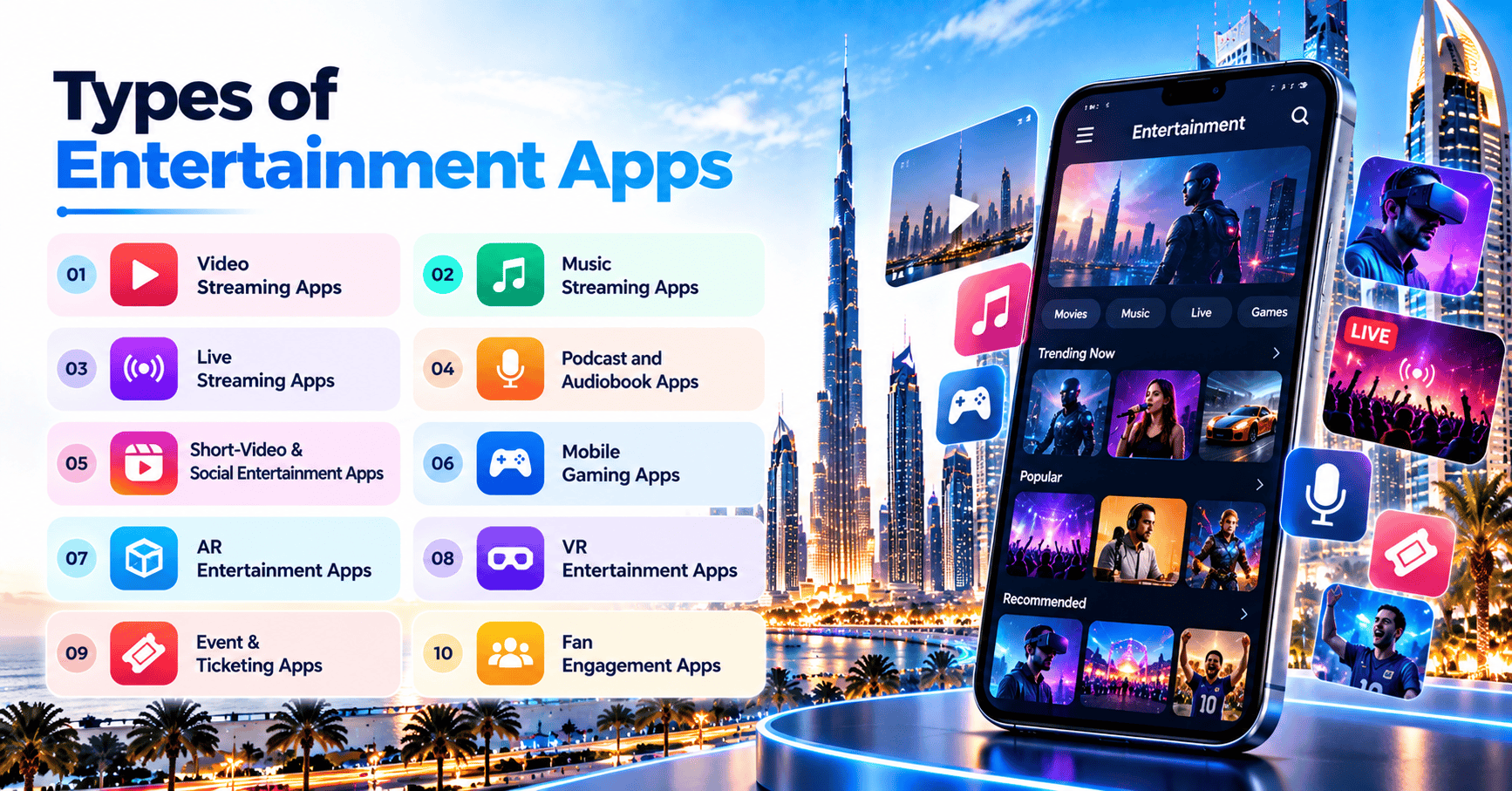
What Types of Entertainment Apps Can You Build for Your Audience?
-
Video Streaming Apps
Video streaming app development covers both on-demand libraries and live video, and the difficulty is rarely the player screen. It’s making sure playback holds up when ten thousand people press play in the same minute, with DRM protecting the content the whole way.
-
Music Streaming Apps
Music streaming apps live or die on catalogue depth and recommendations. Playlists, offline listening and background playback are expected. Licensing is the messy part, and it’s usually sorted out before a single screen is designed.
-
Live Streaming Apps
Concerts, matches, esports and creator broadcasts all share one challenge: timing. Live audiences notice even a few seconds of lag, while chat can race ahead of the video. Add sudden traffic spikes, and the experience can quickly fall apart without the right infrastructure in place.
-
Podcast and Audiobook Apps
These apps may be lighter on infrastructure, but the small details matter. Users expect to resume exactly where they left off, change playback speed, and download content before a flight. Visual polish usually takes a back seat.
-
Short-Video & Social Entertainment Apps
Creators are at the heart of these platforms, so social media app development needs to make content creation, editing, uploading, sharing, and moderation feel seamless. At the same time, the social media feed algorithm determines what users see next, helping surface relevant content and keep them engaged. This makes content discovery and personalised recommendations an important part of the product itself.
-
Mobile Gaming Apps
Whether it’s casual games, trivia or multiplayer, monetisation needs to be considered from the start. In-game economies and anti-cheat systems can be difficult and expensive to add once development is already underway.
-
AR Entertainment Apps
Augmented Reality App Development is behind camera filters, location-based games and branded experiences that mix digital objects into the real room. Older phones and inconsistent tracking are the usual headaches, so testing across devices takes longer than people expect.
-
VR Entertainment Apps
VR apps create immersive experiences where users can move through virtual environments. They can support gaming, virtual events, interactive storytelling and other entertainment formats. A Virtual Reality App Development Company can build these experiences around VR headsets, interactive environments, spatial audio and motion-based controls.
-
Event & Ticketing Apps
The journey is straightforward: browse an event, choose a seat, pay and scan a QR code at the door. The payment step needs to be especially reliable, because a failed checkout during a popular sale can become publicly visible within minutes.
-
Fan Engagement Apps
Polls, predictions, second-screen features and community threads can keep fans involved around a show or team. These apps rarely work in isolation; they are most effective when connected to something people already follow, such as a live broadcast.
Why Are Businesses Investing in Their Own Entertainment Apps?
Broadcasters, telecom operators, sports bodies and production houses are reaching the same conclusion: posting on someone else’s platform means renting access to an audience. Your own app changes that equation, giving you direct access to viewing data, the billing relationship and greater control over how your content is presented.
Which is why a growing number of organisations look at media and entertainment app development services as a revenue channel and not a line in the IT budget.
For businesses, the benefits can include:
- Direct access to audience data and viewing behaviour
- Recurring subscription revenue
- Full control over branding and content presentation
- Personalised experiences for each viewer
- Reach across mobile, tablet, web, and smart TV
- Less dependence on third-party platform algorithms
- Flexibility to test new formats and pricing
One warning: it’s easy to picture this as a website with a video player simply added on top. It’s much more than that. Behind a simple-looking catalogue are encoding pipelines, rights management and billing logic, and that underlying infrastructure is where much of the real budget goes.
What Are the Benefits of Building an Entertainment App?
1. Stronger audience relationship:
Your audience stays yours. You’re not relying on a social platform’s feed algorithm to decide whether people see your latest episode.
2. Predictable revenue:
Ad revenue swings with every campaign, and one-off sales swing with the calendar. A subscription base doesn’t. When a few thousand people pay on the same day each month, you can plan hiring, licensing and marketing around a number you trust.
3. Better content insights:
Viewer drop-off points and failed searches reveal what your audience wants next. These insights help you decide what to commission, improve, or quietly leave behind.
4. Personalised experiences:
A large content library can quickly overwhelm users. Personalised recommendations and continue-watching sections make it easier to discover relevant content and pick up where they left off.
5. Multiple monetisation options:
Subscriptions, advertising, pay-per-view and in-app purchases can work together, giving your app multiple ways to generate revenue.
6. Wider reach:
One backend can support the app across different screens and devices, from smartphones and tablets to browsers and smart TVs.
7. Brand control:
You have full control over your pricing, design, tone, and the overall experience your audience gets from the app.
What Features Should an Entertainment App Include?
Features aren’t something you simply collect. A live event ticketing app needs seat maps and a fast checkout, while a podcast app depends on resume playback and downloads, with little overlap between the two. Start with what your audience actually comes to do, then build the features that make that experience work.
1. User Registration and Profiles
Keep sign-up short. Mobile number, email or social login with an OTP is usually enough. Multiple profiles and parental controls are worth designing from the start, particularly if families will share one account.
2. Content Discovery and Search
Most people open the app without a title in mind. Search, genre rows, trending lists and filters shorten the distance between launch and play.
3. Media Player
Treat the player as the product, because that’s how users experience it. Adaptive bitrate, subtitles, alternate audio tracks, picture-in-picture and casting should work seamlessly without getting in the way.
4. Offline Downloads
Think about a daily commute or a long-haul flight from Dubai. Offline downloads become especially valuable in these moments, but they also need expiry rules and DRM to ensure saved content can’t simply be copied from the device.
5. Watchlist and Continue Watching
It’s a small feature with a big impact on retention. Users rarely notice when it works smoothly, but they’re quick to leave when it doesn’t.
6. In-App Purchase & Subscription Billing
Billing looks simple until real customers use it. Someone’s card expires mid-trial, another person subscribes through the app store and then tries to pay by card, and a third asks for a refund. Each case needs a rule. If those rules are wrong, revenue can slip away without any error message, so give billing as much attention as the player.
7. Push Notifications
New-episode alerts and kickoff reminders can bring users back at the right moment. Send too many, though, and they may mute notifications or remove the app altogether.
8. Social Sharing & Ratings
Sharing helps your content reach new audiences, while ratings reveal what users genuinely enjoy rather than what they simply click on.
9. Admin Panel & Content Management
Your editorial team should be able to upload, tag, schedule and geo-restrict content, manage plans and generate reports without depending on developers for every routine update.
10. Analytics & Reporting
Watch time, completion rates, churn and revenue per user reveal how people interact with your app. These metrics help pinpoint what keeps viewers engaged and where they drop off.
What Advanced Features Can Take an Entertainment App Further?
1. AI-Powered Content Recommendation Engine
Every play, skip, replay and search offers a small clue about what someone likes. The recommendation engine uses these signals to shape each person’s home screen around their interests. But a new app has little data to learn from, so it’s better to start with simple rules such as popular titles and “more like this”, then introduce more advanced models as viewing data grows.
2. AR/VR Integration in Entertainment Apps
Picture a virtual try-on for team merchandise, a character sitting on your desk, or a 360-degree view of a concert for headset owners. The test is whether it adds something to the experience. If it exists purely as a demo, users notice, and it still needs careful checking across devices.
3. Live Streaming with Real-Time Chat
Live content brings energy and a stronger sense of community to the experience. It also puts extra pressure on your infrastructure, so plan for traffic, scaling and moderation tools well before the first major event.
4. Multi-DRM Content Protection
Widevine, FairPlay and PlayReady between them cover Android, iOS, browsers and smart TVs. Rights holders often insist on it before they’ll license anything.
5. Multi-Language Subtitles & Arabic Support
Support right-to-left layouts, Arabic and English subtitles, and multiple audio tracks. In the UAE, these are often expected rather than optional, so Arabic support should be part of the experience from the start.
6. Watch Parties
Let friends press play together and react in real time. This works particularly well for live matches, premieres, reality shows, and other content people enjoy watching together.
7. Voice Search
Typing a film title with a TV remote can be frustrating, which makes voice search especially useful on connected TVs. Users can find what they want without navigating an on-screen keyboard.
8. Personalised Advertising
For ad-supported apps, server-side ad insertion can keep playback smooth while audience segmentation helps deliver ads that are more relevant to each viewer.
9. Casting and AirPlay
Users expect to move content from their phone to the living-room TV with just a couple of taps. Casting and AirPlay make that transition simple without interrupting playback.
10. Gamification & Rewards
Streaks, badges, and loyalty points can encourage users to return more often. The key is keeping them as optional extras that add value rather than turning the viewing experience into another task.
Get a Clear Estimate for Your Entertainment App
No guesswork. Share your idea and receive a transparent breakdown of features, timeline, and development cost.
What Does the Entertainment App Development Process Look Like?
The order matters. Start with the interface and you may discover later that the video pipeline cannot support what the screens promise. Content, technology, rights, and monetisation decisions need to stay connected from the beginning.
Step 1: Define the Content & Revenue Model
Start by getting the business model clear. In OTT app development, licensed catalogues, original content, and creator uploads require very different setups. Whether you rely on subscriptions, advertising, pay-per-view, or a combination also affects the architecture.
Step 2: Research Your Audience & Competitors
Understand who will use the app, which devices they prefer, and where competing platforms fall short. Even a quick look through one-star reviews can uncover recurring complaints and opportunities to do things differently.
Step 3: Plan Rights, Compliance & Regional Requirements
Work out licensing, territory restrictions, age ratings, payment rules, and data protection requirements for each market you plan to serve. Sorting these out early is far easier than fixing them after launch.
Step 4: Design the UX & Architecture
Map the journey from installation to the first play and remove unnecessary steps along the way. In parallel, plan the backend, storage, encoding, and content delivery infrastructure so the product design stays realistic.
Step 5: Build the MVP
An MVP should focus on the core experience rather than simply offering fewer screens. For a video app, that may include sign-up, content discovery, playback, subscriptions, notifications, and an admin panel. Secondary features can come later.
Step 6: Test Playback, Load & Billing
A reliable office connection is not enough. Test on real devices and networks, including weak bandwidth, heavy traffic, failed payments, unusual subscription scenarios, and content-protection requirements.
Step 7: Launch, Monitor & Improve
Track startup time, buffering, crashes, retention, and churn from the beginning. Once real users arrive, their behaviour will reveal what needs fixing or improving far more clearly than assumptions made during planning.
What Technology Stack Do You Need for an Entertainment App?
The technology stack should follow the content, features, and audience rather than whatever happens to be trending. A live sports platform has very different technical demands from an audiobook app, so the foundation needs to reflect how the product will actually be used.
-
Frontend
Android App Development needs attention to a wide range of devices, screen sizes, and network conditions, with players such as ExoPlayer commonly used for media playback. iOS App Development, on the other hand, benefits from AVPlayer, tight integration with AirPlay and picture-in-picture, and a consistent device range. Cross-platform frameworks like Flutter can speed things up for simpler products, though heavy playback or AR features often justify native code.
-
Backend
The backend manages users, catalogues, subscriptions, recommendations, and APIs. Node.js, Java, Python, .NET, and Go are common choices, depending on scale and team experience.
-
Streaming Infrastructure
Video is typically encoded into multiple resolutions and delivered with HLS or MPEG-DASH so the player can switch quality as the connection changes. Transcoding tools such as FFmpeg and a content delivery network sit at the centre of this layer.
-
Content Protection
DRM systems, tokenised URLs, watermarking, and geo-restrictions protect licensed content. None of these is foolproof on its own, so they’re best used together.
-
Database & Search
PostgreSQL and MySQL handle structured data like users and subscriptions, while MongoDB or Elasticsearch suit flexible metadata and fast catalogue search. Redis helps with caching and session data.
-
Cloud Infrastructure
AWS, Microsoft Azure, and Google Cloud offer scalable storage, compute, media services, and monitoring. Traffic for entertainment products is spiky, so auto-scaling is more important than raw capacity.
-
AR & VR Engines
ARKit, ARCore, Unity, and Unreal Engine power most immersive experiences, while WebXR can serve lighter browser-based ones. Performance budgets are tight, especially on mid-range phones.
How Much Does It Cost to Develop an Entertainment App?
The entertainment app development cost depends on the type of app, the number of platforms, the streaming and personalisation requirements, and how much content protection you need. A simple audio app costs far less than a multi-device video service with live channels and downloads.
Estimated Entertainment App Development Cost
| App complexity | Estimated cost | Typical timeline |
| Basic MVP (audio or simple video) | 25,000–50,000 | 3 – 5 weeks |
| Medium-complexity app | 50,000–100,000 | 8 – 12 weeks |
| Advanced streaming platform | 100,000–200,000+ | 12 – 16+ weeks |
| Large OTT or AR/VR ecosystem | 150,000–300,000+ | 16 – 20+ weeks |
These are planning ranges, not fixed prices. Content licensing, CDN and cloud usage, DRM fees, music or video rights, and marketing usually sit outside the development budget, and for a streaming product they can end up larger than the build itself.
What Factors Affect the Cost of Developing an Entertainment App?
-
Content Type & Scale
Audio is relatively inexpensive to store and deliver, while HD and 4K video, live streams, and large content libraries require significantly more encoding, storage, and delivery capacity.
-
Platform Coverage
Supporting Android, iOS, web, and smart TVs adds design, development, and testing work. For many products, starting with two platforms and expanding later can keep the initial scope more manageable.
-
Feature Depth
Recommendation engines, live chat, watch parties, and AR features all require additional engineering time. They also introduce ongoing maintenance and support requirements after launch.
-
Third-Party Integrations
Payment gateways, analytics platforms, ad servers, DRM providers, and CRM systems can add both implementation and usage costs. The more integrations involved, the more moving parts the app needs to support.
-
Security & Content Protection
Multi-DRM, secure downloads, and anti-piracy measures require specialised expertise and thorough testing. For content-heavy apps, these costs can become an important part of the overall development budget.
-
Design Complexity
Custom animations, immersive interfaces, and advanced player controls take more time to design, develop, and test than standard components. A more detailed interface usually means a larger development effort.
How Long Does It Take to Develop an Entertainment App?
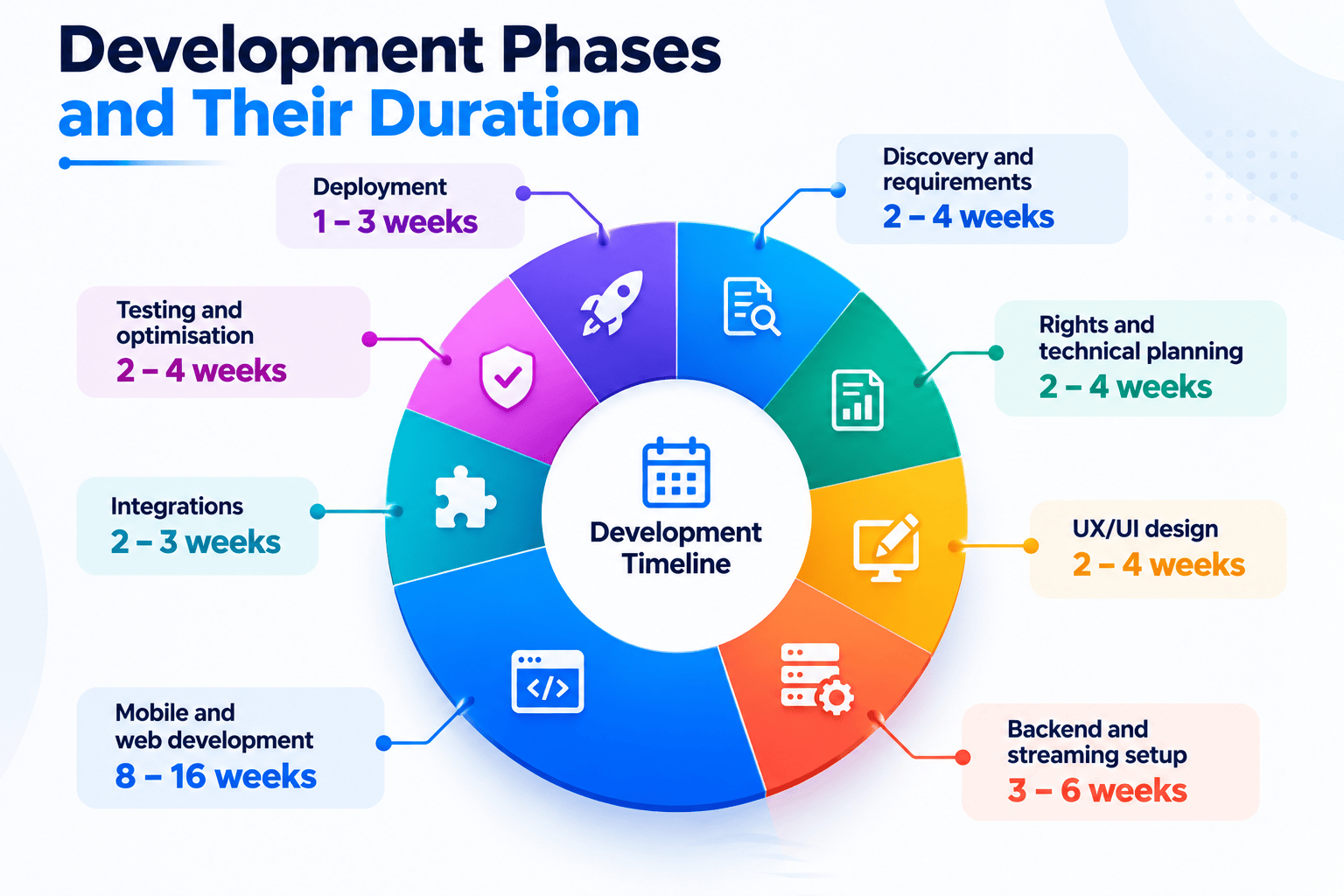
| Development phase | Approximate duration |
| Discovery and requirements | 2 – 4 weeks |
| Rights and technical planning | 2 – 4 weeks |
| UX/UI design | 2 – 4 weeks |
| Backend and streaming setup | 3 – 6 weeks |
| Mobile and web development | 8–16 weeks |
| Integrations | 2 – 3 weeks |
| Testing and optimisation | 2 – 4 weeks |
| Deployment | 1 – 3 weeks |
Several phases overlap, so the total is not simply the sum. A focused MVP can be ready in 3–5 weeks, while a multi-platform service with live content and personalisation can take a year or longer.
What Challenges Can Affect Entertainment App Development?
1. Playback Quality
Users often judge the entire app by how quickly a video starts and whether it keeps playing without buffering. Delays that seem minor during testing can quickly become reasons to leave when thousands of viewers are watching.
2. Traffic Spikes
A season finale or live match can send concurrent users soaring within minutes. Your infrastructure needs to scale quickly under pressure and scale back down afterwards without creating unnecessary costs.
3. Content Licensing
Content rights can differ by title, territory, and format. Keeping licensing details organised helps prevent unexpected restrictions, takedowns, or availability issues after launch.
4. Piracy & Account Sharing
Protecting digital content is an ongoing process rather than a feature you configure once. DRM, secure playback, access controls, and monitoring all need continued attention.
5. Retention
Getting people to install an app is only the first step. Without fresh content, reliable performance, and a reason to return, viewers can move on quickly and churn starts to climb.
6. Device Fragmentation
Screen sizes, chipsets, operating systems, and smart TV platforms can all behave differently. Testing across the devices your audience actually uses helps catch issues before they reach viewers.
Why Choose Aarmeh for Entertainment App Development in the UAE?
If you’re evaluating an entertainment app development company UAE businesses can rely on, pay attention to how they handle the less visible parts of the product: reliable playback, billing, content protection, and scaling. Aarmeh brings mobile engineering experience across streaming, subscriptions, and audience engagement, helping turn those moving parts into a product that works reliably in the real world.
1. Products Built Around Your Content
As custom entertainment app developers, Aarmeh builds around your content model, audience, and business goals rather than squeezing the product into a ready-made template.
2. Streaming Engineering
As a video streaming app development company, Aarmeh handles adaptive playback, encoding pipelines, CDN delivery, and low-latency streaming to keep video running smoothly, even across average networks.
3. OTT Expertise
Aarmeh develops subscription and ad-supported OTT platforms across mobile, web, and connected TV, with the content management and admin tools teams need to run them day to day.
4. Immersive Technology
For brands exploring AR and VR, Aarmeh combines mobile development with immersive technology so virtual and augmented experiences fit naturally into the wider product.
5. Personalisation & AI
Recommendation engines, smarter search, and audience segmentation can be introduced through AI app development, helping the experience become more relevant as viewing data grows.
6. Billing & Monetisation
Subscription plans, free trials, coupons, renewals, and pay-per-view can be built into the product alongside the payment methods your audience already uses.
7. Content Protection
DRM, secure content delivery, device controls, and geo-restrictions help safeguard licensed content while supporting the requirements of rights holders.
8. Scalable Cloud Architecture
The infrastructure is designed to handle sudden traffic spikes, with monitoring and auto-scaling in place to keep launches, premieres, and live events running reliably.
9. Flexible Engagement
Businesses looking to hire entertainment app developers can work with a dedicated team, choose a fixed-scope engagement, or combine both approaches as the product and its requirements evolve.
10. Support After Launch
The work continues after release. Aarmeh provides ongoing monitoring, updates, performance optimisation, and feature improvements as the app grows.
Ultimately, the aim is to create an entertainment app that loads quickly, performs reliably, gives people a reason to return, and scales alongside your content catalogue and audience.
What Trends Are Shaping the Future of Entertainment Apps?
1. AI-Powered Content & Experiences
AI is reshaping entertainment apps through personalised recommendations, automated content discovery, AI-generated content, intelligent search, and virtual assistants. As these capabilities mature, apps can use AI to make experiences more relevant and responsive while still keeping human creativity and user control at the centre.
2. Smarter Personalisation
Recommendations are moving from “people also watched” to models that consider time of day, mood signals, and viewing context. The challenge is doing this without making users feel watched.
3. Interactive & Participatory Content
Polls, choose-your-path stories, and live audience interactions are making entertainment more interactive, giving viewers a chance to actively shape the experience.
4. Immersive Experiences
As headsets and phone AR mature, virtual venues and mixed-reality content will find bigger audiences. The winners will be experiences that are actually fun rather than technically impressive.
5. Faster Networks & Lower Latency
Improved mobile networks and better streaming protocols make high-quality live experiences more practical, particularly for sports and events.
6. Hybrid Monetisation
Cheaper ad-supported tiers alongside premium subscriptions are becoming common, so platforms should be flexible enough to support both.
Conclusion
Building an entertainment app isn’t only about putting a catalogue on a phone. The product needs reliable streaming, a smooth user journey, sensible billing, protected content, and a plan for keeping people engaged after launch.
Start with the audience and the content model. Then choose the technology, features, and monetisation approach around them, not the other way round.
The best entertainment apps aren’t necessarily the ones with the most features. They’re the ones that start quickly, play without fuss, recommend something worth watching, and give people a reason to come back tomorrow.
If you’re planning to launch, working with an entertainment app development company UAE businesses can turn to for strategy, design, engineering, and post-launch support can help keep the journey from idea to stable product connected from the start.
Frequently Asked Questions (FAQs)
Q. What is the average budget for an entertainment app?
Budgets range from about $25,000 for a focused MVP to $200,000+ for an advanced platform, and $300,000+ for large streaming or immersive ecosystems. Content type, platforms, integrations, content protection, and personalisation all influence the final figure.
Q. How long does it take to build an entertainment app?
A basic MVP usually takes 3–5 weeks. Medium-complexity apps take 5–8 weeks, while advanced platforms with live streaming, personalisation, and multi-device support can take 8–18 weeks.
Q. Which features should an entertainment app launch with?
Most apps should launch with registration, content discovery, a reliable player, subscriptions or another monetisation method, push notifications, and an admin panel. Advanced features such as AR, watch parties, and AI recommendations can be added after you learn how people use the product.
Q. How do entertainment apps make money?
Common models include subscriptions, advertising, pay-per-view, in-app purchases, and hybrid plans combining a free ad-supported tier with a paid premium tier. The right choice depends on your content and audience.
Q. How do I protect my content from piracy?
Use DRM, secure tokenised streaming URLs, device limits, watermarking, and geo-restrictions. No single method stops everything, so a layered approach works best.
Q. How do I choose an entertainment app development company UAE businesses can rely on?
Look for proven experience with streaming, billing, and scalable infrastructure, ask to see live products, and check how the team handles testing and post-launch support. A company that talks only about design and never about playback or scaling may not be equipped for the technical demands of an entertainment platform.
Q. Can AI improve an entertainment app?
Yes. AI can power recommendations, smart search, personalised notifications, content tagging, and moderation. It works best when there is enough viewing data and clear goals for what it should improve.
Q. Do I need to build my own streaming infrastructure?
Usually not. Most products use managed cloud media services and CDNs, then build the app, business logic, and user experience on top. Building your own infrastructure only makes sense at a very large scale.
Q. Can entertainment apps include AR or VR?
Yes. AR fits mobile experiences such as filters, interactive characters, and location-based games. VR suits immersive content for headset users. Either should be added where it improves the experience, not just for novelty.


 Book a call




 CLUTCH VERIFIED
 Top App Developer UAE
 100% NDA Protected
 IN THE HEART OF UAE