





Table of Contents
📌 Key Takeaways
- Trading software development can cost approximately AED 150,000 – 350,000 for a basic MVP, while complex platforms can require AED 2 million to 5.5 million or more.
- The final budget depends on the supported asset classes, market data, broker integrations, security requirements, trading logic, and expected transaction volume.
- A basic platform may take 12 – 16 weeks to develop, whereas advanced trading systems can require 36 – 52+ weeks or longer.
- Dubai and the wider UAE offer opportunities for fintech businesses, but licensing, data protection, financial regulations, and third-party service costs must be evaluated before launch.
- AI analytics, automated execution, cryptocurrency wallets, and high-frequency trading infrastructure can significantly increase the development budget.
- Starting with a clearly defined MVP and expanding through planned releases can help control initial investment without compromising essential security and reliability.
Trading platforms have become important digital infrastructure for brokerage firms, fintech startups, investment businesses, and financial institutions. However, building one involves much more than creating a dashboard where users can view prices and place orders. Market data, account management, transaction processing, security, reporting, and external integrations all contribute to the overall cost.
For businesses entering the UAE market, the investment depends on the type of trading product, the intended customers, and the markets the platform will serve. A straightforward application connected to an existing broker has different requirements from an exchange that manages its own order book, liquidity connections, and transaction infrastructure.
This guide explains the estimated development costs, platform-specific budgets, essential features, technology choices, compliance considerations, and timelines involved in building trading software in Dubai and the wider UAE.
What Determines Trading Software Development Costs at Different Levels?
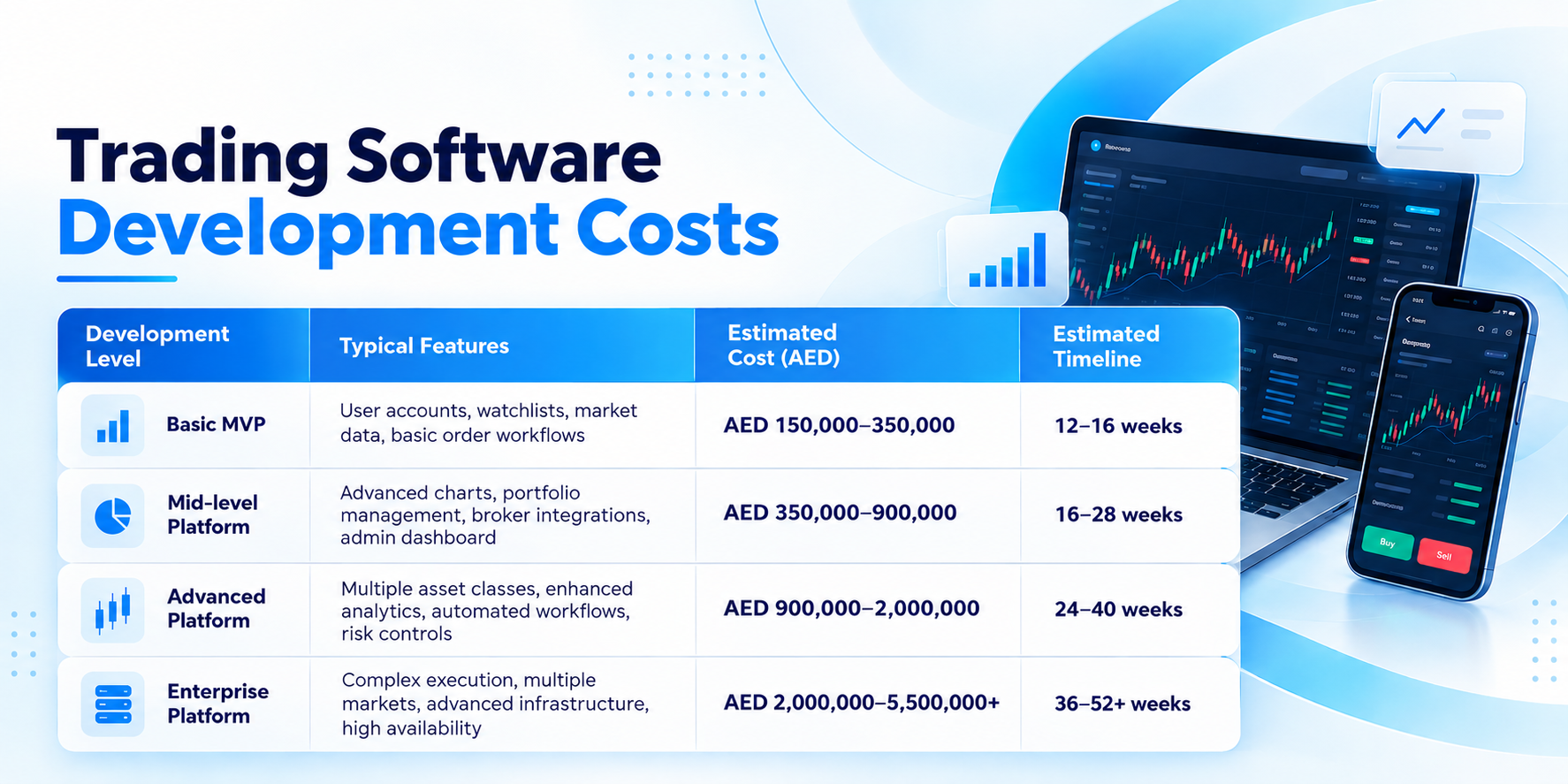
The total trading software development cost depends on the complexity of the platform, the number of supported instruments, the execution model, and the infrastructure needed to process transactions reliably. A basic product may use established third-party services, while an advanced platform may require custom trading logic, multiple integrations, and specialised performance testing.
The following figures are indicative estimates for custom software development. They are intended for initial budgeting rather than guaranteed market prices or vendor quotations.
|
Development level |
Typical features | Estimated cost (AED) | Estimated timeline |
| Basic MVP | User accounts, watchlists, market data, basic order workflows | 150,000–350,000 | 12 – 16 weeks |
| Mid-level platform | Advanced charts, portfolio management, broker integrations, admin dashboard | 350,000–900,000 | 16 – 28 weeks |
| Advanced platform | Multiple asset classes, enhanced analytics, automated workflows, risk controls | 900,000–2,000,000 | 24 – 40 weeks |
| Enterprise platform | Complex execution, multiple markets, advanced infrastructure, high availability | 2,000,000–5,500,000+ | 36- 52+ weeks |
These ranges cover the software built at different levels of complexity. They may not include financial-service licensing, regulatory capital, exchange fees, commercial market-data subscriptions, liquidity arrangements, or ongoing operational expenses.
A business can obtain a more accurate estimate by defining the required features, identifying third-party integrations, and separating launch requirements from later enhancements. This also helps prevent the initial budget from being consumed by features that are not essential to the first release.
What is the Cost of Building Trading Software in Dubai, UAE?
Dubai is an important location for fintech companies, investment services, brokerage businesses, and digital-asset ventures. Businesses planning a local launch should account for the product’s technical requirements as well as its intended customers, operating model, and regulatory environment.
The cost of building a trading software in Dubai can be estimated using the following planning ranges.
| Project type | Estimated cost (AED) | Typical scope |
| Basic trading application | 150,000–350,000 | Core interface, user accounts, basic market data |
| Retail brokerage platform | 350,000–900,000 | Trading workflows, account management, broker connectivity |
| Multi-asset platform | 900,000–2,000,000 | Multiple instruments, advanced charts, reporting |
| Enterprise trading system | 2,000,000–5,500,000+ | Complex integrations, risk controls, scalable infrastructure |
The trading software development cost in Dubai can vary according to the selected technology stack, development team, market-data providers, and integration requirements. Arabic and English interfaces, right-to-left layouts, regional payment integrations, and local support arrangements may also affect the scope.
Businesses should distinguish between developing the software and obtaining permission to provide financial services. Requirements can vary according to the activity, products, customers, and jurisdiction, including whether the business operates in mainland Dubai, the Dubai International Financial Centre, or another regulated area. The relevant requirements should be confirmed with qualified legal and compliance advisers before development begins.
What Factors Affect Trading Software Development Costs?
Two platforms may have similar interfaces but very different engineering requirements. One might display market prices and send orders to an existing broker, while another may need custom execution logic, multiple liquidity connections, complex risk calculations, and continuous monitoring.
The principal cost drivers should be assessed before finalising the budget.
-
Platform Complexity & Business Model
The scope of trading platform software development depends on whether the product is a brokerage application, a proprietary trading system, a digital-asset exchange, or an institutional platform. Each model requires different workflows, integrations, permissions, and operational controls.
Supporting multiple order types, account categories, financial instruments, and trading strategies increases the development and testing effort. Businesses should define the intended trading model early so the architecture reflects actual requirements rather than assumptions.
-
Asset Classes & Market Coverage
Stocks, foreign exchange, commodities, options, and cryptocurrencies have different pricing conventions, trading rules, market hours, and settlement requirements. Supporting multiple asset classes may require separate data feeds, instrument specifications, order validations, and risk calculations.
The more markets a platform supports, the more work may be needed to keep prices, orders, balances, and transaction records consistent. The budget should reflect the actual instruments and exchanges required at launch.
-
Market Data & External Integrations
Trading systems often depend on data providers, brokers, liquidity providers, identity verification services, banking integrations, and notification systems. Each connection introduces development work, testing requirements, and potentially recurring fees.
Live market data may also require commercial subscriptions and permissions for displaying or redistributing information. These costs should be confirmed with providers rather than assumed to be included in the software quotation.
-
Security & Risk Management
Financial applications handle sensitive account information and may process transactions with direct monetary consequences. Authentication, encryption, access controls, audit trails, secure APIs, and monitoring must therefore be included in the core architecture.
Depending on the business model, risk controls may include exposure limits, margin monitoring, order validation, suspicious activity detection, and transaction reconciliation. These safeguards increase development effort but are essential to dependable operation.
-
Scalability & Performance
A platform designed for a small user base has different infrastructure needs from one serving thousands of active traders and processing frequent market updates. Expected traffic, order volume, data throughput, and uptime requirements all influence architecture and hosting costs.
Defining measurable performance targets early helps the development team choose suitable infrastructure and plan realistic load testing. It also reduces the likelihood of expensive redesigns after the user base grows.
-
Design & User Experience
Trading interfaces must present prices, balances, charts, order status, and risk information clearly. Poorly designed workflows can lead to user errors, confusion, and unnecessary support requests.
The design budget depends on the number of user journeys, device types, supported languages, accessibility requirements, and custom visualisations. Complex interfaces for professional traders generally need more specialised design and validation than simple portfolio applications.
How Much Does Each Type of Trading Platform Cost?
Different trading products have different infrastructure, integration, and operational requirements. The estimates below provide a starting point for comparing common platform categories.
| Platform type | Estimated cost (AED) | Typical timeline |
| Stock trading platform | 300,000–1,200,000 | 16-32 weeks |
| Forex trading platform | 350,000–1,500,000 | 16-36 weeks |
| Cryptocurrency exchange | 500,000–2,000,000+ | 24-52+ weeks |
| Commodity trading platform | 400,000–1,500,000 | 20-36 weeks |
| Options trading platform | 500,000–1,800,000 | 24-40 weeks |
| AI-enabled trading system | 600,000–2,500,000+ | 24-52+ weeks |
| High-frequency trading system | 1,500,000–5,500,000+ | 36-52+ weeks |
The figures are indicative custom-development ranges, not fixed quotations. A platform using an established trading engine may cost less than a fully custom implementation, even when both serve the same asset class.
Planning a Trading Platform for Your Business?
From platform features and development costs to security and compliance, get expert guidance to plan a trading solution that fits your business goals and budget.
1. Stock Trading Platforms
A stock trading application typically includes market quotes, watchlists, interactive charts, order placement, portfolio views, transaction histories, and notifications. Depending on the business model, it may also need brokerage connectivity, corporate-action processing, and detailed reporting.
The stock trading software budget increases when the platform supports multiple exchanges, real-time market data, advanced order types, and sophisticated portfolio analytics. The project scope should clarify whether the software only provides the user interface or also manages additional trading operations.
2. Forex Trading Platforms
Forex platforms commonly require currency-pair displays, price feeds, order management, account balances, and risk controls. Depending on the trading model, they may also support leveraged positions, margin monitoring, price alerts, and liquidity-provider integrations.
The cost to build a forex trading software solution depends on whether it connects to an existing trading engine or requires custom pricing, execution, and account-management services. Broker-side integrations and order-processing requirements can make a substantial difference to the budget.
3. Cryptocurrency Trading Platforms
Crypto platforms can support asset listings, wallets, deposits, withdrawals, order books, transaction histories, and account security. A full exchange may additionally require a matching engine, blockchain connectivity, liquidity arrangements, transaction monitoring, and operational safeguards.
The cryptocurrency trading platform software budget depends on whether the product is a portfolio application, a brokerage interface, or a full exchange. Custody arrangements, wallet security, blockchain network support, and withdrawal controls can significantly affect both cost and delivery time.
4. Commodity Trading Platforms
Commodity systems may support energy, metals, agricultural products, and related financial instruments. Depending on the business, the platform may need contract management, trade capture, pricing, exposure tracking, settlement workflows, and reporting.
A commodity trading and risk management software solution can become more complex when it connects trading activities with procurement, inventory, logistics, finance, and physical delivery. The budget should reflect the operational processes being automated rather than the number of screens alone.
5. Options Trading Platforms
Options platforms must account for contract specifications, strike prices, expiry dates, option chains, and relevant pricing and risk calculations. More advanced products may also include strategy builders, payoff charts, and portfolio exposure analysis.
The cost of developing these systems depends on the supported instruments, calculations, execution workflows, and reporting requirements. Extensive validation is particularly important because errors in pricing or contract handling can have direct financial consequences.
6. High-Frequency Trading Systems
High-frequency systems are designed to process market information and execute orders under strict latency constraints. They require a different architecture from conventional retail applications because performance, execution reliability, and system recovery are critical.
The high frequency trading software budget can exceed AED 5.5 million for specialised implementations. Exchange connectivity, low-latency data processing, infrastructure placement, performance engineering, monitoring, and recovery mechanisms all contribute to the cost.
What Is the Cost of Developing an MVP Trading Platform?
A minimum viable product is a limited first release designed to validate the core business proposition before the company invests in a broader platform. It focuses on essential user journeys rather than implementing every feature planned for the long term.
The MVP trading software cost may range from AED 150,000 to AED 350,000 for a narrowly scoped application using suitable third-party integrations. This estimate assumes a limited feature set and does not automatically include licensing, regulatory capital, or specialist financial-service fees.
A basic MVP may include the following components:
| Component | Initial scope |
| User accounts | Registration, authentication, profile management |
| Market information | Watchlists, quotes, basic charts |
| Trading workflows | Basic order entry through an approved integration |
| Portfolio tools | Holdings, balances, transaction history |
| Notifications | Order status and account alerts |
| Admin dashboard | User support, reporting, access controls |
| Security | Authentication, encryption, audit records |
| Testing | Functional, integration, security, and performance checks |
A project may exceed the estimate if it requires a custom matching engine, multiple liquidity providers, digital-asset custody, or complex regulatory reporting. Using a proven third-party trading engine can reduce custom engineering, provided that the licence, integration terms, and long-term suitability are acceptable.
A phased launch also allows businesses to prioritise features using real user feedback. Advanced analytics, additional markets, automated strategies, and expanded reporting can be introduced after the core product has been validated.
What Features Should a Trading Platform Include?
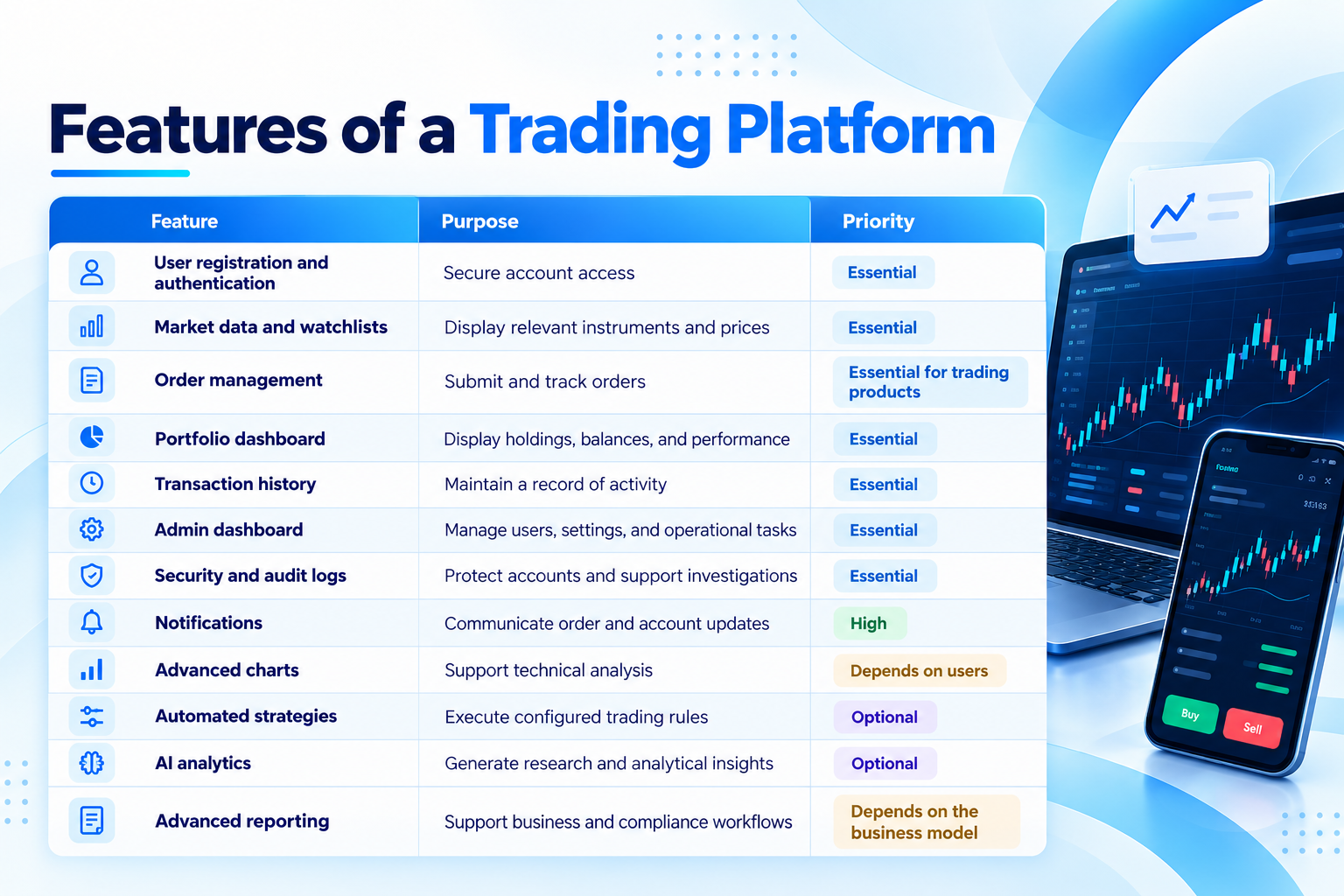
The right feature set depends on the users, asset classes, and trading model. However, most platforms need a reliable foundation for accounts, market information, orders, transaction records, security, and administration.
| Feature | Purpose | Priority |
| User registration and authentication | Secure account access | Essential |
| Market data and watchlists | Display relevant instruments and prices | Essential |
| Order management | Submit and track orders | Essential for trading products |
| Portfolio dashboard | Display holdings, balances, and performance | Essential |
| Transaction history | Maintain a record of activity | Essential |
| Admin dashboard | Manage users, settings, and operational tasks | Essential |
| Security and audit logs | Protect accounts and support investigations | Essential |
| Notifications | Communicate order and account updates | High |
| Advanced charts | Support technical analysis | Depends on users |
| Automated strategies | Execute configured trading rules | Optional |
| AI analytics | Generate research and analytical insights | Optional |
| Advanced reporting | Support business and compliance workflows | Depends on the business model |
Automated Trading & Strategy Tools
Automation can help users execute predefined rules, process signals, or manage selected trading workflows. It also introduces additional requirements for strategy validation, order controls, failure handling, and ongoing monitoring.
The budget for artificial intelligence trading software depends on whether the product provides analytical insights, generates trade signals, or executes orders automatically. Automated execution requires particularly careful testing because model outputs and trading instructions must be handled reliably under changing market conditions.
AI-Based Stock Analysis
Stock-focused AI applications may analyse historical prices, trading volume, financial statements, news, and other permitted data sources. The quality of the results depends on data coverage, model selection, validation methods, and the conditions under which the model is evaluated.
The cost of artificial intelligence stock trading software development rises when the project requires specialised datasets, multiple models, real-time processing, explainability, and brokerage execution integration. Historical performance does not guarantee future results, so suitable backtesting, out-of-sample validation, and monitoring are necessary.
Trading Journals & Performance Analysis
Trading journals help users record transactions, review decisions, track strategy performance, and identify recurring mistakes. A commercial product may add broker synchronisation, analytics, tagging, reporting, and personalised insights.
Free trade journal software can serve as a reference point for traders who need basic record-keeping without a subscription. Businesses developing a similar product should identify what differentiates their offering, such as automated imports, detailed performance analysis, or integration with a wider trading application.
What is the Cost of MT4-Integrated Trading Software?
MetaTrader 4 is used by many forex brokers and trading businesses. Integrating it with a separate application can connect customer-facing features with existing trading and account infrastructure, subject to the relevant licensing and access arrangements.
The MT4 integrated trading software development cost may range from approximately AED 350,000 to AED 900,000 for a custom integration project. The final estimate depends on broker-side access, account synchronisation, reporting, additional applications, and the complexity of the required workflows.
- Typical integration features include:
- Trader registration and account linking
- Price displays and chart integration
- Trade history and account information
- Administrative dashboards and reporting
- Account-status notifications
- Deposit and withdrawal workflows, where supported
- Security controls and integration testing
The estimate may exclude platform licensing, broker infrastructure, market data, liquidity services, and other vendor charges. Businesses should confirm these expenses separately before committing to the project.
MT4 should also be evaluated against the long-term product roadmap. If the business requires additional asset classes, specialised execution logic, or a different trading architecture, those requirements should be considered before choosing an integration strategy.
How Much Does Forex Broker Software Development Cost?
A forex brokerage requires more than a customer-facing application. Depending on its business model, it may need client onboarding, account management, pricing feeds, order processing, risk monitoring, reporting, and integrations with liquidity providers and payment services.
The forex broker software development cost may range from AED 350,000 to AED 1.5 million for a custom platform, with more complex enterprise implementations potentially costing more.
| Broker solution | Estimated cost (AED) | Typical scope |
| Basic broker interface | 350,000–600,000 | Client portal, account views, basic integrations |
| Mid-level brokerage platform | 600,000–1,000,000 | Trading workflows, reporting, multiple integrations |
| Advanced broker infrastructure | 1,000,000–1,500,000+ | Complex execution, risk controls, monitoring |
These estimates relate to software development rather than the full cost of launching a brokerage. Licensing, legal advice, regulatory capital, liquidity arrangements, market data, and ongoing operational staffing may require additional investment.
A foreign exchange trading software development company should be able to explain how pricing feeds, liquidity providers, order execution, account records, and risk controls will work together. The proposal should also identify which components are custom-built and which are supplied by third parties.
Businesses assessing a forex trading software development company should review relevant financial technology experience, integration capabilities, testing methods, and post-launch support. Experience with general business applications alone does not demonstrate the ability to implement financial-market workflows safely.
For businesses targeting the UAE, a forex software development company UAE search should be followed by a review of the provider’s technical expertise, local support arrangements, and understanding of the intended business model. The project team should distinguish software implementation from regulated financial activities that require separate permissions.
Projects specifically targeting Dubai should also assess forex trading software development Dubai requirements, including the intended customer base, infrastructure, language support, and broker integrations. The applicable legal and regulatory obligations should be confirmed for the chosen jurisdiction before the platform is launched.
How Much Does Crypto Trading Software Development Cost?
Crypto projects range from portfolio applications connected to an existing exchange to full platforms that manage order books, deposits, withdrawals, and digital-asset custody.
The crypto trading software development budget may start at approximately AED 500,000 for a contained custom trading product and exceed AED 2 million for a more complex exchange. The estimate depends on wallet architecture, blockchain connectivity, liquidity, security testing, supported networks, and transaction monitoring.
A crypto trading application may require:
- Digital-asset listings and price feeds
- Order placement and transaction histories
- Wallet or third-party custody integration
- Blockchain deposit and withdrawal monitoring
- Liquidity and exchange connectivity
- Identity verification and transaction screening
- Administrative tools and audit logs
- Incident monitoring and recovery procedures
The choice of custody model is particularly important. Managing private keys directly creates different security and operational requirements from integrating a specialist custody provider. The decision affects the architecture, testing effort, incident procedures, and ongoing service costs.
Businesses comparing a cryptocurrency trading software development company should examine its experience with wallet security, blockchain integrations, transaction workflows, and operational monitoring. A proposal should clearly distinguish custom development from third-party custody, liquidity, and infrastructure services.
The term cryptocurrency software trading may refer to tools for analysing digital assets, managing portfolios, executing orders, or automating strategies. Defining the intended functionality helps establish whether the business needs a simple trading interface or a full exchange system.
What is the Cost of Commodity Trading Risk Management Software?
Commodity systems can support energy, metals, agricultural products, and related financial instruments. Their scope may range from basic trade capture to enterprise workflows covering contracts, inventory, logistics, exposure, settlement, and reporting.
The commodity trading risk management software budget may fall between AED 400,000 and AED 1.5 million for a custom platform of moderate complexity. More extensive implementations may exceed this range when they require multiple trading desks, complex exposure calculations, or deep integration with finance and logistics systems.
A commodity trading software development company should understand the relevant contract structures, trading workflows, risk calculations, and external system integrations. This is particularly important when the software must connect physical commodity transactions with inventory, procurement, transport, and financial reporting.
How is Currency Trading Software Different from Forex Software?
Currency-related software can support different business activities, from exchange-rate monitoring and currency conversion to speculative foreign-exchange trading. The required features depend on whether the platform handles payments, spot transactions, leveraged products, or brokerage workflows.
The scope of currency trading software development may include currency-pair pricing, market data, transaction records, account balances, order management, and risk monitoring. The business model should be established early because a currency-conversion service and a forex trading platform have different technical and regulatory requirements.
What Technology is Used to Build Trading Software?
The technology stack affects performance, maintainability, scalability, and development effort. The right choices depend on the supported asset classes, data volumes, execution requirements, user experience, and infrastructure needs.
| Technology layer | Common technologies | Purpose |
| Web frontend | React, Next.js, Angular | Trading screens and dashboards |
| Mobile apps | Flutter, React Native, Swift, Kotlin | iOS and Android applications |
| Backend services | Java, C++, C#, .NET, Python, Node.js | Business logic and APIs |
| Databases | PostgreSQL, MongoDB | Account and application records |
| Real-time communication | WebSockets, message queues | Live prices and status updates |
| Caching | Redis | Fast access to frequently used data |
| AI and analytics | Python, PyTorch, TensorFlow | Research and model workflows |
| Cloud infrastructure | AWS, Azure, Google Cloud | Hosting, monitoring, and scaling |
| Security | Encryption, MFA, access controls | Account and system protection |
| DevOps | Docker, CI/CD, infrastructure automation | Repeatable deployment and operations |
A platform with demanding execution requirements may need specialised services and carefully optimised infrastructure. Technology should be selected against measurable performance and reliability targets rather than popularity alone.
Real-time price display and reliable order execution are also separate technical challenges. The execution path needs its own validation, monitoring, reconciliation, and recovery mechanisms.
What Are the Development Stages and their Costs?
A trading platform typically moves through discovery, design, architecture, implementation, integration, testing, and deployment. Security and quality assurance should continue throughout the project rather than being treated as final-stage tasks.
The following example shows how a hypothetical AED 600,000 project might allocate its software development budget.
| Development stage | Illustrative allocation | Example cost |
| Discovery and requirements | 8% | AED 48,000 |
| UI/UX design | 10% | AED 60,000 |
| Architecture and infrastructure | 12% | AED 72,000 |
| Core application development | 32% | AED 192,000 |
| Integrations and data workflows | 16% | AED 96,000 |
| Testing and security validation | 15% | AED 90,000 |
| Deployment and handover | 7% | AED 42,000 |
| Total | 100% | AED 600,000 |
This is an illustrative allocation rather than a standard industry breakdown. Projects with complex market-data integrations may require more integration and testing effort, while those using an established trading engine may spend less on custom execution infrastructure.
1. Discovery & Requirements
The team defines the business model, target users, supported instruments, trading workflows, external integrations, and security needs. The outcome should be a documented scope with priorities, acceptance criteria, dependencies, and an initial estimate.
2. UI/UX Design
The design stage covers trading screens, charts, portfolio views, account workflows, and administrative interfaces. It should make financial information clear without obscuring important transaction details or risk information.
3. Backend & Trading Logic
Developers implement account services, business rules, order workflows, data handling, and core integrations. Where a third-party engine is used, the integration still needs to be tested for order changes, failed requests, retries, and reconciliation.
4. Integration & Quality Assurance
The platform is connected to relevant data providers, brokers, payment services, identity verification tools, and reporting systems. Testing should cover partial fills, rejected orders, interrupted connections, duplicate requests, and inconsistent transaction records.
5. Deployment & Monitoring
The final stage includes production configuration, access permissions, monitoring, backups, recovery procedures, and operational handover. Post-launch support is important because external integrations, market data services, and infrastructure requirements can change over time.
What Compliance and Security Requirements Apply in Dubai, UAE?
Financial software requirements depend on the product, the activities being offered, the location of customers, and the relevant regulatory framework. A platform serving brokerage clients may face different obligations from a portfolio tracker or a business application that only displays market information.
For trading software development UAE projects, the team should establish which financial activities the business intends to provide and which licences or approvals may apply. The regulatory framework should be confirmed with qualified advisers and the relevant authorities before development and launch.
Key areas to assess include:
-
Licensing and permissions:
Determine whether the business model involves regulated brokerage, exchange, investment, payment, or digital-asset activities.
-
Identity verification:
Define how customer identities will be checked and how required records will be maintained.
-
Data protection:
Establish how personal information is collected, stored, accessed, and retained.
-
Security:
Implement suitable authentication, encryption, access control, monitoring, and incident-response procedures.
-
Auditability:
Maintain appropriate records of orders, account changes, transactions, and administrative actions.
-
Third-party dependencies:
Confirm the permissions, contracts, and service obligations associated with brokers, data providers, and payment partners.
Businesses should also evaluate whether Arabic-language interfaces, right-to-left layouts, regional payment services, or particular data-hosting arrangements are needed for their target customers. These requirements should be identified during discovery because retrofitting them can increase cost and delay launch.
What Are the Ongoing Costs After Launch?
The initial development budget is only part of the total cost of ownership. A trading platform also requires infrastructure, software maintenance, monitoring, security updates, integration support, and potentially new vendor licences.
For preliminary budgeting, businesses can reserve approximately 15–20% of the original development cost each year for routine maintenance and improvements. This is a planning assumption rather than a universal benchmark, and complex systems may require a larger support budget.
| Expense | What it covers | Main cost driver |
| Software maintenance | Bug fixes, upgrades, compatibility updates | Support scope |
| Cloud infrastructure | Compute, storage, networking, backups | Usage and performance |
| Market data | Quotes, historical data, exchange feeds | Provider and data rights |
| Third-party services | Broker APIs, identity checks, analytics | Subscriptions and usage |
| Security | Monitoring, audits, vulnerability remediation | Risk profile |
| Legal and compliance support | Regulatory reviews and specialist advice | Business model and jurisdiction |
| Customer support | Account issues and operational queries | User volume and service hours |
| New features | Additional markets, tools, and integrations | Product roadmap |
For example, a platform with a development cost of AED 600,000 might allocate AED 90,000–120,000 per year for routine maintenance using the 15–20% assumption. Hosting, market data, legal services, licensing, and other third-party expenses would need to be budgeted separately.
What is the Difference Between Financial Trading Software and Global Management Software?
Financial trading platforms focus on activities such as market data, order execution, portfolios, and financial transactions. International trade management systems, by contrast, help businesses coordinate cross-border commercial operations.
Global trade management software typically supports trade documentation, customs workflows, shipment tracking, supplier coordination, compliance checks, and logistics processes. It is designed around the movement of goods and associated business records rather than financial-market order execution.
A business planning a software project should define whether it needs financial trading functionality, international trade operations, or integration between the two. This distinction helps prevent an inaccurate scope and an unsuitable cost estimate.
How Can Businesses Reduce Trading Software Development Cost?
Reducing development expenses does not mean removing essential security controls or cutting testing time. A more effective approach is to limit unnecessary scope, reuse appropriate components, and make important architecture decisions early.
Start with a Defined MVP
Prioritise the essential user journey and the minimum functionality needed to validate the product. Advanced analytics, additional asset classes, and secondary features can be scheduled for later releases.
Use Proven Components Where Appropriate
Established identity providers, charting libraries, payment services, and licensed trading engines can reduce custom engineering effort. Each component should still be assessed for security, licensing, compatibility, and long-term commercial suitability.
Confirm Integrations Early
Market data, broker connectivity, and payment services can introduce unexpected dependencies. Confirming vendor access, documentation, testing environments, and pricing before development begins helps avoid delays and unplanned expenses.
Test Trading Edge Cases
Order failures, duplicate requests, interrupted connections, and inconsistent transaction records can be expensive to resolve after launch. Testing these scenarios throughout development reduces the risk of production incidents.
Avoid Overengineering
The architecture should meet expected demand and support realistic growth. Building complex infrastructure for hypothetical workloads can waste money, while ignoring known scalability requirements can create costly rework.
How to Choose the Right Trading Software Development Partner?
Choosing a technical partner requires more than comparing hourly rates or reviewing interface designs. Financial applications need dependable data handling, integration experience, security controls, and a clear approach to operational risk.
An online trading software development company should be able to explain its experience with financial integrations, order lifecycle management, audit trails, performance testing, and secure application architecture. It should also clarify which components are custom-built and which depend on third-party services.
During the evaluation process, ask potential providers:
- How are order submission, rejection, cancellation, and reconciliation handled?
- Which market-data and brokerage integrations does the project require?
- How will account security, user permissions, and audit logs work?
- How will performance, availability, and recovery be tested?
- What is included in the quotation, and which third-party costs are excluded?
- Who owns the source code, deployment configuration, and documentation?
- What support is available after launch?
Businesses searching for a trading software development company in Dubai should also evaluate communication, project governance, local support arrangements, and familiarity with regional requirements. A transparent proposal should specify milestones, deliverables, exclusions, testing, and post-launch support.
The best partner is one whose experience matches the project. A retail trading interface, a crypto exchange, a brokerage back office, and an institutional trading system require different engineering capabilities. Relevant case studies and technical discussions can help determine whether a provider can meet the actual requirements.
Why Consider Aarmeh for Trading Software Development?
Aarmeh is a Dubai-based technology company working across web and mobile applications, custom software, and emerging technologies. For businesses considering a trading platform, an initial assessment can help clarify the required functionality, integrations, security controls, and external service dependencies.
A project assessment can establish whether an MVP, a broker-integrated solution, or a larger custom platform is the most suitable starting point. It can also identify major cost drivers, delivery milestones, and dependencies before development begins.
Businesses planning a trading app development company engagement should seek a clearly defined scope, realistic cost estimate, and transparent delivery plan. Financial-market integrations and regulated activities should be assessed separately so the software requirements are not confused with licensing or operational responsibilities.
What Are the Future Trends in Trading Software Development?
Trading technology continues to evolve as businesses adopt more sophisticated analytics, automation, and digital-asset infrastructure. The relevance of each trend depends on the customers being served and the commercial problem the platform is intended to solve.
AI-Assisted Market Analysis
Machine learning can help analyse market data, identify patterns, and support research. The usefulness of these models depends on data quality, appropriate validation, and continuous monitoring rather than simply adding an AI component.
Digital-Asset Infrastructure
Businesses are exploring digital assets, tokenised products, and new forms of market access. These platforms require careful consideration of custody, liquidity, transaction records, and applicable regulations.
Improved Risk Monitoring
Real-time alerts and automated controls can help identify unusual activity, excessive exposure, and operational problems. Clear escalation procedures are still necessary when an issue requires human review.
Better Data & Integration Architecture
Trading businesses need consistent information across applications, broker services, reporting tools, and internal operations. Reliable integration and data reconciliation can be as important as the features visible to users.
Security & Resilience
Account protection, access management, monitoring, backups, and incident recovery remain essential as platforms become more connected. Security needs to be incorporated into design, development, testing, and ongoing operations.
Ready to Build a Secure Trading Platform?
Explore the right technology, security measures, and development approach for your trading platform. Get guidance on building a scalable solution aligned with your requirements and budget.
Conclusion
The cost of building trading software in Dubai, UAE, depends on the platform type, supported asset classes, trading infrastructure, security requirements, and external integrations. A focused MVP may start at approximately AED 150,000, while complex platforms can require several million dirhams in development investment.
For businesses in Dubai and the wider UAE, the most important early decisions involve defining the trading model, selecting suitable integrations, understanding regulatory responsibilities, and separating development expenses from recurring operational costs. These decisions provide a more reliable basis for planning than a single headline price.
A phased approach can help control initial investment while retaining a clear path toward additional markets, users, and features. Before committing to development, obtain a scope-based estimate that identifies the required functionality, delivery milestones, exclusions, and post-launch support.
Frequently Asked Questions (FAQs)
Q. How much does trading software development cost in Dubai, UAE?
A basic custom trading MVP may cost around AED 150,000–350,000. Mid-level platforms can cost AED 350,000–900,000, while advanced and enterprise systems may require AED 900,000–5.5 million or more. The final price depends on functionality, integrations, security, and infrastructure.
Q. How long does it take to develop trading software?
A narrowly scoped MVP may take around 12–16 weeks. Mid-level applications commonly require four to seven months, while complex systems with multiple asset classes, specialised execution, and extensive integrations may take nine to twelve months or longer.
Q. What is the cheapest way to launch a trading platform?
Start with a limited feature set and consider integrating an established trading engine rather than building every component from scratch. Essential security, testing, and operational safeguards must remain in scope, and licensing and third-party charges should be considered separately.
Q. Is trading software development different for Dubai and the wider UAE?
The underlying engineering requirements are broadly similar, but the target customers, financial products, jurisdiction, language support, data handling, and regulatory permissions can change the project scope. Requirements should be confirmed for the specific activity and location.
Q. Can AI be integrated into a trading platform?
Yes. AI can support market analysis, forecasting, anomaly detection, and automated decision-support workflows. The cost depends on data quality, model complexity, execution integration, and monitoring requirements. AI cannot guarantee trading profits.
Q. What is the difference between a trading application and a complete trading platform?
A trading application may provide the interface for viewing prices and submitting orders through an existing service. A complete platform can also include backend trading logic, market connectivity, account services, risk controls, reporting, and operational monitoring.
Q. What costs should be considered beyond development?
Businesses should budget for hosting, market data, third-party services, software maintenance, security reviews, legal advice, regulatory requirements, and customer support. These expenses depend on the platform’s scale and business model and may not be included in the initial quotation.
Q. How can a business obtain an accurate development estimate?
Prepare a scope covering the intended users, supported assets, trading workflows, integrations, security needs, target jurisdictions, and expected usage. A technical discovery exercise can then translate those requirements into a phased budget, timeline, and list of assumptions.



 Book a call



 CLUTCH VERIFIED
 Top App Developer UAE
 100% NDA Protected
 IN THE HEART OF UAE