





Table of Contents
The Middle East region, particularly Dubai, has been one of the destinations that have embraced tomorrow’s technologies. This has also pushed the government to take the necessary steps in building such an environment. However, the shift from manual voice assistants is shifting towards an AI-based one, which is leading to such a boom. As the ecosystem is shifting and a gradual change is happening in Dubai, it is necessary to decode the level of growth and what the market looks like for businesses. Thus, understanding the transformation of Arabic voice AI in mobile apps becomes integral.
Decoding The UAE AI Apps Market
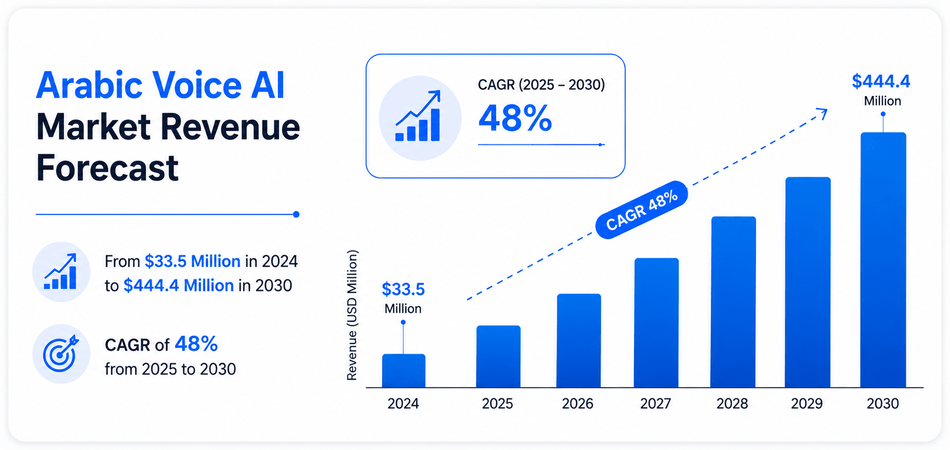
If we take a look at the UAE AI apps market, it has generated a revenue of $33.5 Million. However, it is expected to reach the revenue mark of $444.4 Million by the end of 2030. The UAE market is expected to grow at a compounded annual growth rate (CAGR) of 48% from the period 2025 to 2030.
If we take a step deep, the Natural Language Processing (NLP) segment was the largest revenue-generating AI segment in 2024. However, Computer Vision has been the most lucrative AI functionality segment, registering the fastest level of growth.
Why Arabic Voice AI Matters In Dubai?
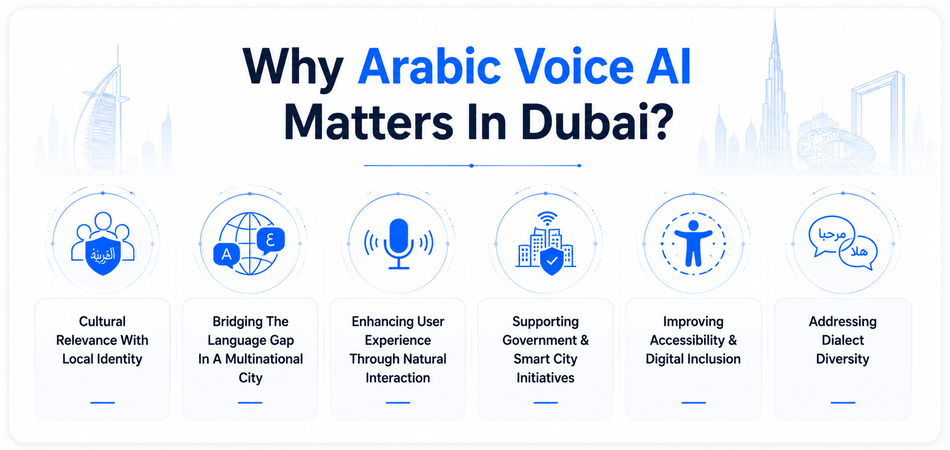
If you take a look at the demographics of Dubai, you will realise that there are so many nationalities and dialects. This demands the need to be catered to, which is why the Arabic voice AI on apps matters, and some other reasons explain it better through:
Cultural Relevance With Local Identity
Arabic is deeply tied to the roots of identity, governance, and daily communication in Dubai. As the demographics are mixed, a certain section of the population does speak English; however, a large population relies on Arabic for daily communication. This is why voice AI app development Dubai matters in the current day and age.
Closing The Language Gap In One Of The World’s Most Diverse Cities
Dubai is home to residents from more than 200 nationalities, so language barriers are a daily reality for businesses and users alike. Voice assistant apps help by letting people speak in their own language or dialect, including a mix of Arabic and English, which makes them a strong opportunity for entrepreneurs in Dubai.
Enhancing User Experience Through Natural Interaction
Replacing complex steps with simple and conversational interactions leads to an effective user experience. Now, searching for information, making payments, going through book recommendations, and more have become easier than ever. Therefore, the impact of Arabic voice AI on apps is making significant strides in the technology game.
Supporting Government & Smart City Initiatives
Making government processes simple, such as checking visa status and paying utility bills, Arabic voice AI in mobile apps does a great job. Hence, the services will be much faster, simpler, more efficient, and easily accessible to all.
Improving Accessibility & Digital Inclusion
Not every user shares the same ease with typing or maneuvering complex interfaces. Arabic voice AI enhances the reach of mobile applications for older individuals, those with impairments, and people with lower literacy skills. This is why the opportunity is immense, and you can hire a voice AI app development company UAE like Aarmeh.
Addressing Dialect Diversity
Arabic is not vast. It contains various regional variations like Gulf, Levantine, and Egyptian Arabic. In Dubai, Gulf Arabic holds particular significance, and people expect technology to understand these differences. This is why, to tackle such vast problems and understand minute nuances in Arabic, taking the assistance of AI mobile app development services UAE can be beneficial.
AI Voice Features For UAE Apps
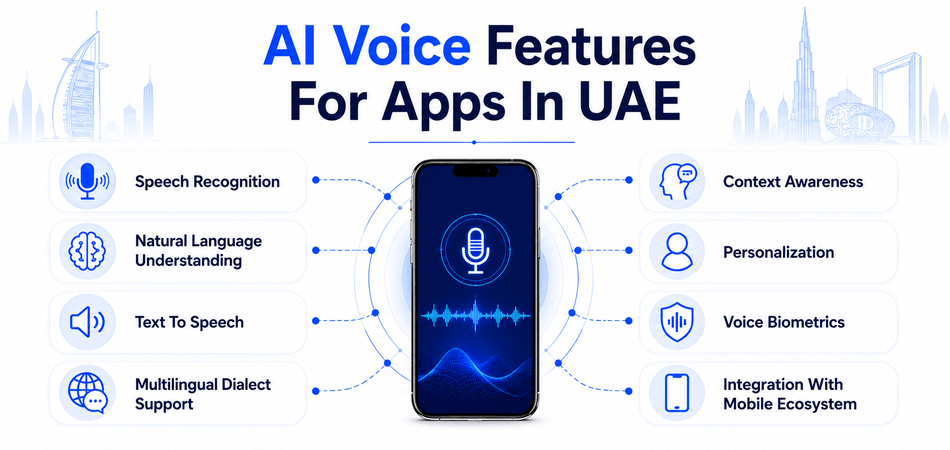
The AI voice features for UAE apps listed here are not experimental. On the contrary, these have been tried and tested and are generating meaningful outcomes. To employ these in your AI voice platform, taking the help of a mobile app development company in UAE is beneficial, who will provide:
Speech Recognition (Automatic Speech Recognition – ASR)
At the core, AI voice apps do the conversion from simple language to text. This is done seamlessly with the help of Automatic Speech Recognition. A strong and effective ASR system can:
- Understand different dialects and accents.
- Work in noisy environments.
- Processing speech in real time.
Natural Language Understanding (NLU)
After the speech is turned into text, the application must understand the user’s true meaning. Natural Language Understanding manages this through:
- Detect user intent.
- Interpret what the context is.
- Handle complex or conversational queries.
Text To Speech (TTS)
Voice AI involves more than just hearing; it also replies. Text-to-Speech transforms written replies into audio output that sounds genuine. Thus, Arabic NLP in mobile applications is capable of:
- Mimicking human tone and emotion.
- Support multiple languages and voices.
- Adjust speech and pitch for clarity.
Multilingual & Dialect Support
In regions such as Dubai, people often switch between Arabic and English within one sentence. Thus, understanding the multilingual and dialect support helps in:
- Conversations in two languages
- Blending of languages (code-switching)
- Recognition of regional accents
Context Awareness
Current Voice AI programs do not view every instruction separately. They retain the context throughout an exchange. For example:
User: “Book a table for two.”
Follow Up: “Make it at 8 PM.”
The platform understands that “it” relates to the initial reservation.
Personalization
Voice AI tools improve based on how users interact with them over time. They possess the ability to:
- Recommend services based on past actions.
- Recognize the taste of users.
- Adapt responses to individual needs.
Voice Biometrics
Protecting data is a primary concern for mobile applications, which are especially in the banking and finance segments. Therefore, voice biometrics offers applications the capability to:
- Identify users based on their voice.
- Preventing unauthorized access.
- Enable secure and password-free login.
Integration With Mobile Ecosystem
Voice AI doesn’t function in isolation – it connects with other apps and features. It’s able to combine with:
- Payment Gateways.
- GPS and Maps.
- Calendars & Reminders.
- Smart Home Devices.
Want these voice features in your app?
From Arabic speech recognition to dialect support, see how we build AI-powered mobile apps.
Countless Benefits of Voice AI In Mobile Apps
If you are on the verge but can’t come to a conclusion of whether to go or avoid AI applications for voice, it is better to look at what you are going to get from it. Therefore, the benefits of voice AI in mobile apps include:
Faster & More Convenient User Interaction
Instead of typing, scrolling, or navigating through multiple screens, users can go ahead and speak their requests. Processing commands in real time, making interactions quicker and more efficient, technologies like Automatic Speech Recognition make a lot of difference by:
- Reducing time spent on typing enables multitasking.
- Voice command allows quick task completion.
- Overall, platform efficiency and usability improve.
Hands Free Functionality
Using a platform that allows AI voice commands helps in multitasking, driving, cooking, and more. These AI voice features for UAE apps ease convenience and ensure safety in situations where manual work is key.
- Allows users to interact without touching the device.
- Useful during multitasking.
- Supports continuous interaction without interruptions.
Enhanced User Experience
When compared to traditional touch-based interfaces, voice interactions feel more comfortable. With the help of Natural Language Processing, applications have a much better idea of conversational language and respond intelligently. This better illustrates through:
- Reduces friction in completing tasks.
- Making the applications more intuitive and engaging.
- Manufactures natural and conversational interactions.
Improvement In Accessibility
Voice AI is crucial for broadening mobile app accessibility. Its advantages include:
- Users with visual impairments
- Elderly individuals
- Individuals with lower literacy skills
Multilingual Support
Current Voice AI platforms can accommodate numerous languages and even conversations blending different languages. This proves highly beneficial in international settings where users often transition between tongues.
- Accommodates several languages within a single application
- Permits smooth language transitions
- Manages conversations involving code-switching
Personalization & Smart Recommendations
Voice AI solutions evolve based on ongoing user interaction. They analyze inclinations, previous engagements, and usage habits to furnish customized replies and suggestions.
- Proposes pertinent offerings and information
- Adjusts feedback according to prior actions
- Boosts user contentment through customized service
Increased Efficiency of Businesses
Voice AI lessens reliance on manual customer assistance by automating replies to frequent inquiries. This enables companies to manage numerous requests concurrently while cutting down operational expenditures.
- Computerizes routine customer questions
- Decreases the requirement for extensive support staff
- Manages numerous users at once
Real Time Customer Support
Users receive prompt answers without having to wait for human assistance. This elevates the level of service and ensures support is accessible whenever required.
- Offers immediate replies around the clock
- Removes hold times for consumers
- Addresses typical problems rapidly
Aarmeh: The Best AI App Development Company In UAE
Are there any lingering doubts about how an Arabic AI voice assistant can be beneficial? After witnessing all the possible aspects of how you and the large parts of the population will benefit, coupled with the immense opportunity it possesses, it allows business owners to take the help of an expert mobile app development company in Dubai. Thus, in this endeavour, Aarmeh is the best platform to partner with because:
- 1400+ Mobile Apps Developed From Scratch
- 800+ Happy Clients
- 750+ Websites Developed
- 200+ Developers
- 50+ AI Solutions
- 869M+ Raised Through Developed Apps
Ready to build an Arabic voice-enabled app?
Share your idea and we’ll set up a discovery call, then send a detailed proposal.
When you get the best from your Arabic AI voice assistant, then why wait for a second? Let Aarmeh help you in your endeavour of entrepreneurship.
The Final Word
Arabic voice AI in mobile apps is more than just changing mobile applications in Dubai; it’s reshaping human-technology interaction. By merging language, cultural nuances, and artificial intelligence, it generates user journeys that feel organic, straightforward, and uniquely customised. In a metropolis fueled by progress and variety, this tech perfectly matches what users expect. Partnering with a mobile app development company in the UAE, especially the Dubai region, like that of Aarmeh, is an unstoppable team.
Frequently Asked Questions (FAQs)
Q. What is Arabic voice AI in mobile apps?
Arabic voice AI lets users speak to a mobile app in Arabic and get a spoken or on-screen response. It combines speech recognition, natural language understanding and text-to-speech so the app can understand requests, interpret intent and reply in natural-sounding Arabic.
Q. How does Arabic voice AI work in a mobile app?
It works in three steps. Automatic Speech Recognition (ASR) converts speech into text, Natural Language Understanding (NLU) detects the user’s intent and context, and Text-to-Speech (TTS) turns the app’s written reply into natural-sounding audio.
Q. Which Arabic dialects should a voice AI app support in Dubai?
Arabic has regional variations such as Gulf, Levantine and Egyptian Arabic. Gulf Arabic is particularly important in Dubai, and users expect voice AI to understand these differences and regional accents.
Q. Can voice AI handle users who mix Arabic and English?
Yes. Modern voice AI supports multilingual conversations and code-switching, where users move between Arabic and English within one sentence. This matters in Dubai, where bilingual speech is common.
Q. Why does Arabic voice AI matter in Dubai?
Dubai is home to people of more than 200 nationalities, and a large part of the population relies on Arabic for daily communication. Arabic voice AI makes apps culturally relevant, bridges language gaps and understands local dialects.
Q. How does voice AI improve mobile app accessibility?
Voice AI lets people use an app by speaking instead of typing or navigating complex screens. It helps elderly users, people with visual impairments and users with lower literacy levels.
Q. How can Arabic voice AI support government and smart city services?
Arabic voice AI can simplify tasks such as checking visa status and paying utility bills through spoken requests. This makes government services faster, simpler and accessible to more people.
Q. What is voice biometrics in mobile apps?
Voice biometrics identifies users by their voice. It helps prevent unauthorized access and enables secure, password-free login, which is especially useful in banking and finance apps.
Q. What can an Arabic voice assistant integrate with?
Voice AI can connect with payment gateways, GPS and maps, calendars and reminders, and smart home devices. It also keeps context during a conversation, so a follow-up like “make it at 8 PM” is linked to the earlier booking request.
Q. How big is the UAE AI apps market?
The UAE AI apps market generated about $33.5 million in revenue and is projected to reach $444.4 million by the end of 2030, a 48% CAGR from 2025 to 2030. Natural Language Processing was the largest revenue-generating AI segment in 2024, while Computer Vision was the fastest-growing.




 Book a call





 CLUTCH VERIFIED
 Top App Developer UAE
 100% NDA Protected
 IN THE HEART OF UAE