





Table of Contents
📌 Key Takeaways
- AI improves property search, valuation, and market analysis through machine learning, NLP, and predictive analytics.
- AI-powered tools streamline property management through predictive maintenance, chatbots, and automated document processing.
- AI supports data-driven investment decisions by helping businesses analyse rental demand, property performance, and potential costs.
- Successful AI implementation requires reliable data, strong security, system integration, and appropriate human oversight.
- Businesses should start with a focused AI solution, measure its performance, and scale gradually based on results and business needs.
AI is changing how real estate businesses operate, from helping buyers find suitable properties to making property management and maintenance more efficient. With features such as personalised recommendations, virtual tours, and predictive maintenance, real estate companies can better understand customer needs, simplify daily tasks, and make more informed decisions based on data.
As the real estate market becomes more competitive, developers, brokers, investors, and property managers are looking for smarter ways to improve customer experiences and manage their daily operations. This is particularly relevant in the UAE, where digital property platforms, smart buildings, and data-driven services are becoming an increasingly important part of the real estate industry.
This guide explores how AI works in real estate, its key applications and benefits, the types of solutions businesses can develop, implementation challenges, development costs, and future trends.
How Is AI in Real Estate Used Across the Property Lifecycle?
AI in real estate refers to the use of machine learning, natural language processing, computer vision, predictive analytics, and generative AI to automate tasks and support real estate decisions. These technologies analyse information such as property listings, transaction records, rental prices, building sensor readings, and customer preferences to identify patterns and generate useful insights.
For example, an AI-powered platform can recommend properties based on a buyer’s budget, preferred location, amenities, and previous searches. A property management system can analyse equipment data to identify potential maintenance issues before they cause costly breakdowns.
Real estate businesses can apply AI throughout the real estate lifecycle, from land acquisition and construction planning to sales, leasing, facility management, and investment analysis. The objective is not simply to automate existing tasks but to improve the speed, consistency, and quality of business decisions.
How Does AI in Real Estate Work?
AI systems combine real estate data, computational models, and business rules to produce recommendations, predictions, classifications, or automated actions. The technology used depends on the business problem, the available data, and the required level of accuracy.
Machine Learning for Property Analysis
Machine learning models learn patterns from historical and current data. In real estate markets, these models can analyse sale prices, rental yields, neighborhood characteristics, property age, amenities, and transaction history to estimate values or identify market trends.
For instance, a developer can use machine learning to compare the performance of residential projects across different locations. An investor can also assess which properties have characteristics associated with stronger rental demand, subject to market conditions and data limitations.
Natural Language Processing for Property Search
Natural language processing (NLP) enables systems to understand written or spoken requests. Instead of selecting multiple filters, users can search for properties using everyday language, such as “a two-bedroom apartment near the metro with parking and a balcony.”
The system interprets the request, identifies relevant criteria, and retrieves matching listings. NLP can also support document extraction, lease summarisation, customer query classification, and multilingual real estate search.
Computer Vision for Property Assessment
Computer vision enables AI systems to interpret images and videos. Real estate businesses can use it to identify visible real estate features, classify rooms, assess image quality, and detect certain types of visible damage.
A developer might use image analysis to categorise apartments by interior features, while a property manager could compare inspection photographs to identify changes over time. However, visual models cannot reliably assess every structural defect from photograph alone; physical inspections and specialist assessments may still be necessary.
Predictive Analytics for Market Forecasting
Predictive analytics uses historical data, statistical methods, and machine learning to estimate possible future outcomes. Real estate applications include rental demand forecasting, occupancy predictions, maintenance planning, and sales trend analysis.
These forecasts are useful for scenario planning, but they are not guarantees. Interest rates, government policies, economic conditions, infrastructure projects, and unexpected market changes can affect actual outcomes.
Real-time real estate analytics can help teams monitor changing listing activity, rental demand, and transaction signals, provided the underlying data is refreshed frequently enough.
Generative AI for Real Estate Operations
Generative AI can create or summarise text, answer questions, extract information from documents, and help employees prepare marketing materials. When connected to approved real estate databases, it can also support conversational search and internal knowledge assistants.
For example, a leasing team could use an AI assistant to draft real estate descriptions from verified listing details. Human review remains important to prevent fabricated amenities, incorrect pricing, unsupported claims, and misleading descriptions.
How Is AI in Real Estate Used Across Property Services?
Want These AI Features Built Into Your Real Estate App?
Bring real estate search, smart recommendations, virtual tours, and AI-powered management into one seamless experience.
The applications of AI extend across real estate discovery, sales, leasing, investment, and building operations. Businesses can adopt individual capabilities or combine them into a connected platform that supports multiple stages of the real estate lifecycle.
AI-Powered Property Search and Recommendations
Smart real estate search tools help users find suitable listings without manually reviewing hundreds of options. These systems consider factors such as budget, location, real estate type, amenities, commute preferences, and previous interactions.
AI buyer matching can connect prospective buyers with properties that align with their requirements. For example, a family searching for a three-bedroom apartment near schools may receive recommendations based on location, floor area, price, and nearby facilities.
AI-driven recommendations can also help agents identify promising leads, prioritise follow-ups, and suggest alternative properties when a listing does not meet a buyer’s budget. To remain useful, recommendations should explain relevant matching criteria and avoid unfairly excluding eligible customers.
AI-driven real estate technology should make recommendations traceable to relevant data and give staff a way to review uncertain or inappropriate results.
AI-powered CRM systems can connect lead histories, follow-up reminders, and customer communication records so agents can manage enquiries in one workflow.
Automated Property Valuation
Traditional valuation involves reviewing comparable transactions, property characteristics, location, market conditions, and other relevant factors. AI models can process these inputs at scale to estimate a property’s potential market value.
An AI-assisted property valuation system can help valuers compare similar properties, identify unusual price movements, and update estimates when new transaction data becomes available. It is particularly useful for large portfolios containing properties across multiple locations.
An AI-based smart valuation service should distinguish between estimated values and formal valuations. Its reliability depends on recent comparable sales, accurate real estate records, local market conditions, and appropriate human oversight.
Virtual Property Tours and AI Visualisation
Virtual viewing technology allows buyers and tenants to explore properties remotely through interactive 360-degree imagery, 3D walkthroughs, and digital staging. These tools are useful for international investors, relocating professionals, and customers who cannot visit a property in person.
Virtual property tours can help prospective buyers inspect layouts, room dimensions, and available amenities before arranging an in-person visit. More advanced systems can provide guided navigation and personalised room recommendations.
Immersive virtual property viewing can also help developers present planned projects before construction is complete. However, digitally staged furniture, proposed finishes, and simulated views should be clearly distinguished from actual real estate features.
Predictive Maintenance for Buildings
Property owners can use sensor readings, equipment histories, inspection reports, and maintenance records to identify potential faults before they result in major disruptions. Predictive maintenance models estimate when equipment may require attention based on observed patterns and operating conditions.
For example, an AI system may detect unusual vibration in an HVAC unit or a gradual increase in energy consumption. It can alert facility managers to inspect the equipment before a breakdown affects occupants.
These models work best when buildings have reliable sensor data and documented maintenance histories. They should complement, rather than replace, scheduled inspections and safety procedures.
AI Chatbots for Customer Support
AI chatbots provide round-the-clock assistance for common real estate-related questions. They can answer queries about availability, rental requirements, amenities, viewing appointments, and application procedures using information from approved databases.
Conversational assistants can also qualify leads by collecting budget ranges, preferred locations, and real estate requirements before routing inquiries to an agent. Multilingual support is particularly useful for businesses serving international customers.
For complex legal, financial, or contractual questions, chatbots should escalate the conversation to a qualified professional rather than generate unsupported answers.
Real Estate Investment and Risk Analysis
Investors often compare several properties based on purchase price, rental income, operating expenses, occupancy, financing costs, and expected resale value. AI can combine these variables to model alternative investment scenarios.
An investment platform may estimate rental yield, project cash flow under different occupancy assumptions, and flag properties whose financial performance differs from comparable assets. It can also help analysts identify concentrations of risk across a portfolio.
These outputs remain estimates rather than guaranteed returns. Interest rates, vacancies, unexpected expenses, and market volatility must be considered alongside model predictions.
Smart Property Management
AI-powered property management can bring maintenance requests, lease information, tenant communications, utility monitoring, and operational reports into one system. Automated workflows can assign service tickets, notify staff about overdue tasks, and summarise recurring issues.
For large portfolios, AI asset management can help owners prioritise inspections, compare property performance, and allocate maintenance budgets according to risk and operational importance.
A connected system may also track occupancy, utility usage, and service costs to identify inefficient buildings. Managers should retain control over important decisions affecting tenants, access, and property safety.
Automated Document Processing and Contract Analysis
Real estate transactions involve rental agreements, title documents, sale contracts, inspection reports, invoices, and compliance records. Document AI combines optical character recognition, language models, and extraction rules to convert these files into searchable information.
A document-processing workflow can identify contract dates, payment terms, renewal clauses, and missing fields. It can also flag inconsistent information for legal or administrative review.
AI-driven real estate technology can connect document extraction with listing, CRM, and property management workflows, provided access permissions and review processes are defined.
Automation reduces repetitive data entry, but extracted clauses should be checked against the original document. Contract interpretation and legal approval should remain with appropriately qualified professionals.
What Are the Key Benefits of AI in Real Estate?
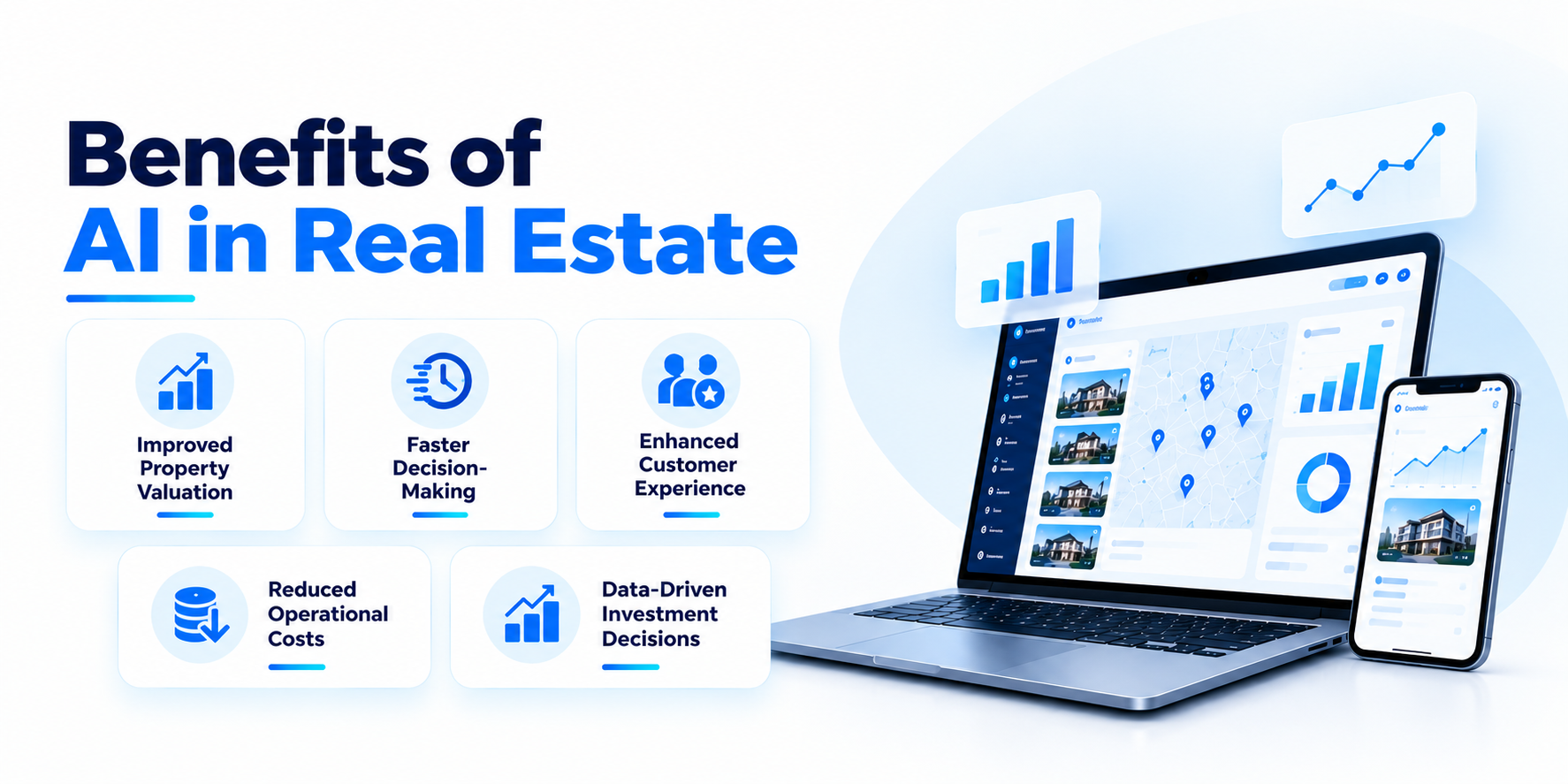
The value of AI in real estate depends on how well a solution addresses a measurable business problem. When implemented with reliable data and appropriate oversight, it can help property organisations improve service delivery, manage resources, and make more consistent decisions.
Improved Property Valuation
AI valuation models can evaluate large sets of comparable transactions and property characteristics more quickly than manual analysis alone. This helps agents, investors, and valuers prepare initial estimates and identify properties that need further investigation.
Faster Decision-Making
Automated reporting and real estate analytics can reduce the time spent collecting data from disconnected systems. Teams can compare locations, monitor rental trends, and evaluate investment scenarios through a shared dashboard.
Enhanced Customer Experience
Personalised search, conversational support, and remote viewing allow customers to explore suitable properties with less effort. Relevant recommendations can also reduce the number of unnecessary viewings and repetitive inquiries.
Reduced Operational Costs
Automating routine administrative work can reduce manual data entry, repetitive customer support, and inefficient maintenance scheduling. Actual savings depend on staff workflows, integration requirements, software fees, and the volume of tasks being automated.
Data-Driven Investment Decisions
AI can combine transaction histories, rental data, operating expenses, and market indicators to support portfolio analysis. Investors can use these insights to compare opportunities and test how different assumptions affect potential returns.
How Is AI in Real Estate Used Across Different Solutions and Applications?
Organisations can select a solution based on their users, operational needs, and existing technology infrastructure. The following table outlines common options.
| AI solution | Main capabilities | Suitable businesses |
| AI-powered mobile apps | Property discovery, personalised alerts, chat support | Brokers, property portals, agencies |
| Intelligent listing platforms | Search, listing classification, recommendations | Marketplaces, listing aggregators |
| AI property management software | Maintenance workflows, tenant support, reporting | Landlords, property managers |
| Predictive analytics platforms | Valuation estimates, demand forecasting, portfolio analysis | Developers, investors, analysts |
| Conversational AI assistants | Lead qualification, FAQs, document-based answers | Agencies, leasing teams, developers |
| Smart building and IoT systems | Equipment monitoring, energy analysis, fault alerts | Facility operators, commercial landlords |
AI-Powered Real Estate Mobile Apps
Mobile applications can provide real estate discovery, location-based search, saved listings, appointment scheduling, and AI-powered assistance in one interface. Features may also include mortgage calculators, document uploads, and notifications when relevant properties become available.
Real Estate App Development is worth considering when customers need these discovery and engagement features in a dedicated mobile experience rather than only through a website.
The most useful app features depend on the target audience. A rental app may prioritise availability and viewing schedules, while an investment app may focus on financial metrics, comparable properties, and portfolio performance.
Intelligent Property Listing Platforms
These platforms use machine learning and NLP to improve listing classification, identify duplicate entries, and match user searches with relevant properties. Computer vision can also help categorise real estate photographs and flag images that may not meet listing requirements.
A well-designed platform should display verified listing information, indicate when data was last updated, and give users meaningful filters alongside AI-generated results.
AI-Based Property Management Software
Property management software can combine tenant records, lease administration, service requests, maintenance schedules, and financial reporting. AI features may identify recurring repair issues, classify incoming requests, and estimate equipment failure risks.
Predictive Analytics Platforms
Analytics platforms help developers and investors evaluate market conditions, compare locations, forecast rental demand, and monitor portfolio performance. Users should be able to inspect the data behind important forecasts and understand the assumptions that influence results.
Virtual Assistants & Conversational AI
Conversational AI can support real estate searches, tenant inquiries, internal employee questions, and lead qualification. Connecting the assistant to approved databases makes its responses more relevant, while access controls help protect confidential information.
Smart Building & IoT Solutions
IoT sensors collect information about temperature, air quality, energy consumption, occupancy, and equipment performance. AI models can analyse these readings to recommend operating adjustments, detect unusual patterns, and support maintenance planning.
For complex properties, an AI building classification framework can organise assets by building type, use, equipment, risk level, and maintenance needs. Consistent classifications make it easier to compare buildings and apply appropriate operational rules.
Residential Property Sales & Rentals
Residential agencies can use personalised search, automated lead qualification, price estimates, and viewing recommendations to improve the customer journey. Landlords can also use analytics to compare rental performance and identify properties that may require changes to marketing or maintenance strategies.
Real estate AI fraud checks can flag suspicious listing patterns, duplicated photographs, inconsistent real estate details, or unusual transaction signals for human review; they should not be treated as proof of fraud on their own.
Commercial Real Estate Management
Commercial property operators manage offices, retail spaces, warehouses, and mixed-use developments. AI can analyse occupancy, utility consumption, maintenance records, and lease data to help operators allocate resources and understand building performance.
Real Estate Investment & Portfolio Management
Investors can use AI to compare assets across multiple locations, estimate potential cash flow, and identify properties with unusual operating costs. Portfolio-level dashboards can highlight exposure to particular real estate types, tenants, or geographic markets.
Construction & Property Development
Developers can apply AI to project scheduling, construction progress monitoring, cost estimation, and design analysis. Computer vision may compare site photographs with planned progress, while predictive models can help identify scheduling risks.
The accuracy of these applications depends on current project records and the quality of the underlying data. AI-generated estimates should be reviewed by project managers and technical specialists.
Facility Management & Smart Buildings
AI can help facility teams monitor HVAC systems, elevators, lighting, energy usage, and service requests. By identifying abnormal equipment behavior, the system can help prioritise inspections and reduce avoidable disruptions.
A practical deployment connects sensor data with maintenance records and work-order systems, allowing managers to track whether alerts lead to successful interventions.
How Is AI in Real Estate Shaping Government Initiatives and Regulatory Compliance in the UAE?
The UAE’s real estate sector is increasingly embracing digital technologies, with Dubai focusing on innovation, technology adoption, and data-driven services. The Dubai Land Department (DLD) is supporting this shift through initiatives linked to the Dubai Economic Agenda D33 and the Dubai Real Estate Strategy 2033. The strategy aims to increase the sector’s contribution to Dubai’s GDP to approximately AED 73 billion and grow the market’s value to AED 1 trillion.
In February 2026, Dubai hosted PropTech Connect Middle East under DLD’s supervision. The event brought together real estate professionals, investors, technology providers, and government representatives to explore new developments in the sector, including the role of AI. Discussions also highlighted the importance of transparency, governance, and responsible technology adoption as digital solutions become more common in real estate.
Businesses planning to use AI in property platforms should consider data protection and advertising requirements early in the development process. The rules that apply will depend on where the business operates, the data it handles, and the nature of its activities. Relevant frameworks may include:
-
UAE Personal Data Protection Law (Federal Decree-Law No. 45 of 2021):
Sets requirements for processing and protecting personal data within its scope.
-
DIFC Data Protection Law No. 5 of 2020, as amended:
Applies to relevant organisations and data processing activities within the Dubai International Financial Centre.
-
ADGM Data Protection Regulations 2021:
Cover eligible organisations and personal data processing activities within Abu Dhabi Global Market’s regulatory scope.
Since these frameworks have different scopes, businesses should confirm which requirements apply to their operations with qualified legal counsel before deploying an AI system.
Advertising is another area that needs attention, particularly in Dubai, where property advertisements may require permits from the relevant DLD/RERA authorities. AI-generated listing descriptions, promotional content, and digitally staged property images should be checked for factual accuracy and compliance before publication. These checks help ensure that AI-generated material does not misrepresent a property or mislead potential buyers and tenants.
Considering these requirements during planning can help real estate businesses adopt AI more responsibly while supporting operational efficiency, customer experience, data privacy, and accurate property advertising.
What Are the Key Challenges of Implementing AI in Real Estate?
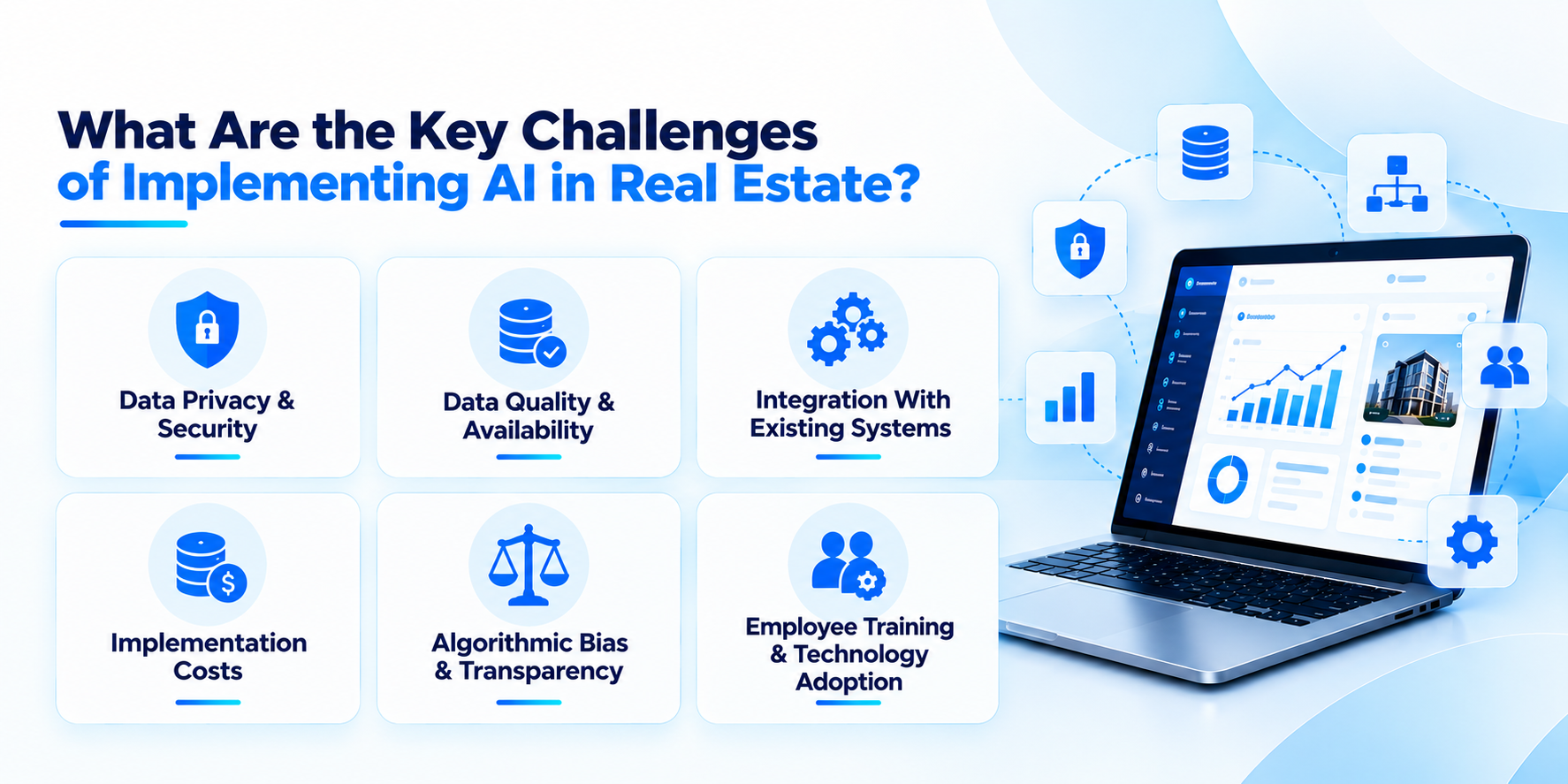
Although AI can improve real estate operations, implementation requires careful planning. Businesses should assess technical constraints, data quality, legal responsibilities, and employee readiness before deploying a solution.
Data Privacy & Security
Real estate platforms may process identity documents, contact details, lease agreements, payment information, and financial records. These data require appropriate access controls, encryption, retention policies, and secure integrations.
Organisations operating in the UAE should assess applicable data protection requirements, including relevant federal and free-zone rules, before deciding how information can be collected, stored, and processed.
Data Quality & Availability
Incomplete real estate records, outdated listings, inconsistent addresses, and missing transaction details can reduce model accuracy. Businesses should establish data validation rules, standardise real estate identifiers, and define how frequently records must be updated.
Integration With Existing Systems
Real estate companies may already use CRM platforms, listing portals, accounting software, building management systems, and property management tools. AI applications must integrate with these systems without disrupting critical workflows.
Implementation Costs
Development expenses include data preparation, model selection, software engineering, integrations, testing, deployment, and ongoing maintenance. Costs rise when a project requires custom predictive models, complex legacy integrations, large datasets, or specialised security controls.
Algorithmic Bias & Transparency
Historical real estate data may reflect existing market inequalities or incomplete coverage. Models can reproduce those patterns if training data and evaluation procedures are not carefully designed.
Businesses should test model performance across relevant real estate categories and user groups, explain significant recommendations where possible, and provide human review for consequential decisions.
Employee Training & Technology Adoption
Employees need to understand how to use AI tools, verify generated information, recognise model limitations, and escalate uncertain cases. Training should focus on real workflows rather than technology alone.
How Can Businesses Implement AI in Real Estate Successfully?
Implementing AI in real estate through a phased approach allows businesses to validate use cases before committing to a larger investment. By testing a focused solution, measuring its performance, and addressing data or integration issues early, organisations can reduce implementation risks and make better-informed decisions about future expansion.
-
Identify business needs and goals
Define the problem the system should solve, such as slow lead response, inaccurate initial valuations, repeated maintenance issues, or inefficient listing searches. Establish measurable baseline performance.
-
Select the right AI use cases
Prioritise use cases with clear business value, sufficient data, manageable risks, and achievable implementation requirements. Start with a focused pilot rather than automating every department.
-
Prepare & organise real estate data
Clean duplicate records, verify real estate attributes, standardise addresses, and establish data access permissions. Document where information originates and when it was last updated.
-
Choose suitable AI technologies
Select machine learning for forecasting, NLP for conversational search, computer vision for image analysis, or generative AI for document and content workflows. Not every business problem requires a custom model.
-
Develop & integrate the solution
Build the user interface, APIs, data pipelines, AI components, security controls, and integrations. Connect the system to existing real estate databases and business applications where appropriate.
-
Test performance & accuracy
Evaluate predictions against known outcomes, check search relevance, test security, and review incorrect or biased outputs. Run a pilot with real users before a full rollout.
-
Monitor results & optimise
Track accuracy, response times, user engagement, operating costs, and business outcomes. Update models and workflows as data, market conditions, and user requirements change.
How Much Does AI in Real Estate Cost to Develop?
Planning to Build an AI-Powered Real Estate Solution?
Discuss your project requirements, development costs, and the right AI features with our experts
The cost of developing AI software for real estate depends on the scope of the product, the availability of data, the required AI capabilities, and the complexity of integrations. A focused AI feature within an existing platform generally requires less investment than a complete real estate marketplace with personalised recommendations, analytics, and automated workflows.
The following figures are illustrative planning estimates in USD, not verified market averages or vendor quotations. Actual costs differ significantly by development location, team structure, project requirements, and procurement model.
Factors Affecting AI Development Costs
-
Solution complexity:
A basic chatbot differs considerably from a platform combining valuation, forecasting, and image analysis.
-
Data preparation:
Cleaning, labeling, validating, and organising real estate records can require substantial effort.
-
AI model requirements:
Existing APIs may be sufficient for common tasks, while specialised predictions may need custom training.
-
Integrations:
Connecting listing databases, CRM systems, payment services, and building management tools adds engineering work.
-
Security & Compliance:
Sensitive property & customer information may require additional controls, testing, and documentation.
-
Maintenance:
Models, third-party services, real estate data, and software dependencies need ongoing monitoring & updates.
Cost of Different AI Real Estate Solutions
| Solution type | Illustrative development cost (USD) | Estimated timeline |
| AI chatbot or FAQ assistant | 5,000–20,000 | 3 – 6 weeks |
| AI-enhanced real estate search | 10,000–35,000 | 4 – 10 weeks |
| Property recommendation engine | 15,000–50,000 | 6 – 12 weeks |
| AI valuation prototype | 20,000–60,000 | 6 – 14 weeks |
| Predictive maintenance solution | 25,000–80,000 | 8 – 16 weeks |
| AI-powered property management platform | 30,000–100,000+ | 10 – 24 weeks |
| Integrated real estate AI platform | 75,000–250,000+ | 4 – 9+ months |
Estimates assume a defined scope and a development team with relevant technical expertise. Timelines may overlap with data preparation and integration work. Enterprise-scale deployments can exceed these ranges.
Ongoing Maintenance & Optimisation Costs
AI systems need continued support after launch. Typical expenses may include cloud hosting, API usage, monitoring, data updates, model evaluation, bug fixes, security patches, and feature improvements.
| Cost category | What it covers |
| Hosting and infrastructure | Servers, databases, storage, and computing resources |
| AI service usage | Model API calls, inference, and usage-based charges |
| Monitoring and evaluation | Performance checks, error analysis, and model drift detection |
| Software maintenance | Fixes, dependency updates, and security improvements |
| Data management | Data refreshes, validation, and labeling when required |
For early budgeting, a business might provision approximately 15–25% of the initial development cost annually for routine maintenance and optimisation. This is a planning assumption, not a universal industry benchmark; high-usage applications, substantial cloud infrastructure, and frequent model retraining can require more.
A real estate business should also account for internal staff time, third-party licensing, taxes, and any required data-provider subscriptions.
What Does the Future of AI in Real Estate Look Like?
The next phase of real estate technology will focus on connecting AI with real estate data, building infrastructure, customer-facing platforms, and business workflows. These developments may improve automation & personalisation, although their commercial value will depend on implementation quality and customer adoption.
Generative AI for Real Estate Marketing
Generative AI can help create real estate descriptions, listing summaries, email campaigns, and multilingual marketing content. It can also assist with virtual staging and presentation materials for proposed developments.
Businesses should verify real estate details and disclose significant digital alterations to avoid misleading buyers or tenants.
AI Agents for Real Estate Workflows
AI agents can coordinate multiple steps within a defined workflow. For example, an assistant might collect a buyer’s requirements, search approved listings, prepare a shortlist, and suggest available viewing slots.
Such systems need clear permissions, reliable data access, and approval checkpoints before taking consequential actions, such as changing a listing or sending contractual communications.
Digital Twins & Smart Buildings
Digital twins are virtual representations of physical buildings that can incorporate information from sensors, building plans, equipment records, and operational systems. AI can analyse this information to help operators understand building performance and simulate selected operational scenarios.
These systems may be particularly useful for complex commercial buildings, large residential developments, and portfolios with substantial facility management requirements.
Advanced Predictive Analysis
Future analytics platforms may combine transaction records, rental trends, economic indicators, infrastructure developments, and building performance data. This can help businesses compare scenarios and identify changes in demand.
Predictions should include relevant assumptions and uncertainty ranges, especially when used for investment or development decisions.
AI-Powered Sustainable Property Management
AI can help optimise heating, ventilation, cooling, lighting, and equipment schedules using occupancy patterns and sensor data. These adjustments may reduce energy waste while maintaining suitable indoor conditions.
Performance should be measured against actual energy consumption, operating costs, and occupant comfort rather than relying exclusively on estimated savings.
Personalised Property Buying Experiences
Property platforms are likely to offer more conversational and context-aware experiences. Buyers may be able to describe their requirements in natural language, compare shortlisted homes, and receive explanations of how each property matches their preferences.
Personalisation should remain transparent and allow users to adjust their preferences instead of limiting choices based on opaque assumptions.
How Do You Choose the Right AI in Real Estate Development Partner?
Choosing a development partner requires more than comparing quotations. Businesses should assess whether the team understands real estate workflows, can handle sensitive data, and has the technical capabilities to build and maintain the proposed solution.
Industry Experience & Technical Expertise
Look for experience in real estate marketplaces, real estate management systems, valuation tools, analytics platforms, or related business applications. Review relevant case studies to
understand what was delivered, how the system works, and which results were measured.
AI Integration Capabilities
A suitable partner should be able to explain the proposed architecture, data requirements, model selection, and integration strategy. Ask whether an existing AI service can meet the requirement or whether a custom model is justified.
An AI Development Company should also explain how the solution will be tested, monitored, secured, and maintained after launch.
Data Security & Compliance
Assess the partner’s approach to encryption, authentication, role-based access, data retention, audit logs, and third-party services. For UAE deployments, confirm that the solution accounts for applicable data protection and sector-specific requirements.
Scalability & Post-Launch Support
The platform should accommodate increasing listing volumes, user activity, data processing needs, and additional AI features. Confirm the scope of maintenance, monitoring, model updates, incident response, and technical documentation.
Transparent Pricing & Project Timelines
Request a breakdown of discovery, design, development, integration, testing, deployment, and ongoing support costs. Clarify assumptions, exclusions, deliverables, ownership of source code, and acceptance criteria before signing an agreement.
For a business seeking a mobile app development company in Dubai, the evaluation should also cover local market understanding, Arabic and English support where needed, and the ability to maintain the app after release.
A qualified property AI consultant should be able to explain the trade-offs between different approaches, identify implementation risks, and recommend a phased roadmap aligned with business priorities.
For developers and investors evaluating AI real estate developers UAE, compare relevant real estate-sector experience, integration capability, data-security practices, and post-launch support rather than relying on broad claims alone.
Conclusion
AI in real estate is creating new ways for businesses to manage real estate information, personalise customer experiences, evaluate investment opportunities, and maintain buildings. Applications such as automated valuation, conversational real estate search, predictive maintenance, and document processing can improve existing workflows when supported by reliable data and appropriate oversight.
However, successful implementation requires more than adding an AI model to a website or application. Businesses need a clearly defined use case, dependable data, secure integrations, measurable performance indicators, and processes for reviewing AI-generated outputs.
The most effective approach is to begin with a specific operational challenge, test a focused solution, measure the results, and expand gradually. With this strategy, real estate organisations can adopt intelligent technology while keeping business goals, customer trust, and long-term operational requirements at the center of their decisions.
Frequently Asked Questions (FAQs)
Q. How Is AI Used in the Real Estate Industry?
AI is used for real estate search, personalised recommendations, automated valuation, virtual tours, predictive maintenance, customer support, investment analysis, document processing, and building operations. The appropriate application depends on the business objective and the data available.
Q. What Are the Main Benefits of AI in Real Estate?
Key benefits include faster data analysis, more relevant property recommendations, improved initial valuation estimates, streamlined administrative work, better maintenance planning, and more informed investment decisions. Actual results depend on implementation quality and the suitability of the underlying data.
Q. Can AI Predict Property Prices Accurately?
AI can estimate property prices by analysing comparable transactions, real estate attributes, location, rental performance, and market indicators. Accuracy varies by location, real estate type, data quality, and market volatility. Estimates should be validated against reliable transaction data and reviewed by qualified professionals where necessary.
Q. How Much Does It Cost to Develop an AI Real Estate App?
A focused AI feature or simple application may cost approximately $5,000–$20,000, while a more comprehensive AI-enabled real estate platform can cost $30,000–$100,000 or more. Complex integrated platforms may exceed $250,000. These are illustrative estimates; the final budget depends on functionality, integrations, data preparation, security, and maintenance requirements.
Q. Will AI Replace Real Estate Agents?
AI is more likely to automate selected repetitive tasks than eliminate the need for real estate agents entirely. Agents continue to provide negotiation, relationship management, local market knowledge, property visits, and professional judgment. AI can support these activities by reducing administrative work and improving access to relevant information.
Q. Is AI Useful for Small Real Estate Businesses?
Yes. Smaller agencies can start with relatively accessible tools such as AI-assisted listing descriptions, customer support chatbots, lead qualification, and personalised property recommendations. Starting with a narrowly defined problem can make adoption more manageable than building a fully customised platform immediately.
Q. What Is the Future of AI in Real Estate?
Future applications may include AI agents that coordinate workflows, digital twins for building operations, more advanced real estate analytics, personalised buying experiences, and AI-assisted sustainability management. Adoption will depend on data availability, integration costs, regulation, and demonstrable business value.





 Book a call



 CLUTCH VERIFIED
 Top App Developer UAE
 100% NDA Protected
 IN THE HEART OF UAE