





Table of Contents
📌 Key Takeaways
- The digital wallet market was valued at $4.18 Billion in 2024 and is projected to reach $8.28 Billion by 2030.
- The industry is expected to grow at a 12.12% CAGR, driven by digital transformation and increasing smartphone adoption.
- Government initiatives promoting a cashless economy are accelerating the adoption of digital wallet solutions across the UAE.
- The estimated cost to develop a digital wallet app in Dubai ranges from AED 73,500 to AED 1,101,800+ ($20,000–$300,000+), depending on complexity and features.
- A basic digital wallet app typically costs between AED 73,500 and AED 146,900 and takes around 3–5 months to develop, while medium and advanced apps require higher budgets and longer development timelines.
Are you looking for a digital wallet app and don’t know what to do? If you look at this market, it is currently valued at $4.18 Billion in 2024, and the digital wallet industry is anticipated to hit $8.28 Billion by 2030, growing at a compound annual rate of 12.12%. This rise is driven by growing digitisation, broad smartphone usage, and robust public sector efforts to encourage cashless systems. Therefore, I can sense some opportunity brewing, don’t you as well?
But a factor that irritates entrepreneurs in the Middle East region, especially the UAE, is the cost of such apps. That is why in this blog, we will explore the digital wallet app development cost in the UAE, the factors that affect it, and other aspects that are related to it.
Understanding The Digital Wallet App Market Size In The UAE
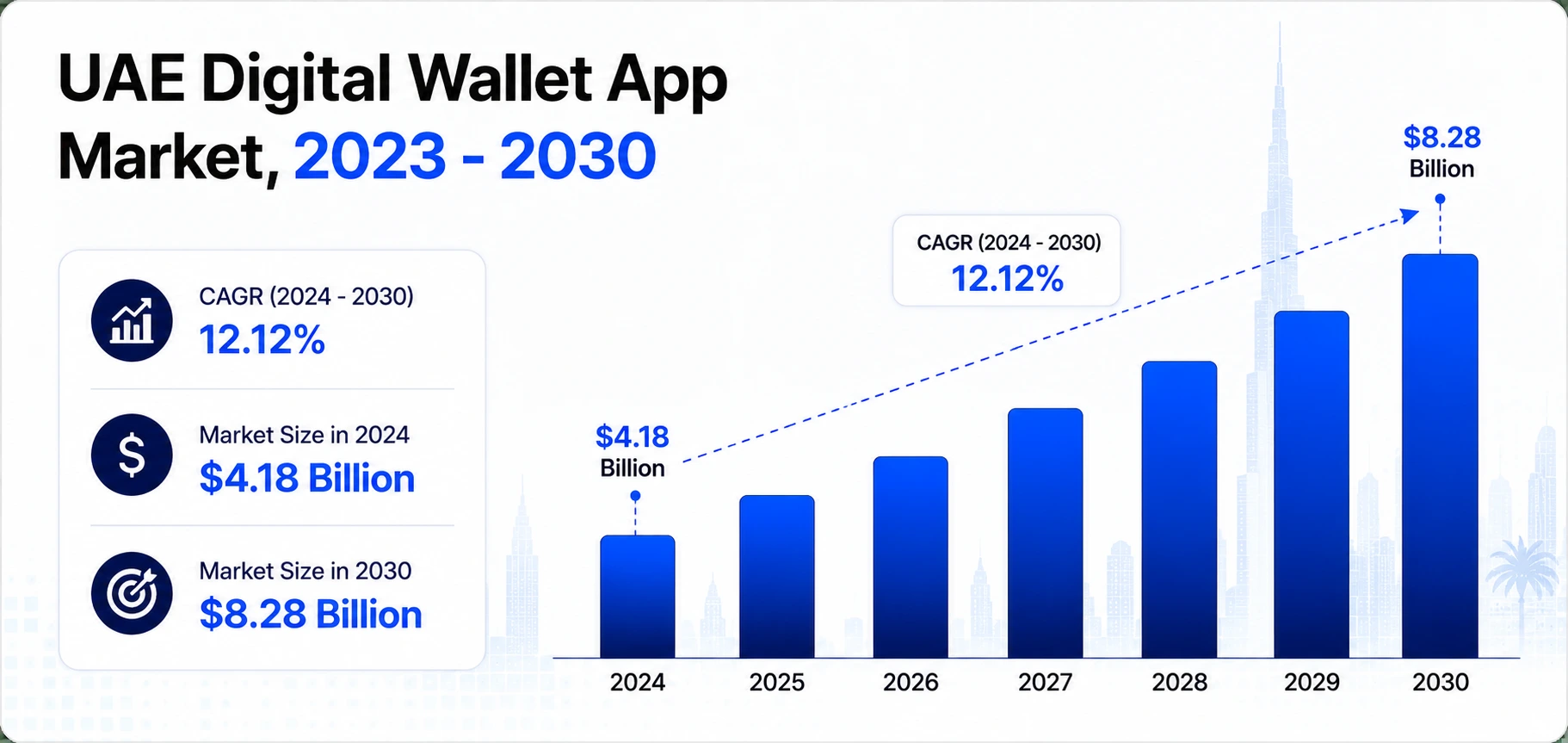
Do you know what the digital wallet market size was in 2024? It was valued at $4.18 Billion. This means the current market size is in Billions. However, it is expected to reach $8.28 Billion by 2030, rising at a CAGR of 12.12%. This level of growth is driven by the rapid rise in digitalisation, high smartphone penetration, and strong government push towards a cashless economy. Hence, when the opportunity is this immense, it makes sense to partner with a mobile app development company in UAE like Aarmeh.
Cost To Build A Digital Wallet App
Want to know the cost of your digital wallet app? It typically ranges from AED 73,500 to AED 1,101,800+ or $20,000 to $300,000+. Take a look at the range of costs, so you can build a budget around it. Thus, the cost looks like this:
| App Type | Estimated Cost (AED) | Estimated Cost (USD) | Estimated Cost (SAR) | Estimated Time |
| Basic Wallet App | AED 73,500 – AED 146,900 | $20,000 – $40,000 | SAR 75,200 – SAR 150,300 | 3 -5 Months |
| Mid-Level Wallet App | AED 146,900 – AED 367,300 | $40,000 – $100,000 | SAR 150,300 – SAR 375,700 | 5 – 8 Months |
| Advanced Wallet App | AED 367,300 – AED 1,101,800+ | $100,000 – $300,000+ | SAR 375,700 – SAR 1,127,000+ | 8 – 12 Months |
These Factors Affect The Cost of Your Digital Wallet App
The cost of developing a digital wallet platform fluctuates greatly, which is influenced by a number of technical, commercial, and legal factors. Entrepreneurs often focus on the final budget without understanding what drives the overall expenditure. Every choice, from the application’s complexity and the security needs to integrating third-party requirements and platform selection, every decision impacts the development cost.
1. Complexity of The App
A simple digital wallet app, capable only of basic money transfers, will demand less development time than an advanced fintech solution that provides advanced functionalities like cryptocurrency dealings, vendor payments, and AI-driven fraud prevention. Therefore, some of the factors that affect it include:
- Number of features and functionalities
- Peer-to-peer payment capability
- Merchant payment systems
- Loyalty and rewards program
2. What Is The Platform Chosen?
Selecting the appropriate platform is a crucial business choice that directly influences development costs. You have the option to build a digital wallet app for Android, iOS, or both. While developing for a single system, it reduces initial expenses, targeting both operating systems and expands market reach. Our digital wallet app development services will help you with:
- Native iOS development
- Native Android development
- Cross-platform development
- Operating system updates
3. UI/UX Design
The user experience is especially important in fintech applications because users need to trust the platform with their financial information. A digital wallet mobile app development company will help you streamline transactions, boost customer loyalty, and elevate general user contentment through:
- Interactive prototypes
- User journey mapping
- Accessibility optimisation
4. Security Features
Given that users keep sensitive financial and personal data within the application, companies need to make sure to implement robust security protocols. This keeps away elements like fraud, data breaches, unauthorised access and keeps the user content. And also as a part of digital wallet web app development, Aarmeh does:
- End-to-end encryption
- Two-factor authentication
- Secure API architecture
- Fraud detection systems
5. Third Party Integrations
Integrating payment gateways, bank APIs, alert systems, and validation services requires the help of a mobile app development company for further development and validation endeavours. The quantity and complexity of these integrations can significantly impact the overall project funding, which is why we help you with:
- Payment gateways
- SMS and OTP services
- Email notification systems
- Analytics platform
6. Compliance & Regulatory Requirement
Following regulations often involves legal advice, record-keeping, security assessments, and specialised development work. So, these requirements add to the project budget but are necessary for operating legally and building consumer confidence. So, as a digital wallet app development company, Aarmeh does:
- Financial licensing requirements
- Follows data privacy regulations
- Do security audits
- Risk management systems
Cost To Develop A Digital Wallet App For iOs v/s Android
When you are in the process of development or have asked a mobile app development company to do so, it is the best time to know where to launch your software. Majorly, 2 platforms dominate this: iOS and Android. So, let’s take a look at the table from the context of a digital wallet app cost:
| Platform | Development Cost (USD) | Development Cost (AED) | Development Cost (SAR) |
| iOS | $30,000 – $100,000+ | AED 110,200 – AED 367,300+ | SAR 112,700 – SAR 375,400+ |
| Android | $30,000 – $90,000+ | AED 110,200 – AED 330,600+ | SAR 112,700 – SAR 337,900+ |
As you can see, the cost of manufacturing an e-wallet application in the UAE will cost around AED 110,200 to AED 367,300+ for iOS and AED 110,200 to AED 330,600+ for Android. Knowing such costs beforehand gives you a brief idea about what is about to come your way.
User Centric Features For A Digital Wallet App
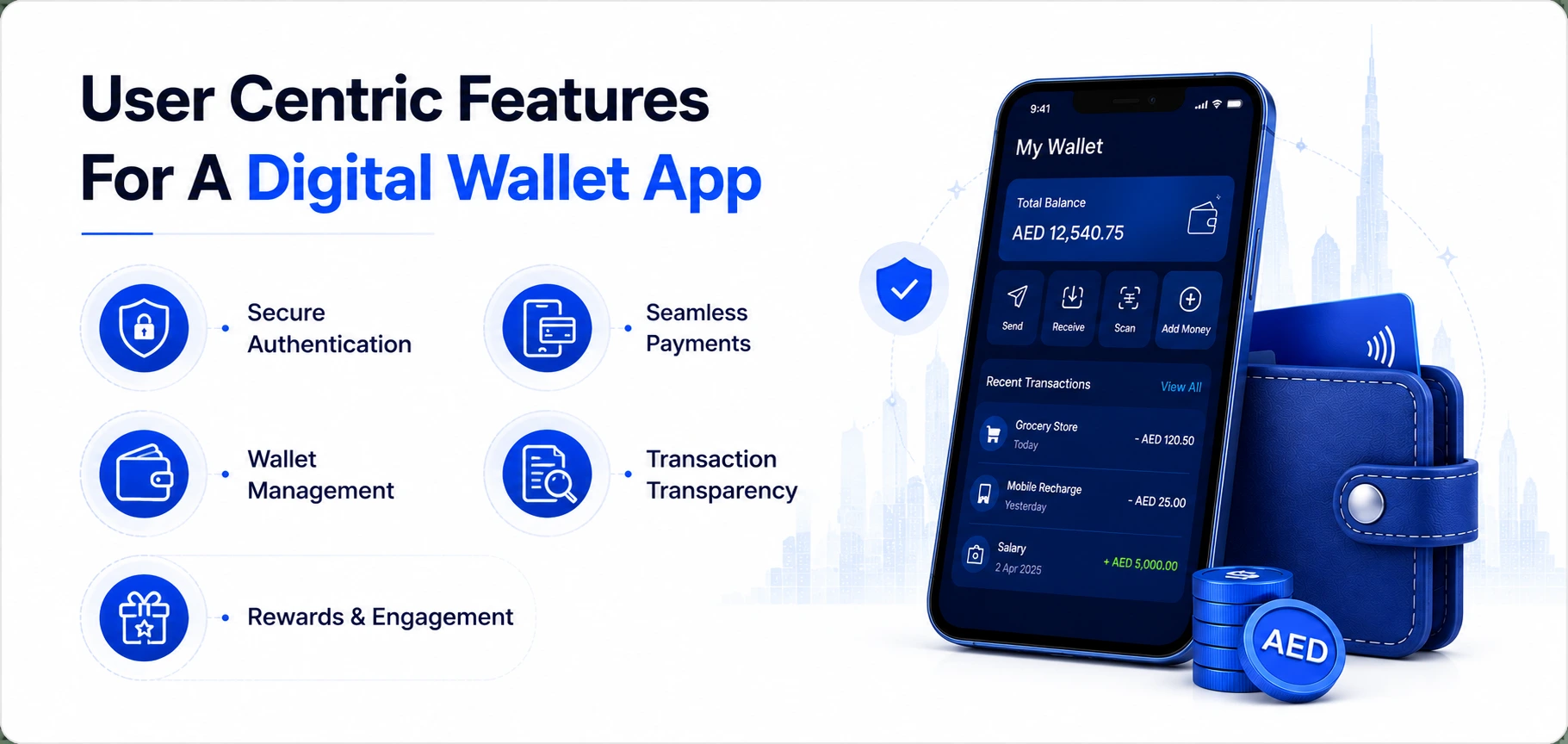
When building a digital wallet application, prioritise user-focused functionalities that give attention to ease of use, safety, clarity, customisability, and enabling financial control. To understand them, below are some features of a digital wallet app:
1. Secure Authentication
The app needs to integrate biometric login options like fingerprint scanning and facial recognition, coupled with multi-factor authentication (MFA) for superior security. Users need to be able to view current sessions and linked devices, with the capability to disconnect from any unrecognised devices remotely.
- Biometric login (fingerprint, Face ID)
- Multi-factor authentication (MFA)
- Device binding and trusted device management
- Real-time fraud detection alerts
2. Seamless Payments
This surrounds sending money between individuals, payments via QR codes, contactless transactions using NFC, settling payments with merchants, paying bills, and international money transfers. Individuals should also be able to ask for payments from friends, relatives, or clients, which is why our mobile app development company in UAE offers comprehensive solutions:
- QR code payments
- NFC/Contactless payments
- Bill and utility payments
- Request money feature
3. Wallet Management
The wallet should support multiple funding sources like bank accounts, debit cards, credit cards, and other accepted payment methods. Users should be able to add funds, withdraw balance amounts, track account activity, and arrange for recurring payments.
- Add and withdraw funds easily.
- Balance overview dashboard
- Scheduled and recurring payments
- Multiple funding sources (bank accounts, cards, and other payment methods)
4. Transaction Transparency
Users will get immediate notifications for all wallet actions and have access to transaction records they can search, featuring sophisticated filtering capabilities. Downloadable account summaries and spending reports should also be provided for personal tracking and financial oversight.
- Real-time transaction notifications
- Detailed transaction history
- Search and filter transactions
- Spending insights and reports
5. Rewards & Engagement
These might involve cashback programs, loyalty points accumulation, referral incentives, promotional offers, and milestone-based achievements. Moreover, personalised rewards based on user preferences and transaction history can encourage greater adoption while powering customer loyalty and satisfaction.
- Cashback programs
- Loyalty points tracking
- Gamified savings challenges
- Achievement badges and milestones
Aarmeh Follows This Digital Wallet App Development Process
Developing a successful digital wallet application involves more than just programming and aesthetics. It requires strategic planning, regulatory awareness, robust security measures, and a deep understanding of user expectations. At Aarmeh, we use a systematic creation process that guarantees each digital wallet offering is protected, scalable, and in sync with business objectives.
1. Discovery & Requirement Analysis
Throughout discovery and requirement analysis, Aarmeh collaborates closely with you to define core features, identify goals, analyse competitors, and establish a clear product roadmap. This strategic groundwork helps in preventing expensive changes later in the development timeline.
2. UI/UX Design & Prototyping
Our developers offer smooth user interactions that streamline monetary exchanges while upholding a polished and guarded interface. Interactive mockups allow you to visualise the application before development begins. That is why it is important to opt for digital wallet app development services.
3. Frontend & Backend Development
Following the completion of the planning and design stages, our developers begin a new project on constructing the application. Front-end development concentrates on developing an adaptive and captivating user journey, while back-end development drives transaction handling, customer administration, and operational activities.
4. Quality Assurance & Testing
Before the release, the application undergoes a thorough assessment to detect and address any potential issues. We test every component of the platform to ensure optimal performance, reliability, and security across different devices and operating systems.
5. Deployment & Launch
Following successful validation, we prepare the application for distribution. Our group oversees the rollout procedure, ensuring the app is correctly set up, published, and fine-tuned for app marketplaces and operational settings.
6. Post Launch Maintenance & Support
Releasing the app marks just the initial step. Ongoing observation, software revisions, and enhancements are crucial for preserving safety, backing commercial expansion, and elevating the user journey. Aarmeh provides ongoing support so that your app reaches the natural conclusion, and hence, our digital wallet app development process is complete.
How Long Does It Take To Build A Digital Wallet App?
In the quest to develop the best digital wallet app and make it viable in the UAE, two factors are important: cost and time. Here, we will be talking about the time aspect.
| App Type | Development Timeline (Estimated) |
| Basic Wallet App | 3 – 5 Months |
| Medium Level Wallet App | 5 – 8 Months |
| Advanced Level Wallet App | 8 – 12 Months |
Now, you know the estimated development timeline of your e-wallet platform. However, it is important to know the factors that make this happen. Thus, some of the major factors include:
- Complexity of the features
- Third-party API integrations
- Security implementation
- Regulatory compliance requirements
- UI/UX design scope
- Testing and quality assurance
- App Store and Play Store approvals
Hidden Costs of Digital Wallet App Development
There are a number of hidden costs during e-wallet app development and after it. Do you know them? Obviously, not everyone has even a slight idea about them. So, take a look at some of the costs that include:
1. Regulatory & Compliance Costs
Regulatory and compliance costs typically require looking for legal advice to follow laws and regulations, settling application fees to acquire the necessary permits or accreditations, and carrying out safety evaluations to identify and mitigate potential hazards. Compliance implementation involves:
- Legal Consultation
- Licensing Fees
- Security Audits
- Compliance Monitoring Systems
2. Third Party Service Fees
Digital wallet applications often depend on a selection of third-party service suppliers to simplify secure, effective, and compliant financial exchanges. These third-party services are usually made up of payment processors for handling deposits, withdrawals, and transfers; SMS confirmation services for user verification and account safeguarding. Some of the factors include:
- Payment Gateways
- SMS Verification Services
- Identity Verification Platforms
- Fraud Prevention Tools
3. Infrastructure Expenses
To preserve operational efficiency, dependability, and uptime, entities often incur supplementary costs for data repositories, which house escalating volumes of user and transaction information; server augmentation, which guarantees the underlying framework can manage augmented needs.
- Data Storage
- Server Calling
- Backup Systems
- Monitoring Services
4. Security Maintenance
Companies need to earmark funds for periodic security enhancements to tackle newly identified threats, intrusion simulation exercises to gauge the efficacy of current protections, weakness identification and correction to locate and fix security deficiencies, and contingency action strategies to guarantee swift and organised responses should a security incident occur.
- Security Updates
- Penetration Testing
- Vulnerability Management
- Incident Response Planning
5. App Store Fees
Application marketplace environments necessitate that creators sustain active developer profiles, adhere to marketplace guidelines, and periodically refresh their software to align with changing safety, confidentiality, and performance benchmarks.
- User Inquiries
- Technical Issues
- Transaction Disputes
- Account Verification Requests
6. Software Updates
Consistent updates guarantee ongoing harmony with the ever-changing landscape of operating systems, gadgets, external tool connections, and industry security protocols. Furthermore, they aid in resolving software glitches, improving capabilities, and safeguarding users against new cyber dangers.
- Compatibility Updates For New Operating Systems
- Security Patches For Newly Discovered Vulnerabilities
- Bug Fixes To Improve The Application
- Monitor & Resolving Post-Release Issues
Tips To Reduce Digital Wallet App Development Costs
Creating a digital wallet application in Dubai might necessitate a substantial outlay, yet companies can streamline expenses without sacrificing excellence by implementing suitable tactics.
1. Begin With An MVP (Minimum Viable Product)
Rather than developing an application overflowing with features from the get-go, introduce an MVP that includes core capabilities like user sign-up, money transfers, payment handling, and a record of transactions. This methodology helps in market validation while bringing down initial development costs.
2. Leverage Cross-Platform Development
Using frameworks such as Flutter or React Native authorises developers to make a singular code base applicable to both iOS and Android operating systems. Thus, it reduces the development timelines and limits overall project expense.
3. Integrating Third-Party APIs
Instead of developing each functionality from scratch, businesses can take advantage of reputable third-party APIs. This is best for aspects like payment processing, identity verification, alerts, and data analysis. This substantially simplifies development efforts and speeds up rollout.
4. Prioritise Features Strategically
Focus on attributes that directly improve user experience and boost income. More advanced features like cryptocurrency compatibility, AI-driven financial intelligence, or reward schemes can be incorporated in the following stages.
5. Adopt Cloud-Based Infrastructure
Cloud environments provide adaptable capacity, diminishing the necessity for costly on-site hardware. Companies are billed solely for the capacity they consume to help in budget management for operations.
UAE Regulations & Compliance Requirements For Digital Wallet Apps
If you look at the digital wallet applications operating in Dubai and across the UAE, they need to comply with the strict laws that are put in place. These are related to the financial security of the consumers, the strict regulatory framework, and data security issues.
1. Central Bank Licensing Requirements
- Obtaining necessary approvals and licenses from the UAE financial authorities.
- Comply with the UAE’s payment services regulations.
- Meet operational, security, and risk management standards.
- Ensure ongoing regulatory reporting and audits.
2. Know Your Customer (KYC) Compliance
- Verifying customer identities before wallet activation.
- Collect and validate government-issued identification documents.
- Aarmeh helps you implement biometric verification where required.
- Maintain secure records of customer verification data.
3. Anti-Money Laundering Operations
- Monitoring transactions for suspicious activities.
- Establish AML policies and internal compliance procedures.
- Report unusual transactions to the relevant authorities.
- Conduct regular risk assessments and compliance reviews.
4. Data Protection & Privacy Laws
- Protect users’ personal and financial information.
- Implement secure data storage and processing practices.
- Obtain user consent for data collection and usage.
- Ensure compliance with applicable UAE privacy regulations.
5. PCI DSS Compliance
- Secure payment card data during storage and transmission.
- Use encryption and tokenisation technologies.
- Conduct regular vulnerability assessments and security testing.
- Follow industry standards for handling cardholder information.
6. Cybersecurity Standards
- Implement end-to-end encryption for sensitive transactions.
- Enable multi-factor authentication (MFA) for user accounts.
- Deploy fraud detection and threat monitoring systems.
- Performing regular security audits and penetration testing.
7. Consumer Protection Requirements
- Provide transparent terms, fees, and transaction policies.
- Ensure secure dispute resolution mechanisms.
- Offer clear transaction records and notifications.
- Protecting users against unauthorised transactions and fraud.
Technology Stack Used For Digital Wallet App Development
When providing digital wallet app development services, the technology stack used is directly responsible for the functioning of the platform. Hence, to make an e-wallet application a success, the combination of such technologies needs to be used by mobile app developers. Some of them consist of:
| Development Type | Technologies Used |
| Frontend Technologies | Flutter, React Native, Swift (iOS), Kotlin (Android) |
| Backend Technologies | Node.js, Java Spring Boot, Python Django, .NET Core |
| Database Solutions | PostgreSQL, MySQL, MongoDB, Firebase |
| Cloud Infrastructure | Amazon Web Services (AWS), Microsoft Azure, Google Cloud Platform |
| Security Technologies | SSL/TLS Encryption, OAuth 2.0, JWT Authentication, Biometric Authentication APIs, Multi-Factor Authentication (MFA) |
| Payment Gateway Integrations | Stripe, Paytabs, Network International, Checkout.com |
Future Trends In Digital Wallet Apps
The digital wallet industry in Dubai and in the broader UAE is rapidly changing, which is driven by technological advancements and increasing demand for cashless transactions. Therefore, some of the trends of the future in the digital financial landscape include:
1. Fraud Detection, Powered By AI
Artificial intelligence and machine learning are proving vital in spotting unusual transaction behaviours and preventing fraud instantaneously.
2. Biometric Authentication
Techniques like fingerprint scanning, facial recognition, and behavioral biometrics are set to become commonplace security measures, boosting both safety and ease of use for individuals.
3. Blockchain-Based Payments
Blockchain technology, powered by blockchain app development, has the potential to increase the transparency of transactions, reduce processing time, and enable secure international payments within digital wallet systems.
4. Contactless & NFC Payments
The increasing use of Near Field Communication (NFC) is promoting quicker and more user-friendly contactless payment options across retail, transit, and service industries.
5. Embedded Finance Solutions
Digital wallets are expanding past basic payment functions to deliver grouped financial services like loans, insurance, investment opportunities, and savings tools directly within the app.
Aarmeh: Your Digital Wallet App Development Company
Aarmeh stands as a reliable mobile app development company in UAE, manufacturing cutting-edge, protected, and adaptable digital wallet solutions customised for present-day demands. From effortless payment linking and robust security protocols to intuitive interfaces and following regulations, our experts guarantee each digital wallet application is constructed for making payments. Through a demonstrated development lifecycle and committed after-launch support, Aarmeh helps businesses in turning their fintech concepts into potent digital solutions that matter and add to the ecosystem’s productivity.
- 1400+ Mobile Apps Developed From Scratch
- 800+ Happy Clients
- 750+ Websites Developed
- 200+ Developers
- 50+ AI Solutions
- 869M+ Raised Through Developed Apps
So, are you ready with your digital wallet idea, because we are on our toes to hear from you.
The Final Word
Consumer preference for swift, secure, and effortless digital transactions is fueling the expanding market for digital wallet applications. Nevertheless, the expense of creating these apps is shaped by several elements, such as the app’s intricacy, the chosen platform, security mandates, connections with external services, and adherence to legal standards. By prioritising user-centric features and adopting a systematic development methodology, enterprises can establish a digital wallet platform that is both competitive and prepared for the future. As a trusted ewallet app development company, Aarmeh combines deep fintech expertise with cutting-edge technologies to help businesses confidently navigate the development process and launch secure, scalable, and feature-rich digital wallet solutions that deliver lasting value to both customers and organisations.
FAQs
Q) How much does it cost to build a digital wallet app?
Ans) The cost generally falls between AED 73,500 and AED 1,101,800+ ($20,000 to $300,000+), depending on the app’s complexity and functionalities.
Q) How long does it take to develop a digital wallet app?
Ans) Building it could require between 3 and 12 months, depending on the project’s scope, specific functionalities, and any integration requirements.
Q) What factors affect the cost of digital wallet app development?
Ans) Key factors cover the app’s sophistication, the chosen operating system, UI/UX design, built-in security measures, connections with external services, and following regulations.
Q) Can my digital wallet app support multiple payment methods?
Ans) Yes, modern digital wallets are capable of accommodating bank accounts, debit cards, credit cards, QR code transactions, and various other electronic payment options.
Q) Which is the best mobile app development company in UAE?
Ans) The best mobile app development company in UAE is, no doubt, Aarmeh. By helping 800+ clients and making them happy by delivering 1400+ mobile applications from scratch, which helped them raise 869M+, is what makes Aarmeh the best.



 Book a call




 CLUTCH VERIFIED
 Top App Developer UAE
 100% NDA Protected
 IN THE HEART OF UAE