





Table of Contents
📌 Key Takeaways
- Dubai’s growing digital mobility market makes taxi booking apps a high-potential business opportunity.
- A complete taxi booking solution includes passenger, driver, and admin apps with essential ride management features.
- AI features like smart pricing and route optimization improve efficiency, safety, and customer experience.
- A structured development process ensures a scalable, secure, and high-performing taxi booking application.
- Compliance with UAE regulations and strong security standards is critical for a successful taxi booking app.
Try booking a cab in Dubai at 11 pm after a long flight and you’ll quickly understand the demand for reliable on-demand transport. Dubai welcomed 19.59 million international overnight visitors in 2025, according to the Dubai Department of Economy and Tourism, while its resident population reached approximately 4.58 million by the end of the year, according to Digital Dubai. These figures highlight the opportunity for taxi operators, fleet owners and businesses exploring digital ride-booking platforms in the UAE.
For anyone entering it, building an app takes more than a booking screen and a payment gateway. A taxi platform needs dependable driver allocation, real-time location tracking, secure payments, fleet management and a clear grasp of local transport requirements. Choosing the right Mobile App Development Company in Dubai can help turn that operating model into a product that scales.
Why Is Taxi Booking App Development in Dubai Gaining Momentum Across the UAE?
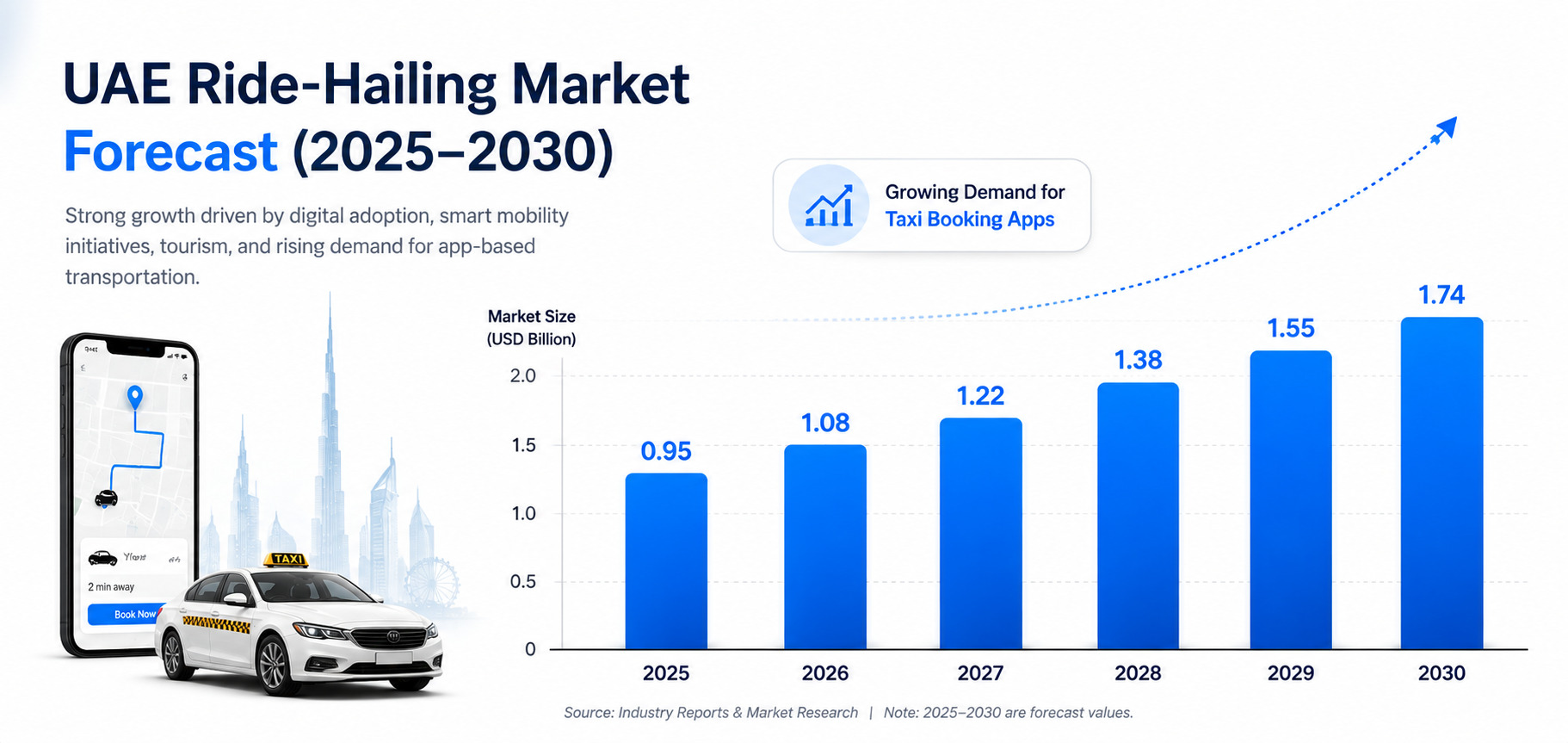
Market forecasts point to steady growth. One estimate projects the UAE e-hailing market will rise from about USD 0.36 billion in 2026 to USD 0.45 billion by 2031, a CAGR of 4.6% (Knowledge Sourcing Intelligence, forecast period 2026-2031). Smart city programmes, tourism and digital payments are cited as the main drivers. On-Demand App Development has grown alongside them, and more new entrants want a local product that can stand up to the established platforms.
So who is this guide for? Anyone planning a Dubai taxi booking app, an Abu Dhabi taxi booking app, or a platform that spans several UAE cities. We’ll cover cost, features, tech, the build process, AI, compliance and what a scalable platform needs in practice.
Why Invest in Taxi Booking App Development in Dubai?
The government here actively supports digital infrastructure, AI adoption and smart mobility, which helps anyone building in this space.
Ride-Hailing Apps have already changed how people move around UAE cities. Riders expect an instant booking, a live map, a choice of payment methods and a booking flow that doesn’t waste their time. Startups, fleet operators and transport firms all feel that pressure.
Market Highlights
| Statistics | Data |
| Dubai international overnight visitors (2025) | 19.59 million |
| Dubai resident population (end of 2025) | ~4.58 million |
That creates opportunities for businesses offering Taxi Booking App Development Services to taxi operators, fleet owners and on-demand transport providers.
What Does Taxi Booking App Development in Dubai Involve?
It’s an app that uses GPS to pair a passenger with a driver nearby. Open it, set the pickup, book. Under the hood, Taxi Booking Application Development usually covers live booking, driver allocation, route optimisation, fare calculation, secure payments, vehicle tracking, scheduled rides and a ratings system.
Starting with a taxi booking app in Dubai and thinking about other Emirates later? Plan for that early. Retrofitting scalability, security and compliance after launch is painful and expensive.
Which Business Models Shape Taxi Booking App Development in Dubai?
The right platform depends on the business model. Cost, architecture and integrations differ significantly between these options, so it helps to decide which one you are building before you scope Taxi Booking App Development.
| Platform type | Main functionality |
| Taxi fleet management app | Booking, driver allocation, fleet monitoring and operational reporting |
| Ride-hailing marketplace | Passenger bookings, independent driver onboarding, matching and commission management |
| Luxury chauffeur booking app | Scheduled bookings, premium vehicles, advance reservations and service management |
| Airport transfer app | Advance reservations, flight details, pickup scheduling and fixed-fare journeys |
| Corporate taxi platform | Employee bookings, company accounts, approval workflows and billing reports |
What Features Does Taxi Booking App Development in Dubai Require?
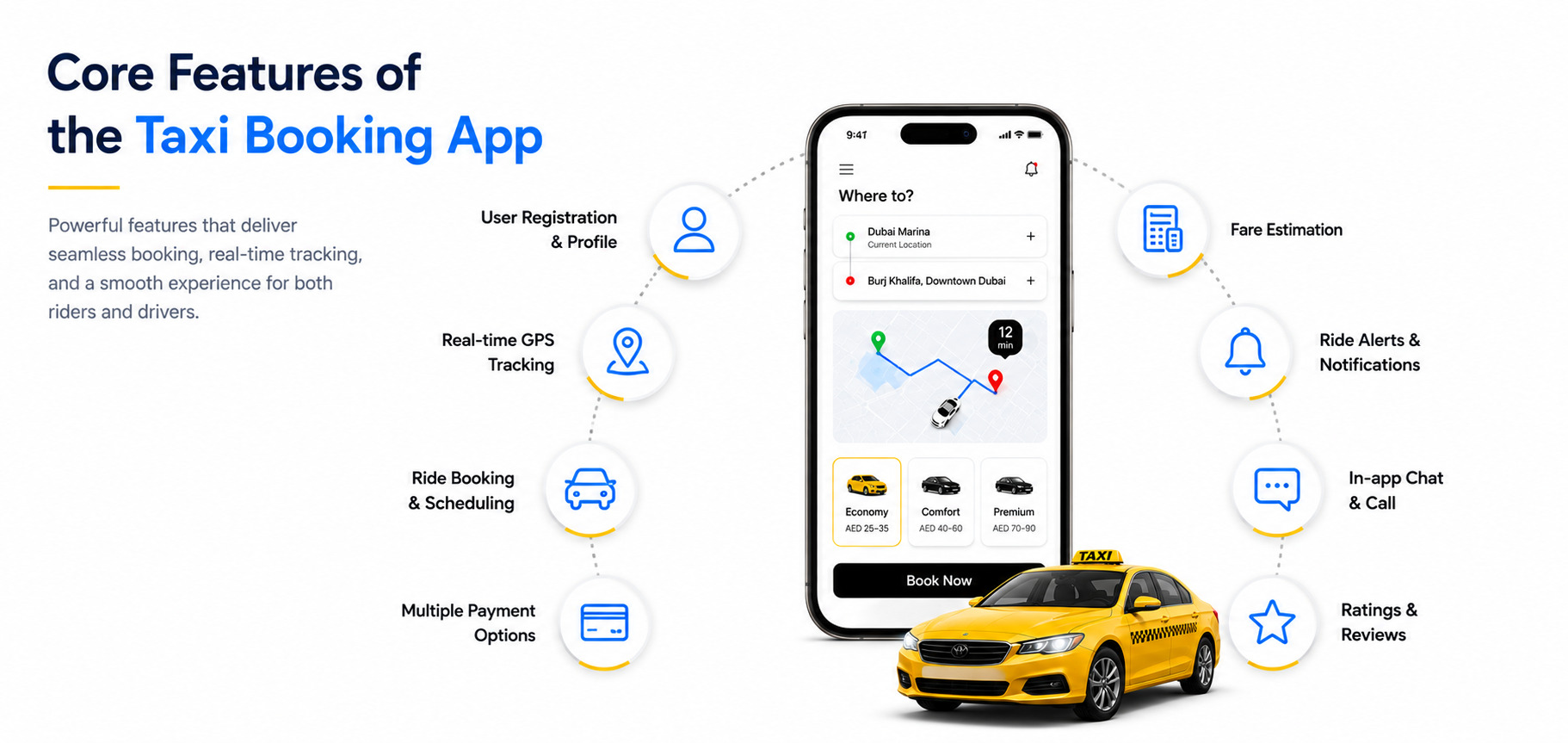
A taxi platform is really three products working together: one for passengers, one for drivers and one for administrators. A well-designed system gives each group its own set of Taxi Booking App Development Features, built around what that group actually does all day.
Passenger App
This is the face of the product. Riders book, watch their driver approach, pay, and scroll back through old trips when they need a receipt.
| Feature | Purpose |
| Registration | Email, Mobile OTP, Social Login |
| GPS Location | Automatic pickup detection |
| Ride Booking | Instant and scheduled rides |
| Fare Estimation | Cost before booking |
| Live Tracking | Driver arrival updates |
| Digital Payments | Cards, Apple Pay, Google Pay |
| Ride History | Previous trips |
| Ratings | Driver feedback |
| Emergency SOS | Passenger safety |
Driver App
Drivers live in this app all day. They accept jobs, follow the route, check their earnings and talk to rides. If it’s clumsy, drivers leave, so it has to be quick.
| Feature | Purpose |
| Driver Verification | Document upload |
| Online/Offline Mode | Availability management |
| Trip Requests | Accept or reject rides |
| GPS Navigation | Optimised routes |
| Earnings Dashboard | Daily and monthly income |
| Wallet | Instant payouts |
| Trip Analytics | Ride performance |
| Customer Ratings | Service improvement |
Admin Panel
Think of it as the control room. Owners manage users, watch vehicles move, change pricing rules, read reports and keep the business compliant, all from one dashboard.
| Feature | Purpose |
| User Management | Passenger and driver management |
| Fleet Monitoring | Vehicle tracking |
| Commission Management | Revenue control |
| Pricing Rules | Fares based on approved pricing rules |
| Reports | Business analytics |
| Customer Support | Ticket management |
| Promotions | Coupons and referrals |
| Compliance Dashboard | Regulatory management |
When the three apps work as one system, riders get a smoother booking, fleets run with better visibility and drivers have what they need to do the job.
How a Taxi Booking Platform Works
Feature lists only tell half the story. Here is how a single trip moves through the platform from start to finish:
- The passenger enters a pickup point and destination.
- The platform calculates an estimated fare and journey time.
- The dispatch engine identifies eligible, available drivers.
- A driver accepts or rejects the request.
- The passenger receives the driver and vehicle details.
- The app tracks the trip and sends status updates.
- Payment is processed after the journey, using the selected payment method.
- The system generates a receipt, updates trip records, commissions and driver earnings, and reconciles driver payouts and settlements.
Real operations also need defined workflows for the messy cases: cancellations, failed payments, driver reassignment and customer complaints. Planning these early is what separates a demo from a platform that fleet operators can run every day.
How Can AI Improve Taxi Booking App Development in Dubai?
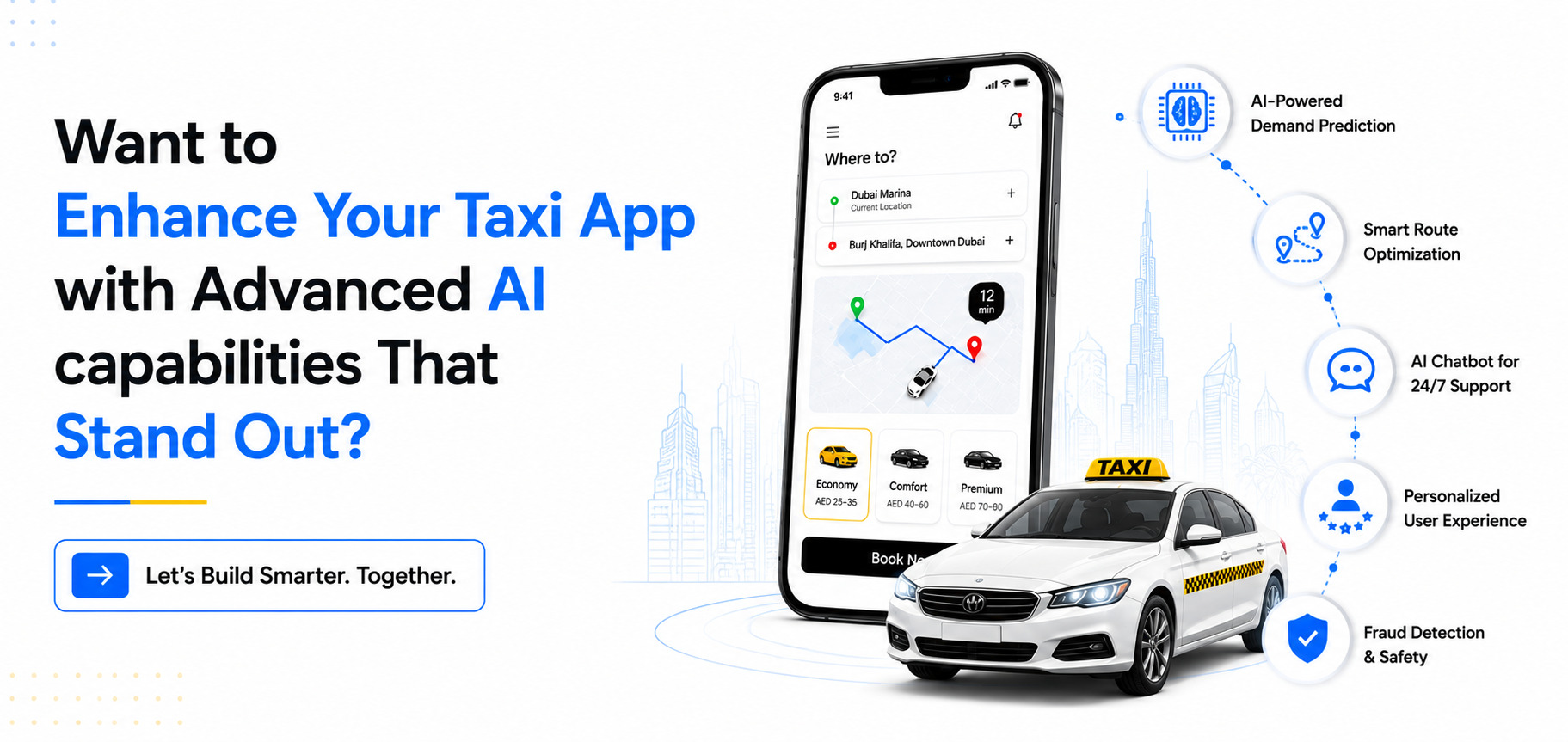
AI can support several operational decisions in a taxi booking platform, particularly driver allocation, demand forecasting, route planning and estimated arrival times. The value of each feature depends on the quality of the available data, the size of the fleet and the business model. Some capabilities can go into the first release, while others suit a later phase, once enough trip data has been collected.
Businesses can bring in AI Development Services to improve dispatch decisions, forecast ride demand and analyse operational patterns. Used well, that can mean shorter waits and better use of each vehicle.
Recommended AI Features
| AI Feature | Business Benefit |
| Dynamic Pricing | Fare calculation based on approved pricing rules and applicable operator requirements |
| Demand Prediction | Better driver allocation |
| Route Optimisation | Reduced fuel costs |
| ETA Prediction | Accurate arrival time |
| Fraud Detection | Secure transactions |
| Driver Performance Monitoring | Improved safety and service quality |
| Voice Assistant | Hands-free booking |
| AI Chatbot | 24/7 customer support |
In Dubai, pricing deserves particular care. A platform can’t assume fares may change freely, because applicable RTA fare schemes and operator requirements have to be taken into account.
Want to Enhance Your Taxi App with Advanced AI Capabilities That Stand Out?
Talk to our team about which AI features fit your fleet size, data and launch plan.
What Are the Steps in Taxi Booking App Development in Dubai?
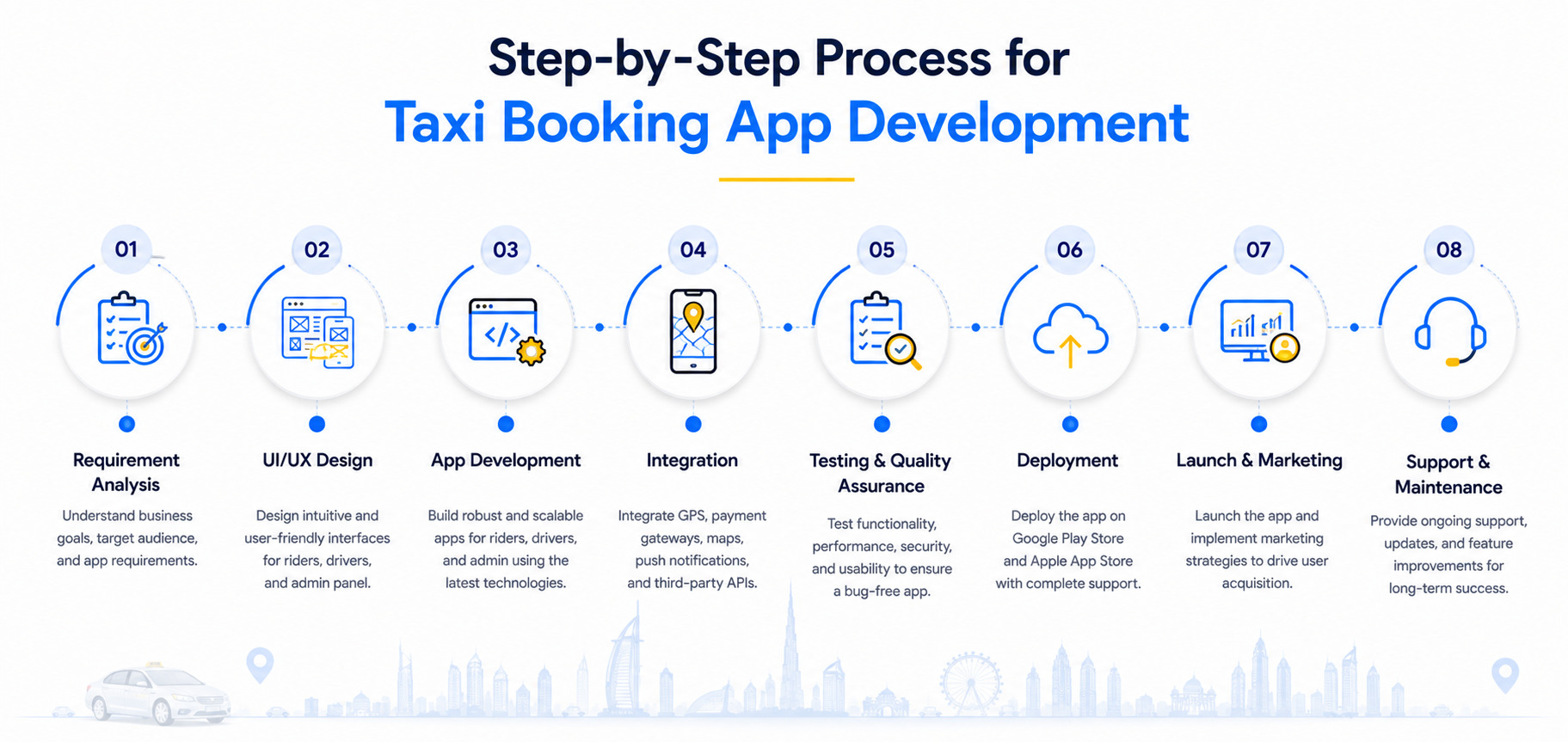
A clear Taxi Booking App Development Process saves time and headaches. Here’s the order we follow.
Step 1- Market Research
Before anything else, find out about:
-
- Competitors
- Customer behaviour
- UAE transportation regulations
- Pricing models
- Target audience
Step 2- UI/UX Design
Don’t write code yet. Spend money first on UI/UX Design Services, where user journeys, wireframes and the look of the app get worked out. Skimping here shows up later as riders who open the app, get confused and leave without booking.
Expect these deliverables:
-
- User journeys
- Wireframe
- Interactive prototypes
- Mobile-first interfaces
A clean design cuts drop-offs and gets more people through to a finished booking.
Step 3- Technology Selection
A typical stack look like this:
| Layer | Technologies |
| Android | Kotlin |
| iOS | Swift |
| Cross-platform | Flutter, React Native |
| Backend | Node.js, Python |
| Database | PostgreSQL, MongoDB |
| Cloud | AWS, Azure |
| Maps | Google Maps API |
| Payment gateways | Stripe, Checkout.com, PayTabs |
Step 4- App Development
Now the actual build. It includes:
-
- Passenger app
- Driver app
- Admin dashboard
- APIs
- Payment gateway
- GPS integration
Good taxi app developers plan for the worst day, when thousands of ride requests land at once, and design the architecture to survive it.
Step 5- Testing
QA is more than clicking around. The checklist:
-
- Functional testing
- GPS accuracy
- Security testing
- Performance testing
- Load testing
- Device compatibility
Step 6- Deployment
Time to launch on:
-
- Google Play Store
- Apple App Store
The cloud setup goes live at the same time, and monitoring starts immediately.
Step 7- Maintenance
Launch isn’t the finish line. Plan for:
-
- Security patches
- New features
- Performance optimisation
- OS compatibility
- Analytics improvements
How Much Does Taxi Booking App Development in Dubai Cost?
What will it cost? It depends. The taxi booking app development cost shifts with app complexity, the amount of AI, how many platforms you cover, the integrations and the compliance work. AI features in particular can change the figure a lot, depending on model complexity, data availability and infrastructure.
The build isn’t the whole bill either. If you’re weighing the Mobile App Development Cost in Dubai, add maintenance, cloud hosting, security updates and third-party API fees to your budget.
| App Type | Estimated Cost (AED) | Estimated Timeline |
| MVP Taxi App | AED 91,750–183,500 | 8–12 weeks |
| Standard Taxi Platform | AED 183,500–367,000 | 12–20 weeks |
| Advanced AI Taxi Platform | AED 367,000–825,750+ | 20–32+ weeks |
The tier names above need clear definitions. Suggested scope for each:
| App type | Scope to clarify |
| MVP Taxi App | Core passenger and driver functionality, basic admin dashboard and booking workflow |
| Standard Taxi Platform | Advanced dispatch, payments, reporting, fleet management and additional integrations |
| Advanced AI Taxi Platform | AI-based forecasting, advanced analytics, automation and enterprise integrations |
Taxi booking app development timelines depend on the number of applications, integrations, business rules and testing requirements. A basic MVP generally needs less development time than a multi-service platform with advanced dispatch, fleet management and AI capabilities. The timeline should also separate software development from regulatory approvals, operator onboarding and commercial launch preparation.
Cost Breakdown
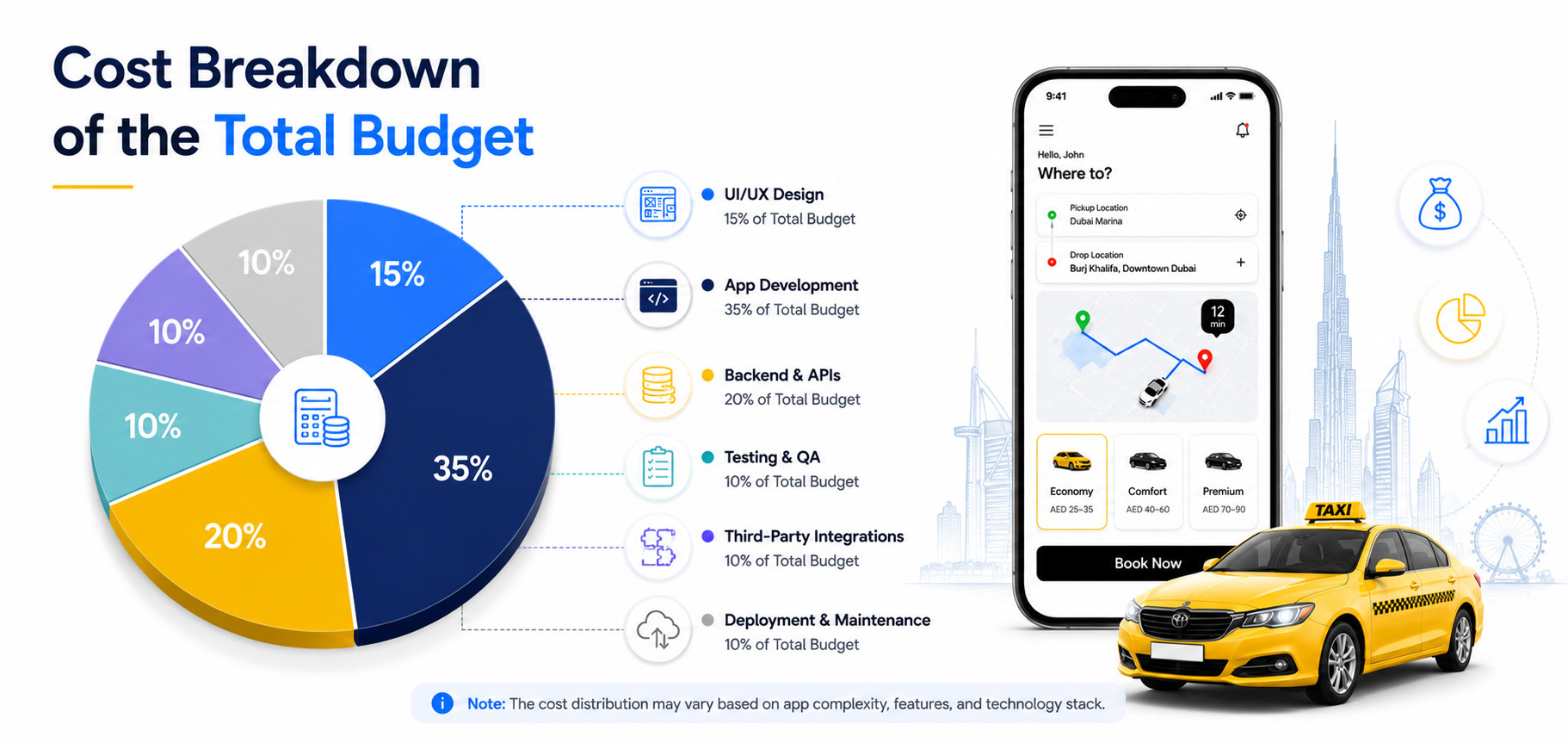
Prefer percentages? This is an indicative split of the total budget for a mid-complexity build. It adds up to 100%, but it is an illustrative allocation, not a universal industry benchmark, so your own split will vary.
| Development Component | Indicative Share of Total Budget |
| UI/UX Design | 10% |
| Passenger App Development | 20% |
| Driver App Development | 15% |
| Admin Panel Development | 10% |
| Backend & API Development | 18% |
| AI Features & Integrations | 15% |
| Testing & Quality Assurance | 7% |
| Cloud Deployment & DevOps | 5% |
Add advanced AI, multiple languages, loyalty schemes or enterprise integrations, and development costs increase.
Which Technologies Power Taxi Booking App Development in Dubai?
Technology choices influence the platform’s performance, security and scalability. Common technology choices include:
- Mobile Development: Flutter, React Native, Kotlin, and Swift for building high-performance Android and iOS applications.
- Backend Development: Node.js and Python for creating scalable, secure, and real-time server-side applications.
- Database: PostgreSQL and MongoDB for efficient data storage, user management, and ride history.
- Cloud Infrastructure: AWS, Microsoft Azure, and Google Cloud for reliable hosting, scalability, and high availability.
- Maps & Navigation: Google Maps API for real-time GPS tracking, route optimisation, and location-based services.
- Push Notifications: Firebase Cloud Messaging (FCM) for sending ride updates, booking confirmations, and promotional notifications.
- Analytics: Google Analytics and Mixpanel for tracking user behaviour, app performance, and business insights.
- Payment Integration: Stripe, Apple Pay, and Google Pay for secure, fast, and seamless digital payment processing.
To reach users across both major mobile ecosystems, businesses often release applications through Android App Development and iOS App Development. Flutter and React Native can cut down the schedule without making the app feel second-rate.
What Makes Taxi Booking App Development in Dubai Enterprise-Ready?
For a fleet operator or enterprise buyer, features are the starting point. These operational areas decide whether the platform holds up day to day:
- Fleet operations: vehicle availability, driver shifts, fleet utilisation and maintenance records.
- Driver onboarding: licence, identity, vehicle and permit verification, as applicable.
- Dispatch management: driver matching, acceptance timeouts, cancellations and reassignment.
- Payment operations: failed transactions, refunds, receipts, reconciliation and driver settlements.
- Security architecture: role-based access, audit logs, data retention, backups and incident response.
- Platform reliability: real-time monitoring, load testing, recovery planning and service availability.
- Customer safety: trip sharing, emergency escalation, incident reporting and support workflows.
You don’t need every item at launch, but each one should be planned for from the start.
What Compliance Requirements Apply to Taxi Booking App Development in Dubai?
A taxi booking platform must be designed around the data protection, payment security and transport requirements that apply to its operating model. A reliable taxi booking app development company in Dubai should work with the business and its regulatory advisers to identify these obligations before implementation starts.
Dubai RTA Authorisation & Transport Requirements: Businesses offering on-demand passenger transport through digital platforms must assess the authorisation and operating requirements that apply to their model. Dubai’s Administrative Resolution No. 516 of 2022 sets out requirements for relevant passenger transport activities, including electronic systems, integration with the prescribed platform and compliance with applicable fare schemes. The rules can differ depending on whether the business runs taxis, luxury cabs or supplies technology to an authorised operator. Building an app doesn’t itself authorise a company to operate a passenger transport service, so confirm the applicable approvals with the Roads and Transport Authority (RTA) before launch. You can read the resolution on the official Dubai Legislation Portal.
UAE Personal Data Protection Law (PDPL): Collect, store & process personal data securely and openly. Doing so protects customer privacy and supports compliance with the law.
Secure Payment Standards (PCI DSS): Strict rules for handling card details online. Ideally, card data is handled by a complaint payment provider rather than stored directly in your app.
Driver Verification Requirements: Check identity, licence, vehicle registration and background before a driver goes live, as applicable to the operating model.
GPS & Location Permission: Ask for permission in line with platform requirements, use location data only for legitimate purposes such as booking, navigation & tracking, and follow applicable privacy obligations.
Data Encryption: Sensitive data such as personal details & ride history should be encrypted in transit and at rest.
GDPR (For International Users): GDPR doesn’t apply automatically just because an app has international users. Its territorial scope depends on how the business offers services to, or monitors, people in the European Union, so check whether it applies to you.
Get these right and you build customer trust, tighten security, reduce legal risk and end up with a mobility platform people can rely on in the UAE.
Not Sure Which Requirements Apply to Your Taxi Business Model?
Book a consultation to map your platform scope and technical requirements before development starts.
What Are the Benefits of Taxi Booking App Development in Dubai?
A well-planned taxi booking platform can improve efficiency, simplify ride management and give businesses better visibility into fleet performance. These are the Taxi Booking App Development Benefits most operators look for.
Key Benefits
-
- Increased customer convenience
- Real-time ride management
- Higher operational efficiency
- Automated dispatch
- Better driver utilisation
- Reduced administrative costs
- AI-powered pricing optimisation
- Enhanced customer retention
- Data-driven decision making
- Scalable business model
For taxi operators, these benefits go beyond passenger convenience. Automated dispatch can reduce manual coordination, fleet reporting can improve resource planning, and centralised payment records can make revenue reconciliation easier. The actual impact depends on fleet size, operating processes and how well the platform is implemented.
What Are the Emerging Trends in Taxi Booking App Development in Dubai?
Several technologies are shaping taxi app development services, with a focus on efficiency, sustainability and a better rider experience. Not every trend matters equally to a business launching today, so they are ordered by near-term relevance.
-
AI Dispatch Automation:
AI-assisted dispatch can evaluate driver availability, traffic conditions and pickup distance when recommending a driver.
-
Predictive Demand Analytics:
AI reads past and live data to forecast where rides will be wanted and when, so drivers can be positioned more effectively.
-
Electric Vehicle Management:
Apps can follow battery levels, charging stations and vehicle health, which makes an EV taxi fleet easier to run.
-
Subscription Ride Plans:
Monthly or yearly plans give customers cheaper fares & perks, which can build loyalty and recurring income.
-
Mobility-as-a-Service (MaaS):
Taxis, public transport, car rentals and bike sharing in a single app, so users plan, book and pay for an entire journey in one place.
-
Autonomous Vehicle Readiness:
This is still an emerging trend. Platforms are being designed so self-driving vehicles can slot in later, using stronger fleet management and AI navigation.
-
Voice-Enabled Bookings:
Riders can book, check a trip or make a request by voice, hands-free.
-
Smart Parking Integration:
Linking to smart parking systems can help drivers find a space near busy pickup zones such as airports and malls, cutting idle driving time.
-
Carbon Footprint Tracking:
Show each trip’s environmental impact and push riders towards greener choices. Operators can use the data for ESG goals.
Taken together, these ideas will keep changing Ride-Hailing Apps: smarter fleets, better trips and leaner operations.
What Other Mobility Solutions Can Complement Taxi Booking App Development in Dubai?
Taxis are rarely the end of the story. Plenty of businesses add other products once the first app is running. Depending on your model, you might look at:
- Car Rental App Development for self-drive and chauffeur-based vehicle rental platforms.
- Smart Parking App Development Cost, for businesses planning apps that help users find, reserve and pay for parking.
- Fleet management systems for corporate transportation.
- Logistics and delivery apps built on On-Demand App Development frameworks.
- Multi-service mobility platforms that combine taxis, rentals, parking and public transport in a single app.
Why Choose a UAE-Based Company for Taxi Booking App Development in Dubai?
Hiring a local Taxi Booking App Development Company in UAE has clear advantages. The team already knows UAE transport context, can connect to local payment gateways, builds bilingual apps in Arabic and English, replies fast, understands the regional market and can offer post-launch support.
A seasoned Taxi Booking App Development Company in Dubai, UAE can also shape the product around your model, whether that’s corporate fleet management, luxury chauffeur services, airport transfers or an EV taxi platform. The platform should reflect the business’s operating model, technical requirements and applicable UAE transport obligations.
Why Choose Aarmeh for Taxi Booking App Development in Dubai?
At Aarmeh, we work as a Taxi Booking App Development Company in Dubai, UAE, supporting startups, enterprises and transport businesses. As a Mobile App Development Company in Dubai, our services cover On-Demand App Development, Android App Development, iOS App Development, UI/UX Design Services and AI Development Services.
Developing a taxi booking platform means coordinating passenger bookings, driver availability, location tracking, payment processing and fleet operations. We start by understanding the business model, target service areas, operational workflows and integration requirements. That shapes the application architecture, core features and MVP scope around your objectives. The development plan then accounts for scalability, security requirements and the integrations needed for launch.
Before development begins, project requirements should be documented across application functionality, backend architecture, third-party integrations, security, deployment and ongoing support. Clear ownership of source code, infrastructure access and technical documentation also helps businesses keep control of the platform as it evolves.
Conclusion
Demand for taxi booking app development in Dubai keeps growing as more people choose on-demand transport. To compete in a market this busy you need a scalable platform, a clean design, well-chosen AI features, secure payments and a clear view of UAE transport requirements.
Pick an experienced Taxi Booking App Development Company in Dubai, UAE and you get a partner who plans for the operational detail as well as the app. Whether it’s a new Dubai taxi booking app or an expansion across the UAE, the right technology and operating strategy can support long-term growth.
Frequently Asked Questions (FAQs)
Q. How much does Taxi Booking App Development cost in Dubai?
The Taxi Booking App Development Cost typically ranges fromAED 91,750 to AED 825,750+, depending on factors such as app complexity, AI-powered features, platform support (Android, iOS, or both), third-party integrations, security requirements, and the level of customisation required.
Q. How long does it take to build a taxi booking app?
A basic MVP can take 8-12 weeks, while a feature-rich enterprise taxi booking application usually requires 20-32+ weeks for design, development, testing, and deployment.
Q. What are the essential Taxi Booking App Development Features?
Key features include GPS tracking, ride booking, fare estimation, secure payments, driver management, admin dashboard, ratings, ride history, push notifications, and AI-powered route optimisation.
Q. Why should I hire a Taxi Booking App Development Company in Dubai?
A local Taxi Booking App Development Company in Dubai understands UAE regulations, integrates regional payment gateways, supports Arabic and English, and delivers solutions tailored to the local transportation ecosystem.





 Book a call



 CLUTCH VERIFIED
 Top App Developer UAE
 100% NDA Protected
 IN THE HEART OF UAE