





Table of Contents
📌 Key Takeaways
- Travel apps are becoming essential digital travel companies, helping users discover destinations, book services, manage itineraries, make payments, and access real-time travel information.
- The right app type and feature set depend on the target audience and business model, with options ranging from booking and hotel apps to AI travel planners and all-in-one platforms.
- A structured development process is critical, covering market research, MVP planning, UI/UX design, backend development, API integration, testing, deployment, and ongoing maintenance.
- Travel app development costs can vary significantly, from around $30,000-$60,000 for an MVP to $180,000-$350,000+ for an AI-enabled platform, depending on scope and complexity.
- AI, personalization, real-time information, conversational search, super apps, and connected travel experiences are shaping the future of travel technology, creating opportunities for businesses to build more intelligent and personalized applications.
Travel has become increasingly digital. From discovering destinations and comparing flights to booking hotels, planning itineraries, navigating unfamiliar cities, and managing payments, travellers now expect most of the journey to be handheld from their smartphones.
This shift creates a strong opportunity for businesses to invest in travel app development. A well-designed travel application can bring bookings, destination discovery, personalized recommendations, payments, customer support, and travel management into one connected experience.
The opportunity is particularly relevant in markets such as Dubai. Dubai welcomed 19.59 million international overnight visitors in 2025, up to 5% from 18.72 million in 2024. India also represents an increasingly mobile-first online travel market, with mobile devices accounting for an estimated 65.37% of online travel bookings in 2025.
This travel app development guide explains the major app types, features, development process, technology choices, costs, timelines, monetisation models, and emerging trends.
Travel App Market: Why Build a Travel App?
The global travel industry continues to generate substantial digital demand. UN Tourism reported approximately 1.52 billion international tourist arrivals in 2025, representing 4% growth over 2024. International tourism receipts were estimated at around $1.9 trillion.
For app businesses, this growth is supported by the increasing use of mobile devices for travel research and transactions.
India provides a useful example. According to Mordor Intelligence, mobile accounted for 65.37% of online travel bookings in India in 2025, while online travel agencies represented 81.74% of the market by business model.
Dubai is another attractive market. Its 2025 tourism performance reached a record 19.59 million international overnight visitors. Western Europe accounted for 21% of visitors, while South Asia contributed 15%, showing the city’s highly international customer base.
These figures demonstrate why travel businesses are investing in mobile experiences that simplify discovery, booking, payment, and trip management.
Different Types of Travel Apps You Can Develop
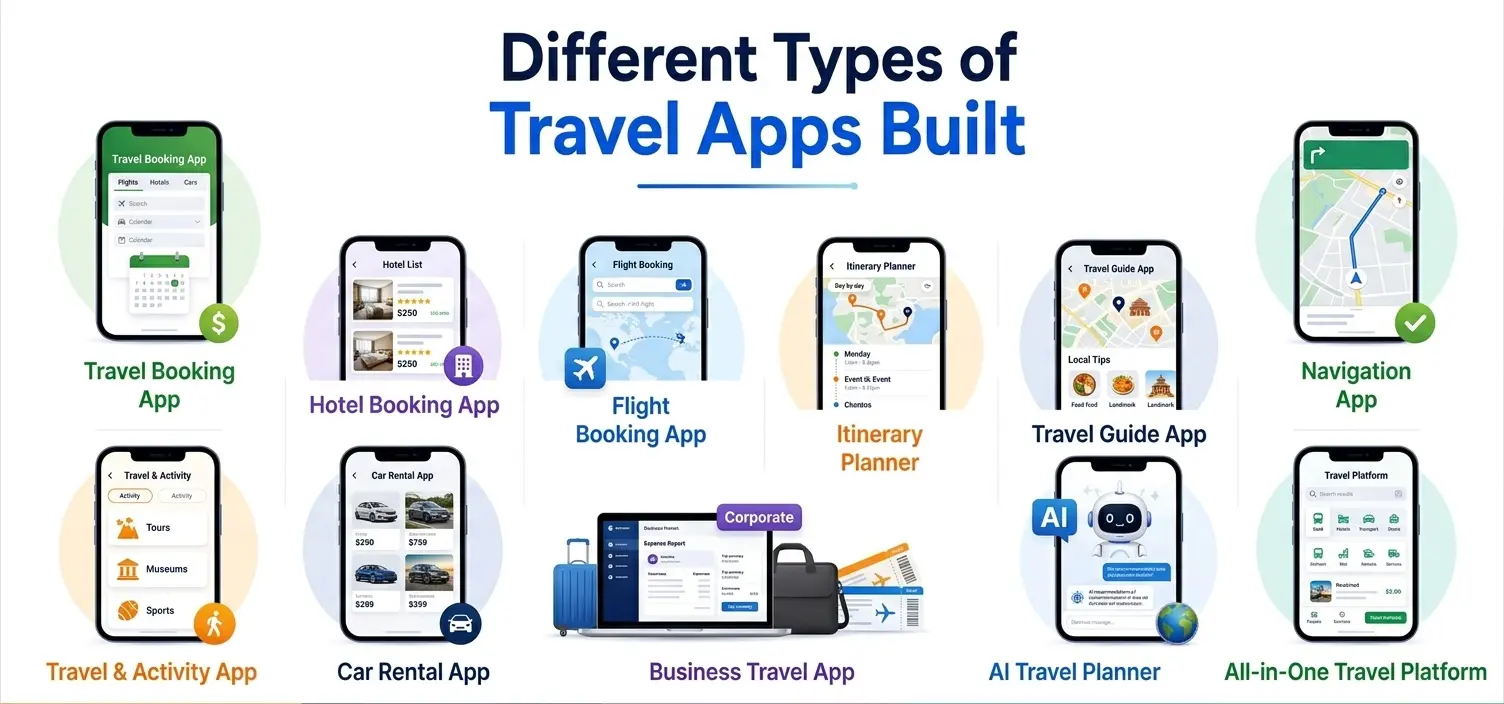
Before deciding how to build a travel app, determine the specific problem the product will solve. Common types include:
1. Travel Booking App:
Enables users to search and book flights, hotels, tours, and transportation from one platform. It is suitable for leisure and business travellers looking for a convenient booking experience.
2. Hotel Booking App:
Focuses on hotel discovery, room availability, pricing, reviews, and reservations. It is designed for tourists and business travellers who need accommodation during their trips.
3. Flight Booking App:
Allows users to search, compare, and book flights based on destinations, dates, fares, and travel preferences. It primarily serves air travellers seeking convenient flight planning and reservations.
4. Itinerary Planner:
Helps travellers organize trips by managing schedules, bookings, activities, and important travel information in one palace. It is particularly useful for independent travellers planning multi-day or multi-destination journeys.
5. Travel Guide App:
Provides destination information, attractions, restaurants, local recommendations, and useful travel tips. It helps tourists discover places and plan activities before and during their trips.
6. Navigation App:
Offers maps, routes, GPS-based navigation, and location services to help users move around unfamiliar destinations. It can support both local commuters and international travellers.
7. Travel & Activity App:
Connects travellers with tours, attractions, excursions, and local experiences that can be discovered and booked through the app. It is mainly designed for leisure travellers looking for things to do at their destination.
8. Car Rental App:
Allows users to discover available vehicles, compare options, select rental periods, and complete bookings. It can serve tourists as well as business travellers who need flexible transportation.
9. Business Travel App:
Helps organizations and employees manage corporate trips, including bookings, travel policies, approvals, itineraries, and expenses. It is designed for companies that need centralized business travel management.
10. AI Travel Planner:
Uses artificial intelligence to provide personalized destination suggestions, itinerary ideas, travel recommendations, and conversational assistance. It is suited to modern digital travellers who want faster and more personalized trip planning.
11. All-in-One Travel Platform:
Combines services such as flights, hotels, transportation, activities, itinerary management, and payments within one ecosystem. It is generally suitable for OTAs and established travel businesses seeking an end-to-end travel experience.
The choice should be driven by the target audience, business model, and specific customer problem rather than simply by the number of features you can add.
Essential Features for a Powerful Travel App
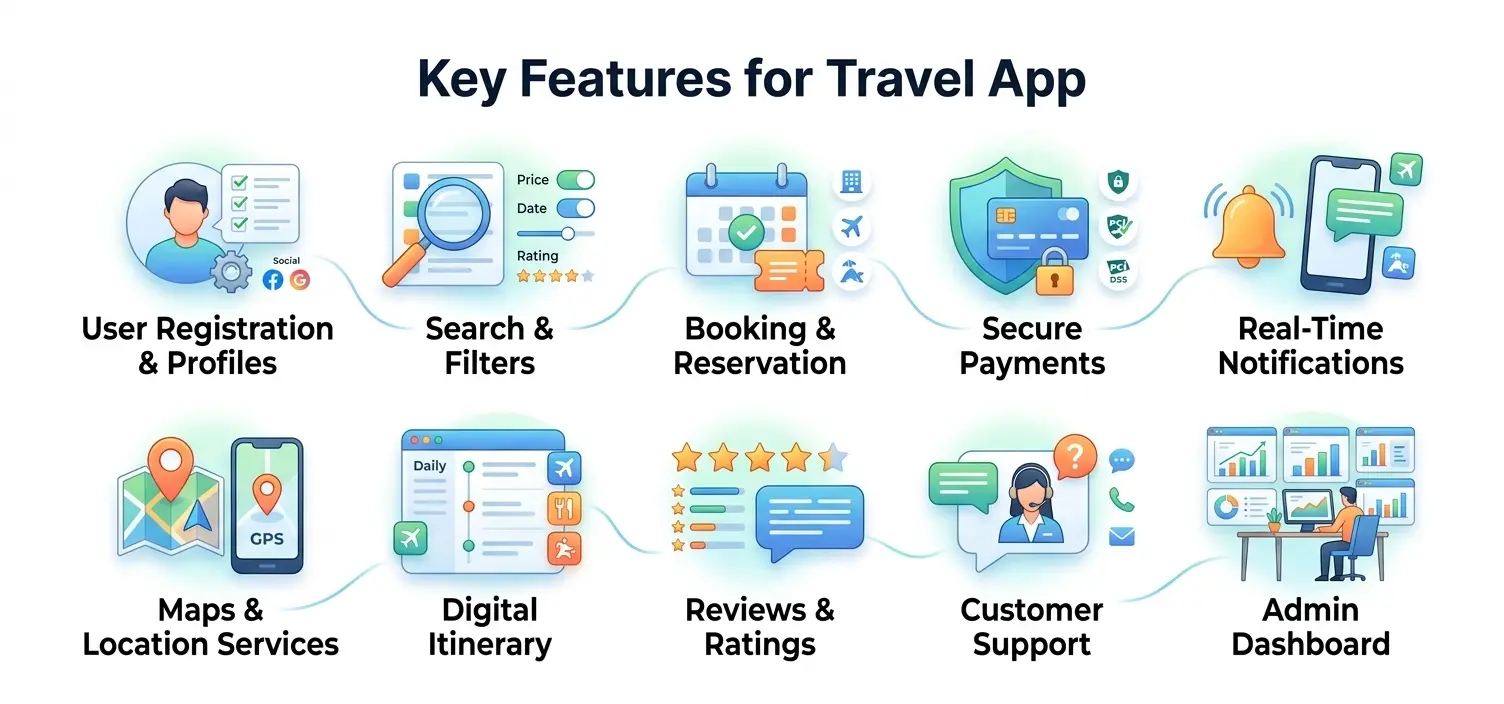
The required travel app features depend on the business model and app category. A booking marketplace will need a different feature set from an AI-powered itinerary planner.
-
User Registration and Profiles
Allow users to create accounts through email, phone numbers, or social authentication. Profiles can store preferences such as preferred destinations, travel history, favourite hotels, preferred airlines, payment methods, currency preferences, dietary or accessibility preferences, and saved itineraries.
-
Search and Filters
Travel discovery should be fast and flexible, allowing users to search destinations, hotels, flights, attractions, tours, restaurants, or transportation. Filters for price, location, dates,ratings, amenities, travel duration, property type, cancellation policy, and availability can make results easier to navigate.
-
Booking and Reservation
A travel booking app should enable users to complete reservations through a simple and streamlined booking flow. Depending on the product, users can book flights, hotels, tours, car rentals, airport transfers, restaurants, and activities from the application.
-
Secure Payments
Integrate reliable payment gateways to support cards, digital wallets, bank transfers, and other relevant payment methods. The payment system should also handle confirmations, refunds, invoices, transaction history, currency conversion, and fraud monitoring.
-
Real-Time Notifications
Push notifications can keep travellers updated throughout their journey and reduce the risk of missing important information. Notifications can cover booking confirmations, flight changes, check-in reminders, payment updates, price changes, trip reminders, and promotional offers.
-
Maps and Location Services
Location intelligence can help travellers navigate destinations and discover relevant places nearby. Features can include GPS navigation, nearby attractions, hotels and restaurants, route planning, distance calculation, geofencing, and location-based recommendations.
-
Digital Itinerary
A digital itinerary brings all trip-related information together in one convenient view. Users can access flight details, airport transfers, hotel reservations, tours, restaurant bookings, and return travel information from a single place.
-
Reviews and Ratings
Reviews and ratings allow travellers to evaluate accommodation, attractions, tours, restaurants, and other travel services before making a decision. A reliable review system can also build trust and help businesses identify areas for service improvement.
-
Customer Support
Travel applications should provide accessible support when users face booking, payment, or trip-related issues. Options can include in-app chat, AI chatbots, FAQs, email, phone support, and ticket management for more complex requests.
-
Admin Dashboard
An admin dashboard provides centralized control over the travel application’s users, bookings, vendors, content, and transactions. Administrators can also manage commissions, analytics, promotional campaigns, review moderation, and customer support from a single interface.
Next-Generation Features for Travel Apps
For a differentiated product, businesses can add advanced capabilities such as:
- AI trip planning
- Personalized recommendations
- Voice search
- Multilingual support
- Real-time flight status
- Dynamic pricing
- Smart itinerary optimization
- Currency conversion
- Travel document storage
- Digital tickets
- AR destination experiences
- Weather-based recommendations
- Emergency assistance
- Loyalty and rewards
- Travel insurance integration
The objective should not be to add every feature. Instead, advanced functionality should solve a specific user problem or create a measurable business advantage.
Key Steps to Building a Modern Travel App
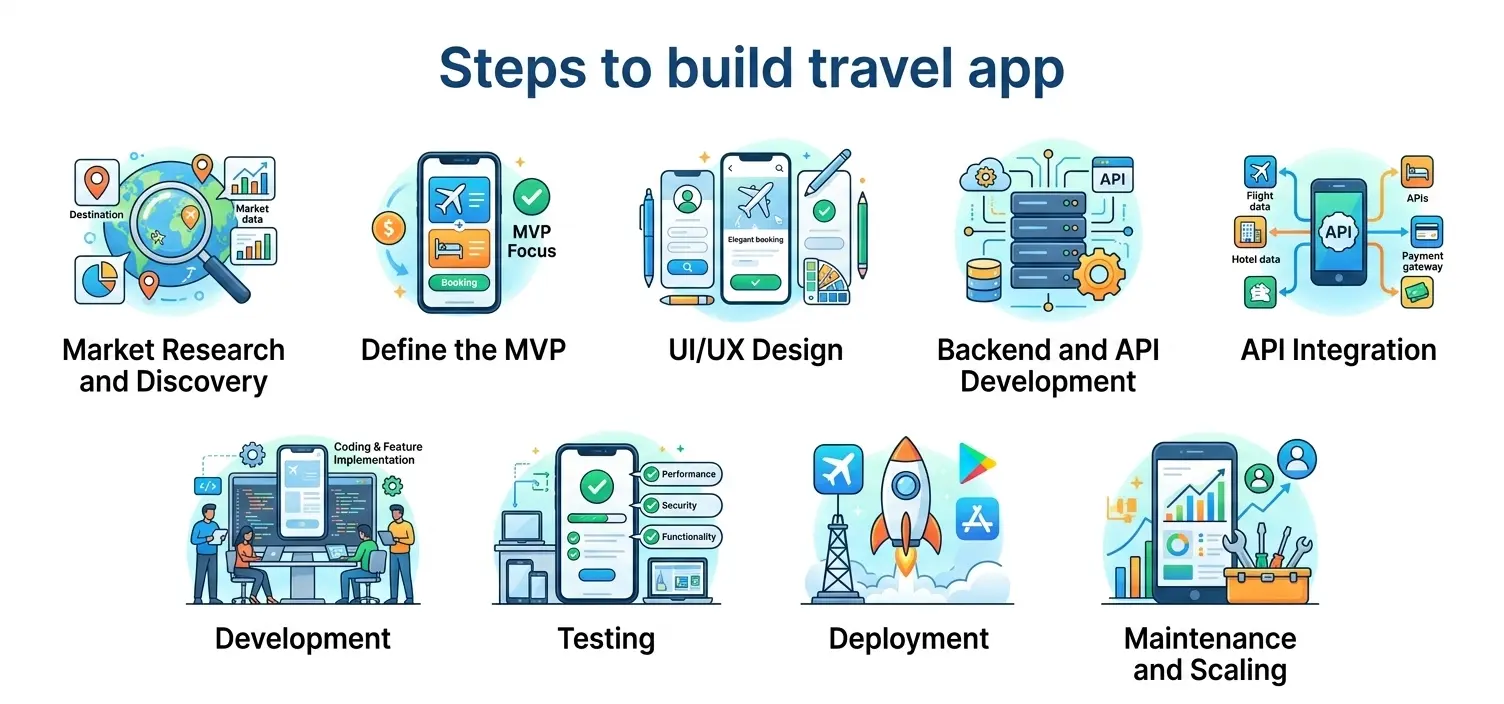
A successful travel app development process generally moves through several structured stages, from initial research and planning to development, testing, deployment, and ongoing optimization.
Step 1: Market Research and Discovery
Begin by understanding the target travellers, travel category, geographic market, competitors, user pain points, business model, revenue strategy, required integrations, and regulatory considerations. This stage establishes the product’s purpose, market positioning, and technical requirements while creating a clear roadmap for development.
Step 2: Define the MVP
An MVP allows a business to validate its travel app concept without investing in the complete platform from the beginning. A travel booking MVP may include registration, search, filters, listings, booking, payments, notifications, user profiles, and an admin dashboard, while advanced features can be introduced after market validation.
Step 3: UI/UX Design
Travel app UI UX design should prioritize clarity, speed, and simple navigation because users may need to make decisions quickly while travelling. The process generally includes user flows, wireframes, information architecture, visual design, interactive prototypes, and usability testing.
Step 4: Backend and API Development
The backend manages essential functions such as users, bookings, payments, availability, pricing, notifications, and business logic. A scalable architecture is important because travel applications can experience sudden traffic increases during holidays, major events, and seasonal campaigns.
Step 5: API Integration
Travel app API integration connects the application with external services required for travel search, booking, payments, navigation, and personalization. Common integrations include flight, hotel, maps, payment, weather, currency, translation, notification, identity, and AI APIs.
| API Category | Purpose |
| Flight APIs | Flight schedules, availability, and pricing |
| Hotel APIs | Hotel inventory and room availability |
| Maps APIs | Maps, routes, and geolocation |
| Payment APIs | Secure transactions |
| Weather APIs | Forecasts and weather conditions |
| Currency APIs | Exchange rates |
| Translation APIs | Multilingual experiences |
| Notification APIs | Push notifications and communication |
| Identity APIs | Authentication |
| AI APIs | Recommendations and trip planning |
Before integration, each API should be evaluated for availability, pricing, usage limits, data quality, reliability, documentation, and commercial agreements. These factors can affect both the application’s functionality and long-term operating costs.
Step 6: Development
Developers build the frontend, backend, database, APIs, admin dashboard, and third-party integrations based on the approved product specifications. Businesses can choose native development for platform-specific experiences or cross-platform technologies such as Flutter and React Native to support multiple platforms efficiently.
Step 7: Testing
Comprehensive testing ensures that the application performs reliably across different devices, platforms, and travel scenarios. Testing should cover functionality, UI, APIs, payments, security, performance, compatibility, location services, devices, and usability, along with booking failures, duplicate transactions, cancellations, refunds, and network interruptions.
Step 8: Deployment
Once development and testing are complete, the application is prepared for release through the relevant app stores and production infrastructure. Deployment includes App Store and Google Play preparation, production database configuration, cloud setup, monitoring, analytics, crash reporting, and security configuration.
Step 9: Maintenance and Scaling
Travel app development continues after launch through regular maintenance, performance improvements, and feature updates. Ongoing services can include bug fixes, OS and API updates, security patches, performance optimization, new features, AI model improvements, cloud scaling, and analytics-driven enhancements.
Technology Stack for Building a Modern Travel App
The travel app development platform should be selected based on the target audience, performance requirements, budget, and long-term product strategy. Businesses can choose Android App Development and iOS App Development for platform-specific experiences, while Flutter and React Native can be suitable for cross-platform products.
| Layer | Technologies |
| iOS | Swift, SwiftUI |
| Android | Kotlin |
| Cross-platform | Flutter, React Native |
| Frontend | React, Next.js |
| Backend | Node.js, Python, .NET |
| Databases | PostgreSQL, MySQL, MongoDB |
| Cloud | AWS, Microsoft Azure, Google Cloud |
| Maps | Google Maps Platform, Mapbox |
| Payments | Stripe, Adyen, regional payment gateways |
| AI/ML | OpenAI APIs, TensorFlow, PyTorch |
| Analytics | Firebase, Google Analytics, Mixpanel |
| Notifications | Firebase Cloud Messaging, Apple Push Notification service |
| Security | OAuth 2.0, JWT, encryption, MFA |
There is no universal technology stack for every travel application. A small MVP may use a lean cross-platform architecture, while a large OTA may require a distributed and highly scalable backend.
Travel App Development Platform: Android, iOS, or Cross-Platform?
Businesses can choose native development when deep platform-specific functionality is required. Android App Development can be suitable for reaching broad device markets, while iOS App Development can be valuable in markets with strong iPhone adoption. Alternatively, Flutter and React Native can support multi-platform applications through a shared codebase, depending on project requirements.
1. Android App Development
Android can be appropriate when targeting broad markets where Android has substantial device penetration.
2. iOS App Development
iOS can be attractive for markets with high iPhone adoption and users with strong purchasing power.
3. Flutter App Development
Flutter App Development allows businesses to create applications for multiple platforms from a shared codebase, making it an option for travel products that need consistent experiences across devices.
4. React Native App Development
React Native App Development is another cross-platform option that can reduce duplicated development effort while supporting native platform capabilities.
A product can launch on one platform initially and expand after validating demand.
5. AI Travel App Development
AI App Development can add intelligent capabilities to modern travel platforms, including personalized recommendations, itinerary generation, conversational assistance, predictive analytics, and automated customer support.
Proven Monetization Strategies for Travel Apps
A clear travel app business model is essential before development.
| Monetisation model | How it works |
| Commission | Earn a percentage from completed bookings |
| Subscription | Charge users a recurring fee |
| Listing fees | Vendors pay to list their services |
| Advertising | Businesses pay for promotional placement |
| Affiliate revenue | Earn from partner bookings |
| Premium features | Charge for advanced functionality |
| Service fees | Add a transaction or convenience fee |
| B2B licensing | Sell the platform to travel companies |
Commission and affiliate models can work particularly well for booking platforms, while subscription or premium models may suit itinerary and travel-planning applications.
How Much Does It Cost to Develop a Travel App in Dubai?
The travel app development cost in Dubai can vary significantly based on whether development is handheld by an in-house team, local agency, offshore team, or hybrid team.
For Dubai-focused product, an indicative budget could look like this:
| Project Type | Estimated Budget (USD) | Estimated Budget (AED) |
| Travel App MVP | $30,000–$60,000 | AED 110,000–220,000 |
| Standard Booking Platform | $60,000–$120,000 | AED 220,000–440,000 |
| Advanced Marketplace | $120,000–$200,000+ | AED 440,000–735,000+ |
| AI-Enabled Travel Platform | $180,000–$350,000+ | AED 660,000–1,285,000+ |
The final price depends on the scope rather than simply the number of screens.
For example, integrating flight inventory, hotel inventory, payments, maps, loyalty systems, AI, multiple vendors, and complex cancellation workflows can significantly increase the development effort.
How Long Does It Take to Build a Travel App?
The travel app development timeline depends on the scope and team size.
A typical project may follow thai schedule:
| Development phase | Approx. duration |
| Discovery and requirements | 2–4 weeks |
| UI/UX design | 3–6 weeks |
| Backend development | 6–12 weeks |
| Mobile development | 8–16 weeks |
| API integrations | 3–8 weeks |
| Testing and QA | 3–6 weeks |
| Deployment | 1–2 weeks |
Some phases can run concurrently, so the total development time is not simply the sum of each stage.
A basic MVP may take around 3-5 months, while a complex multi-service platform can take 8-16 months or more.
Emerging Trends Shaping Travel App Development
The travel industry is moving towards more personalized, intelligent, and connected digital experiences.
1. Generative AI Trip Planning
Travellers can use natural language to describe what they want instead of navigating complex search interfaces.
2. Hyper-Personalization
Apps can use travel history, preferences, budgets, location, and behaviour to personalize recommendations.
3. AI-Powered Customer Service
AI assistants can handle common questions about bookings, cancellations, itineraries, and travel policies.
4. Real-Time Travel Information
Travellers increasingly expect live updates covering flights, delays, whether, traffic, availability, and local conditions.
5. Super Apps
Travel businesses are increasingly exploring experiences that combine flights, hotels, transport, activities, payments, and support.
6. Voice and Conversational Search
Voice and conversational interfaces can make destination discovery and itinerary planning faster.
7. Sustainable Travel
Applications can highlight eco-friendly hotels, transportation, activities, and lower-impact travel choices.
8. Connected Travel Experiences
Modern travel apps can connect booking data, digital tickets, maps, notifications, loyalty, programmes, and customer service into one continuous journey.
How to Build a Travel App That Can Scale?
Building a travel app is not only about creating attractive interfaces. Scalability needs to be considered from the beginning.
1. Focus on a MVP
Start with the smallest set of features required to validate your business idea.
2. Build Modular Architecture
Separate services such as authentication, booking, payments, notifications, and recommendations so that they can evolve independently.
3. Use Reliable APIs
Poor-quality travel data can result in incorrect prices, unavailable rooms, failed bookings, or customer dissatisfaction.
4. Prioritize Security
Travel apps process sensitive information, including personal details and payment data. Use encryption, secure authentication, access controls, secure APIs, monitoring, and appropriate compliance measures.
5. Prepare for Peak Demand
Travel demand can spike during holidays, festivals, sporting events, and promotional campaigns. Cloud infrastructure and caching strategies can help manage traffic fluctuations.
6. Measure User Behaviour
Analytics can reveal where users abandon searches, bookings, payments, and onboarding. These insights can guide product improvements.
Choosing a Travel App Development Company
Selecting the right travel app development company can influence the application’s technical quality, user experience, and long-term scalability. A capable partner should provide end-to-end Mobile App Development expertise along with travel-specific integrations, backend engineering, and post-launch support.
When evaluating Travel App Development Services, look for a partner with experience in:
- Mobile application development
- Travel and hospitality workflows
- API integration
- Payment systems
- Maps and location services
- AI and machine learning
- Cloud infrastructure
- Cybersecurity
- UI/UX design
- Backend development
- App Store and Play Store deployment
- Post-launch maintenance
Ask potential travel app developers to explain their development approach, previous relevant projects, technology choices, estimated timeline, and maintenance strategy.
For businesses operating in the UAE, a travel app development company in Dubai may also provide better familiarity with regional payment preferences, travel businesses, customer expectations, and local market requirements.
Final Thoughts
Travel apps have evolved from simple booking tools into comprehensive digital travel companions. Today’s travellers expect more than search and reservations. They want personalized discovery, seamless payments, real-time updates, intelligent recommendations, navigation, digital itineraries, and responsive support.
A successful product therefore requires more than attractive screens. It needs a well-defined business model, reliable APIs, scalable architecture, secure payment infrastructure, thoughtful travel app features, and a development roadmap aligned with user needs.
Whether you are planning a travel booking app, AI itinerary platform, hotel application, travel marketplace, or destination guide, starting with a focused MVP and expanding based on real user data can reduce unnecessary development costs while creating a foundation for long-term growth.
Frequently Asked Questions (FAQs)
Q. How much does it cost to develop a travel app?
A basic travel app MVP can cost approximately $25,000-$50,000, while an advanced platform can cost $100,000-$180,000+. AI-powered and enterprise solutions can exceed $150,000 depending on integrations, platforms, and complexity.
Q. How long does travel app development take?
A basic MVP can take around 3-5 months. Medium applications commonly require 5-8 months, while complex booking platforms and AI-enabled solutions can take 8-16 months or longer.
Q. What are the most important travel app features?
Core features usually include registration, search filters, booking, payments, notifications, maps, itinerary management, reviews, customer support, and an admin dashboard.
Q. What APIs are required for a travel app?
Depending on the application, APIs can be required for flights, hotels, maps, payments, weather, currency conversion, translation, notifications, authentication, and AI services.
Q. Can AI be integrated into a travel app?
Yes, AI can support personalized recommendations, itinerary generation, conversational search, customer support, review summarisation, travel planning, and other intelligent experiences.
Q. What is the best monetization model for a travel app?
Commission, affiliate revenue, subscriptions, advertising, service fees, premium features, and vendor listing fees are common options. The best model depends on the target audience and type of travel service.
Q. What technology stack is used for travel app development?
A typical stack may include Swift or Kotlin for native apps, Flutter or React Native for cross-platform development, Node.js/Python/.NET for backend services, PostgreSQL or MongoSB for data, cloud platforms such as AWS or Azure, and AI/ML technologies for intelligent features.




 Book a call




 CLUTCH VERIFIED
 Top App Developer UAE
 100% NDA Protected
 IN THE HEART OF UAE