





Table of Contents
📌 Key Takeaways
- eWallet App Development requires a secure, scalable architecture with features such as payments, transfers, KYC, transaction tracking, and authentication.
- eWallet App Development Cost can range from $25,000–$50,000 for a basic MVP to $200,000–$400,000+ for an enterprise wallet, depending on complexity and integrations.
- Advanced capabilities such as AI-powered insights, fraud detection, multi-currency support, blockchain integration, and personalized offers can enhance wallet functionality and user engagement.
- A structured eWallet App Development Process covering discovery, UI/UX, backend development, integrations, security, testing, deployment, and maintenance helps reduce risks and support scalability.
- Choosing the right eWallet App Development Company with fintech, security, integration, technology, and post-launch expertise is essential for building a reliable and future-ready wallet.
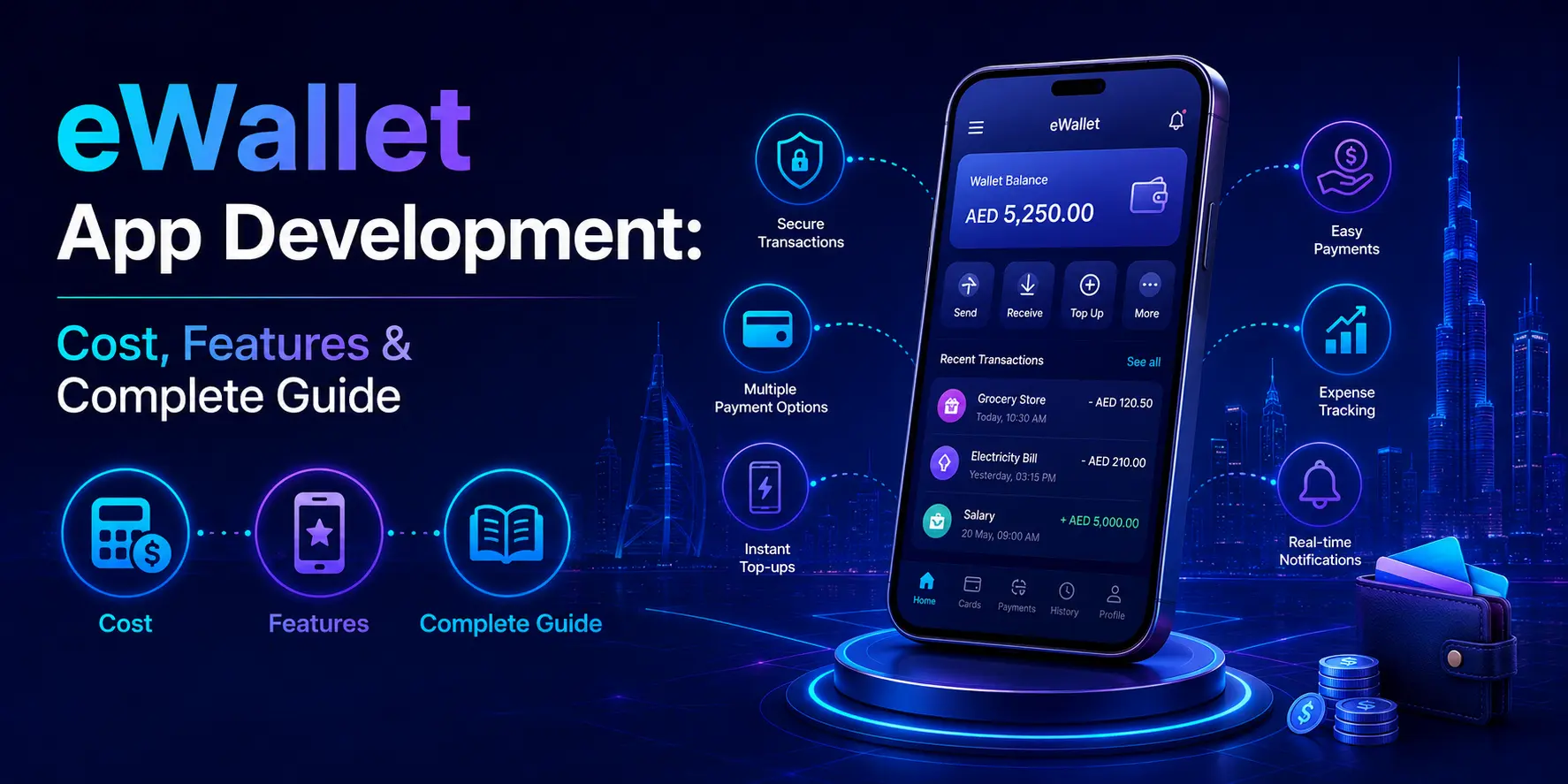
Digital payments have moved far beyond simple card transactions. Consumers now expect to store money, send and receive payments, pay bills, manage cards, access rewards, and complete purchases from a single mobile application.
This shift has created strong opportunities for businesses, financial institutions, retailers, and fintech startups investing in eWallet App Development. A well-designed wallet can combine payments, financial services, identify verification, security, and personalized experiences in one platform.
The global digital payments market continues to expand as smartphone adoption, contactless payments, instant transfers, and embedded finance become mainstream. For businesses, the opportunity is not only to build a payment application but to create a secure financial ecosystem that can scale across users, merchants, currencies, and services.
This guide explains eWallet App Development Cost, essential features, technology choices, development stages, security requirements, timelines, and the factors that influence the overall budget.
What is an eWallet App?
An eWallet app is a mobile or web-based application that allows users to digitally store payment information or monetary value and perform financial transactions.
Depending on the business model, an eWallet can support:
- Digital payments
- Peer-to-peer money transfers
- Bank transfers
- Debit and credit card management
- QR-code payments
- Bill payments
- Mobile recharges
- Merchant payments
- Loyalty and rewards
- International transfers
- Multi-currency transactions
- Transaction history
- Financial insights
Modern Mobile Wallet App Development can also integrate APIs, banking services, payment gateways, biometric authentication, artificial intelligence, blockchain, and cloud infrastructure.
Why Invest in eWallet App Development?
The rise of mobile-first financial services has made digital wallets an important part of the fintech ecosystem. Businesses investing in eWallet App Development and Digital Wallet App Development can create convenient payment experiences while building broader financial ecosystems for customers and merchants.
According to the World Bank’s Global Findex 2021, 76% of adults globally had an account at a bank or regulated financial institution or used mobile money, compared with 51% in 2011. The rapid adoption of digital payments has continued to create opportunities for wallet providers.
For businesses, an eWallet can provide several advantages:
| Benefit | Business Impact |
| Faster payments | Reduces friction during transactions |
| Mobile-first access | Allows customers to transact anywhere |
| Customer retention | Rewards and personalized services encourage repeat usage |
| Transaction data | Helps businesses understand customer behavior |
| Multiple revenue streams | Enables transaction fees, subscriptions, commissions, and partnerships |
| Financial ecosystem | Creates opportunities for lending, insurance, investments, and other services |
| Brand engagement | Keeps financial services within the company’s digital ecosystem |
Popular eWallet App Types for Modern Digital Payments
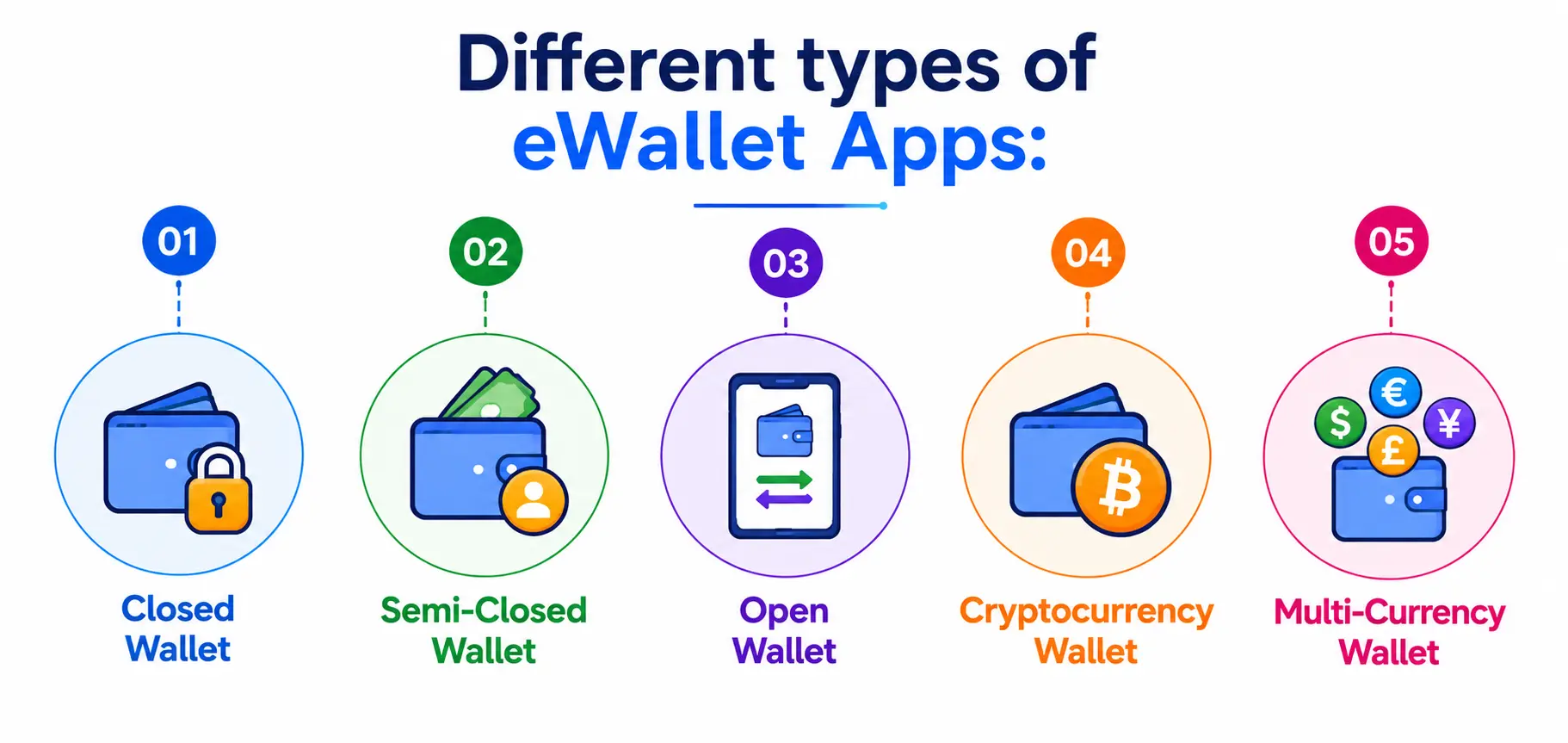
The type of wallet you develop directly affects functionality, compliance, integrations, and development costs.
1. Closed Wallet
A closed wallet is generally designed for transactions within a specific business ecosystem.
For example, customers may add money to a retailer’s wallet and use it to purchase products or services from that retailer.
2. Semi-Closed Wallet
Semi-closed wallets allow users to transact with participating merchants or service providers within an approved network.
3. Open Wallet
Open wallets support broader financial transactions and may enable services such as merchant payments, transfers, withdrawals, and bank integrations, depending on licensing and regulatory requirements.
4. Cryptocurrency Wallet
Crypto wallets manage digital assets and blockchain-based transactions. These platforms can require blockchain infrastructure, smart contracts, wallet security, and specialized key management.
This is where Blockchain App Development can become relevant for businesses planning digital-asset functionality.
5. Multi-Currency Wallet
A multi-currency wallet allows users to hold and transact in multiple currencies. Such applications typically require currency conversion, exchange-rate APIs, international payment integrations, and additional compliance controls.
Core Features Behind a High-Performing eWallet App
The right feature set depends on your target users, business model, regulatory environment, and transaction types.
Customer-Side Features
1. User Registration and Login
Users should be able to create accounts using email, phone numbers, social authentication, or other approved identity methods.
Multi-factor authentication can provide an additional security layer.
2. Digital Wallet
The wallet dashboard should display:
- Available balance
- Linked accounts
- Recent transactions
- Payment options
- Rewards
- Pending transactions
3. Add Money
Users can fund their wallets through supported methods such as:
- Debit cards
- Credit cards
- Bank accounts
- Instant transfers
- Payment gateways
4. Money Transfer
Users can send money to other users or supported bank accounts.
5. QR Payments
QR functionality can enable customers to scan merchant codes and complete payments quickly.
6. Bill Payments
The app can allow users to pay for utilities, telecommunications, subscriptions, and other recurring services.
7. Transaction History
Users should be able to filter transactions by:
- Data
- Amount
- Merchant
- Transaction type
- Status
8. Notifications
Real-time notifications can inform users about:
- Successful payments
- Failed transactions
- Money received
- Money sent
- Login attempts
- Promotional offers
9. Biometric Authentication
Fingerprint and facial authentication can make login and transaction authorization more convenient while adding an additional security layer.
10. Rewards and Loyalty
Businesses can integrate:
- Cashback
- Reward points
- Coupons
- Referral bonuses
- Membership benefits
11. Card Management
Users can add, remove, freeze, or manage supported payment cards depending on the wallet’s capabilities.
Merchant-Side Features
If your application supports merchants, a dedicated merchant dashboard should be included.
Important capabilities can include:
- Merchant registration
- KYC verification
- QR-code generation
- Payment acceptance
- Transaction management
- Refund processing
- Settlement tracking
- Sales analytics
- Customer insights
- Invoice generation
- Staff accounts
- Notifications
A merchant portal can turn the wallet into a two-sided ecosystem connecting consumers and businesses.
Admin Panel Features
The administration system controls the broader wallet ecosystem.
An eWallet admin panel may include:
- User management
- Merchant management
- KYC management
- Transaction monitoring
- Payment management
- Refund management
- Commission configuration
- Fraud alerts
- Content management
- Reports and analytics
- Role-based permissions
- Customer support
- System configuration
For a financial application, the admin panel should also provide detailed audit trails and controlled access to sensitive operations.
Essential Security Measures for a Secure eWallet App
Security should be designed into the architecture rather than added after development.
Important controls include:
1. Multi-Factor Authentication
Combining passwords, OTPs, biometric verification, or device authentication can reduce account takeover risks.
2. Encryption
Sensitive information should be encrypted during transmission and at rest.
3. Tokenization
Payment data can be tokenized to reduce exposure of sensitive card information.
4. Secure APIs
APIs should use authentication, authorization, rate limiting, validation, logging, and secure communication protocols.
5. Device Authentication
The platform can associate accounts with trusted devices and detect unusual login behavior.
5. Fraud Detection
Rule-based and machine-learning systems can monitor transaction behavior for suspicious activity.
6. Role-Based Access Control
Employees and administrators should receive only the permissions required for their roles.
7. Audit Logs
Security-sensitive actions and financial transactions should be recorded for investigation and compliance purposes.
8. PCI DSS Considerations
If the application stores, processes, or transmits payment card data, PCI DSS requirements may become relevant. The exact compliance obligations depend on the architecture, payment partners, and business model.
Next-Gen Features Powering Modern eWallet Apps
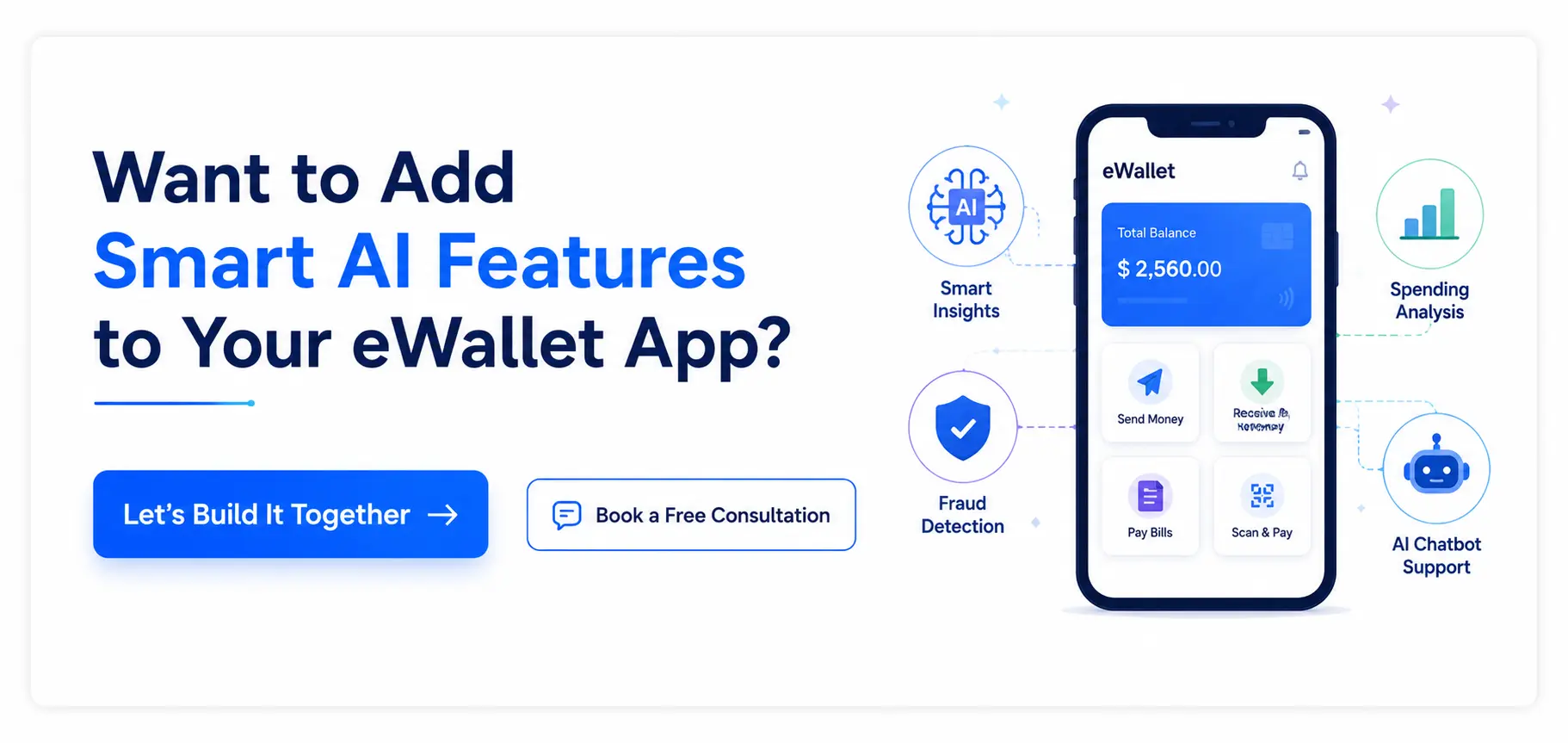
For a more sophisticated product, businesses can introduce advanced functionality to improve security, personalization, convenience, and financial management.
1. AI-Powered Insights:
Analyze user spending patterns and provide personalized financial insights. AI can help users understand their expenses and make more informed financial decisions.
2. Fraud Detection:
Monitor transaction behavior to identify unusual or suspicious activities. AI and rule-based systems can help detect potential fraud and trigger alerts in real time.
3. Expense Categorization:
Automatically organize transactions into categories such as shopping, dining, travel, and utilities. This makes it easier for users to track spending and manage their budgets.
4. Multi-Currency Support:
Allow users to hold, send, receive, and manage multiple currencies within one wallet. This feature is useful for international users, travelers, and cross-border transactions.
5. Voice Payments:
Enable users to perform selected wallet actions through voice commands. This can make common payment and account-management tasks faster and more accessible.
6. Blockchain Integration:
Integrate blockchain technology to support digital assets or blockchain-based transactions. This can be useful for wallets targeting cryptocurrency and other decentralized financial use cases.
7. Smart Notifications:
Deliver personalized alerts based on transactions, account activity, payment reminders, or spending patterns. Timely notifications can improve engagement while helping users monitor their finances.
8. Subscription Management:
Help users identify and track recurring payments and subscriptions. The feature can provide reminders about upcoming charges and make recurring expenses easier to manage.
9. Merchant Analytics:
Provide merchants with insights into transactions, sales patterns, and customer behavior. These analytics can support better decisions around promotions, customer retention, and business growth.
10. Digital Identity:
Integrate secure identity verification and authentication into the wallet experience. This can simplify onboarding and support KYC and other identity-related requirements.
11. Personalized Offers:
Use customer preferences and transaction behavior to deliver relevant offers, rewards, and promotions. Personalization can improve customer engagement and create additional revenue opportunities.
AI can play an important role across these advanced capabilities, particularly in fraud detection, customer segmentation, transaction monitoring, expense analysis, and personalized financial recommendations.
How Much Does It Cost to Develop an eWallet App?
The eWallet App Development Cost typically depends on application complexity, platforms, integrations, security requirements, compliance, design, backend architecture, and the development team’s location.
A particular planning range is:
| eWallet Type | Estimated Cost | Approx. Timeline |
| Basic wallet MVP | $25,000–$50,000 | 3–5 months |
| Standard wallet | $50,000–$100,000 | 5–8 months |
| Advanced fintech wallet | $100,000–$200,000+ | 8–12 months |
| Enterprise wallet | $200,000–$400,000+ | 12–18+ months |
These figures are planning estimates rather than fixed quotations. Actual costs can vary significantly depending on scope, compliance, integrations, development location, and third-party services.
Digital Wallet App Development Cost Breakdown
A typical budget can be distributed approximately as follows:
| Development Component | Estimated Share |
| UI/UX design | 10–15% |
| Mobile app development | 20–25% |
| Backend development | 20–30% |
| Payment and API integrations | 10–15% |
| Security and compliance | 10–20% |
| Testing and QA | 10–15% |
| Deployment | 3–5% |
| Post-launch maintenance | 10–20% annually |
For applications involving advanced fraud detection, blockchain, AI, international payments, or complex banking integrations, the budget can be considerably higher.
Key Factors Affecting eWallet App Development Cost
Several factors determine the final project budget.
1. Feature Complexity
The complexity and number of features have a direct impact on development costs. A basic wallet with registration, balance management, transfers, and transaction history will generally cost less than a platform with lending, investments, AI, rewards, multi-currency support, and merchant management.
2. Number of Platforms
Developing an eWallet for both Android App Development and iOS App Development requires additional development, testing, and maintenance compared with launching on a single platform. Cross-platform technologies can help reduce code duplication and development effort in some projects.
3. UI/UX Design
The scope of UI/UX design also influences the overall budget. A simple financial dashboard requires less design effort than a customized wallet with complex payment flows, financial analytics, merchant tools, personalization, and multiple user journeys.
4. Third-Party Integrations
Third-party integrations can increase development time and cost depending on their number and complexity. Common integrations include payment gateways, banking APIs, KYC and AML providers, SMS and OTP services, identity verification systems, currency exchange APIs, analytics platforms, maps, and cloud services.
5. Security Requirements
Financial applications require stronger security measures than many conventional mobile applications. Features such as multi-factor authentication, encryption, secure APIs, fraud detection, tokenization, device authentication, and audit logs can increase development requirements and costs.
6. Compliance
Compliance requirements can significantly influence the architecture and development process of eWallet. KYC, AML, data protection, payment regulations, reporting requirements, data storage policies, and other regulatory obligations may require additional development, testing, documentation, and operational resources.
7. Technology Stack
The selected technology stack affects both initial development and long-term maintenance costs. Frameworks, backend technologies, databases, cloud infrastructure, APIs, security tools, and third-party services should be selected according to the wallet’s performance, scalability, integration, and security requirements.
8. Development Team Location
The location and expertise of the development team can also affect the overall project budget. Developers rates vary considerably across regions, which is why two companies may provide different estimates for applications with similar features and functionality.
Challenges in eWallet App Development and How to Overcome Them
Building an eWallet involves several technical, security, regulatory, and user-experience challenges. Identifying these challenges early can help businesses reduce development risks, control costs, and create a more reliable financial platform.
1. Security & Fraud Prevention
eWallets handle sensitive financial and personal information, making them attractive targets for fraud and cyberattacks. Strong authentication, encryption, secure APIs, tokenization, fraud monitoring, and regular security testing should be integrated throughout development.
2. Regulatory Compliance
Different markets can have specific requirements for KYC, AML, data protection, payment processing, and financial reporting. Businesses should identify applicable regulations during the discovery stage and design the wallet’s architecture and workflows around those requirements.
3. Payment & Banking Integrations
Connecting an eWallet with payment gateways, banks, KYC providers, currency APIs, and other financial services can increase development complexity. Selecting reliable APIs and designing a modular integration architecture can make integrations easier to manage and scale.
4. Scalability & Performance
Transaction volumes can increase significantly as the wallet gains users and merchants. A scalable backend, cloud infrastructure, database architecture, caching, load testing, and performance monitoring can help the application handle higher traffic without compromising reliability.
5. User Trust and Adoption
Users expect financial applications to be simple, transparent, and secure. A clear UI/UX, easy onboarding, visible transaction statues, timely notifications, biometric authentication, and accessible customer support can help build confidence and encourage adoption.
6. Cross-Platform Compatibility
Supporting both Android and iOS can increase development and testing requirements. Businesses can choose native or cross-platform development based on their performance needs, target audience, budget, and required device capabilities.
7. Transaction Reliability
Failed, delayed, or duplicated transactions can negatively affect user trust. Proper transaction validation, real-time status tracking, error handling, reconciliation mechanisms, and detailed transaction logs can help maintain reliable payment operations.
8. Continuous Maintenance
An eWallet requires ongoing updates as operating systems, payment APIs, security standards, and regulatory requirements change. Continuous monitoring, security updates, performance optimization, and API maintenance help keep the application secure and functional after launch.
Technology Stack Behind a Modern eWallet App
A reliable eWallet App Development Technology Stack should support security, scalability, performance, integrations, and maintainability.
| Technology Layer | Common Options |
| iOS | Swift |
| Android | Kotlin |
| Cross-platform | Flutter, React Native |
| Frontend | React, Next.js |
| Backend | Node.js, Python, Java, .NET |
| Databases | PostgreSQL, MySQL, MongoDB |
| Cloud | AWS, Microsoft Azure, Google Cloud |
| APIs | REST, GraphQL |
| Authentication | OAuth 2.0, OpenID Connect |
| Notifications | Firebase Cloud Messaging, Apple Push Notification service |
| Analytics | Firebase, Mixpanel, custom analytics |
| AI/ML | Python, TensorFlow, PyTorch |
| Blockchain | Ethereum-compatible networks, Hyperledger and other suitable frameworks |
The final stack should be selected according to the application’s transaction volume, security requirements, integrations, team expertise, and regulatory environment.
Step-by-Step Process for Developing an eWallet App
A structured eWallet App Development Process helps businesses control project scope, reduce development risks, and build a secure and scalable financial platform. Each stage focuses on a specific aspect of the product, from initial planning to post-launch optimization.
Step 1: Discovery & Requirement Analysis
The development team defines the target users, business model, wallet type, transaction flows, core features, supported countries, payment methods, integrations, regulatory requirements, and security needs. This stage establishes a clear product specification, feature scope, and technical roadmap.
Step 2: UI/UX Design
Designers develop user journeys, wireframes, prototypes, visual designs, design systems, and responsive interfaces based on the defined requirements. The focus remains on creating a clear experience where users can easily understand balances, payments, transaction statuses, and other financial actions.
Step 3: Backend Architecture
The backend architecture is designed to manage user accounts, wallet balances, transactions, payment processing, authentication, notifications, KYC workflows, reporting, and security monitoring. A scalable backend helps the application handle increasing users and transaction volumes as the platform grows.
Step 4: Mobile App Development
Developers build the customer and merchant applications for the selected platforms based on the approved designs and technical architecture. Businesses can choose native or cross-platform development depending on their performance requirements, target users, budget, and platform strategy.
Step 5: API & Payment Integration
The application is connected with payment gateways, baking APIs, KYC providers, notification services, currency APIs, and other required third-party systems. Proper integration ensures that transactions and supporting financial services work smoothly within the wallet ecosystem.
Step 6: Security Implementation
Security controls are integrated throughout the development lifecycle rather than being added only before launch. Measures such as encryption, multi-factor authentication, secure APIs, tokenization, fraud monitoring, and access controls help protect user and transaction data.
Step 7: Testing and QA
The application undergoes functional, integration, API, performance, security, usability, device, regression, and user acceptance testing. Through QA helps identify technical issues, payment failures, security vulnerabilities, and usability problems before the wallet reaches customers.
Step 8: Deployment
Once development, testing, and required compliance checks are completed, the application is prepared for deployment. The team publishes the mobile applications to the relevant app stores and deploys the backend and supporting infrastructure to the selected cloud environment.
Step 9: Monitoring & Maintenance
Post-launch maintenance includes bug fixes, security updates, performance optimization, operating system compatibility, API maintenance, infrastructure monitoring, and new feature releases. Continuous monitoring helps maintain reliability while allowing the wallet to evolve with changing customer and business requirements.
How Long Does It Take to Develop an eWallet App?
The eWallet App Development Time depends on product complexity and the number of platforms and integrations involved.
| Development Stage | Typical Duration |
| Discovery and planning | 2–4 weeks |
| UI/UX design | 3–6 weeks |
| Backend development | 8–16 weeks |
| Mobile development | 8–16 weeks |
| API integrations | 3–8 weeks |
| Security implementation | 3–6 weeks |
| Testing and QA | 4–8 weeks |
| Deployment | 1–3 weeks |
Some activities overlap, so the total timeline is not simply the sum of every stage.
A basic MVP may take around 3-5 months, while an enterprise-grade wallet can require 12-18 months or longer.
Smart Revenue Strategies for eWallet Apps
An eWallet can generate revenue through multiple channels.
1. Transaction Fees
Charge a small fee for selected transfers, payments, or withdrawals.
2. Merchant Fees
Merchants can be charged transaction or service fees for accepting wallet payments.
3. Premium Subscriptions
Advanced features can be offered through monthly or annual subscriptions.
4. Currency Conversion
Multi-currency wallets can generate revenue through exchange-related fees or spreads, subject to applicable regulations.
5. Partner Commissions
Businesses can generate commissions through financial products, insurance, travel, subscriptions, or other integrated services.
6. Advertising & Offers
Relevant promotions can generate additional revenue while providing merchants with access to wallet users.
A diversified model can reduce dependence on a single revenue source.
How to Choose an eWallet App Development Company?
Selecting the right eWallet App Development Company requires evaluating technical and domain expertise.
Consider these factors:
1. Fintech Experience
Review previous financial applications and payment-related projects.
2. Security Expertise
Ask how the team approaches encryption, authentication, API security, fraud prevention, and secure infrastructure.
3. Integration Capabilities
The development partner should be able to work with payment gateways, banking APIs, KYC providers, and other financial services.
4. Scalability
The architecture should be capable of handling growing users and transaction volumes.
5. Technology Expertise
Check experience across mobile, backend, cloud, databases, APIs, AI, and blockchain where required.
6. Post-Launch Support
A wallet requires continuous maintenance because payment providers, operating systems, security standards, and regulatory requirements can change.
Partner With Aarmeh to Build Your Next-Gen eWallet App
A successful eWallet requires more than a user-friendly payment interface. Aarmeh combines secure architecture, seamless integrations, intuitive UI/UX, and scalable technology to help businesses build reliable digital wallet solutions that can support growing transaction volumes and evolving financial services.
Whether you are planning Mobile Wallet App Development, Fintech App Development, or a broader digital payment platform, Aarmeh helps you define and develop a focused MVP that aligns with your business goals while keeping eWallet App Development Cost under control. As your product grows, additional capabilities can be introduced based on user needs and market opportunities.
As an experienced eWallet App Development Company, Aarmeh provides end-to-end support across strategy, UI/UX design, mobile and backend development, payment integrations, security, testing, deployment, and maintenance. Our eWallet App Development Services are designed to help turn your concept into a secure, scalable, and user-focused wallet solution built for long-term growth.
Final Thoughts
eWallets are becoming an important part of the modern digital payment ecosystem, creating opportunities for fintech startups, banks, retailers, and enterprises. However, successful eWallet App Development requires more than adding payment functionality. Security, compliance, seamless integrations, scalability, user experience, and reliable performance all play an important role.
The overall eWallet App Development Cost depends on the features, platforms, technology stack, integrations, security requirements, and complexity of the product. Starting with a well-defined MVP can help businesses validate their concept and control initial investment before expanding into advanced capabilities such as AI-powered insights, multi-currency payments, rewards, or blockchain-based services.
With the right strategy, technology, and development partner, businesses can build an eWallet that meets current customer expectations while providing a scalable foundation for long-term growth.
Frequently Asked Questions
Q. How much does it cost to develop an eWallet app?
The cost can range from approximately $25,000 to $400,000+, depending on features, platforms, integrations, security, compliance, and complexity. A basic MVP typically costs less, while enterprise-grade fintech platforms require significantly larger budgets.
Q. How long does eWallet app development take?
A basic MVP can take approximately 3–5 months. A standard wallet may require 5–8 months, while advanced and enterprise platforms can take 8–18+ months.
Q. What are the most important eWallet app features?
Core features include registration, wallet balance, money transfers, payment processing, transaction history, notifications, QR payments, security, KYC, and customer support. Advanced wallets can also include AI insights, rewards, multi-currency support, and merchant management.
Q. What technology is best for eWallet app development?
There is no single best stack. Swift or Kotlin can be used for native apps, while Flutter or React Native can support cross-platform development. Backend technologies such as Node.js, Python, Java, or .NET can be selected based on project requirements.




 Book a call




 CLUTCH VERIFIED
 Top App Developer UAE
 100% NDA Protected
 IN THE HEART OF UAE