





Table of Contents
📌 Key Takeaways
- Fantasy sports is a complex digital product, requiring real-time sports data, accurate scoring engines, scalable backends, secure payments, and live leaderboards.
- Core features drive the user experience, from registration and team creation to contests, player statistics, notifications, wallets, customer support, and admin controls.
- AI and advanced features can improve engagement, with player analytics, personalised recommendations, social leagues, multilingual support, and real-time contest formats adding capabilities beyond basic fantasy gameplay.
- Development costs depend heavily on scope, with a basic MVP estimated at $25,000–$45,000 and advanced or enterprise platforms potentially exceeding $100,000 due to infrastructure, integrations, security, and payment requirements.
- UAE regulatory compliance must be addressed early, as the GCGRA framework includes fantasy games within internet gaming; businesses should clarify licensing and legal requirements before development and launch.
Fantasy sports isn’t a side hobby anymore, not for cricket fans, not for football fans, not for anyone. It’s a full digital product category now, built on live match data, player stats, real-money or point-based contests, and a mountain of backend engineering that nobody watching the match ever sees. Think about what’s actually happening when you’re adjusting your fantasy team while a wicket falls in real time. Someone built a pipeline to get that ball-by-ball event onto your screen in seconds. That pipeline is the product. The team-selection screen is just the part users touch.
Fantasy Sports App Development Market and Its Growing Digital Opportunity
And the numbers back it up. The global fantasy sports market sat at roughly $27.8 billion in 2025, and Grand View Research expects it to hit $75.1 billion by 2033 at a 13.3% CAGR. Apps already own this space: 78.1% of the market runs through them, and smartphones alone account for over half by device. The UAE is riding the same wave $246.8 million in fantasy sports revenue in 2024, with projections putting that at $734.7 million by 2030.
So yes, the opportunity’s real. But here’s the thing people underestimate: a fantasy platform is nothing like a regular consumer app. Data has to be accurate down to the second. Scoring can’t have a single bug in it. Payments need to be airtight. And in the UAE specifically, the legal groundwork has to be sorted before anyone writes a line of code not after.
What Exactly Is a Fantasy Sports App?
At its core, a fantasy sports app is simple: pick real athletes, build a virtual team, earn points based on how they actually perform. What’s underneath it isn’t simple at all; there are usually three layers doing the real work. The app itself, which is all the user ever sees. An admin panel behind it, where the operator actually runs contests and keeps an eye on what’s happening. And a backend quietly holding everything together accounts, scoring, payments, data the stuff nobody thinks about until it breaks.
Take a cricket contest as an example. A user picks 11 players within a set budget and role limits. As the match unfolds, a sports data provider sends event updates a wicket, a boundary, a run-out and the backend converts each of those into fantasy points, recalculates the leaderboard, and pushes the update to every participant’s screen. None of that happens by accident. It’s a scoring engine built specifically to never be wrong.
What Types of Fantasy Sports Apps Can You Build?
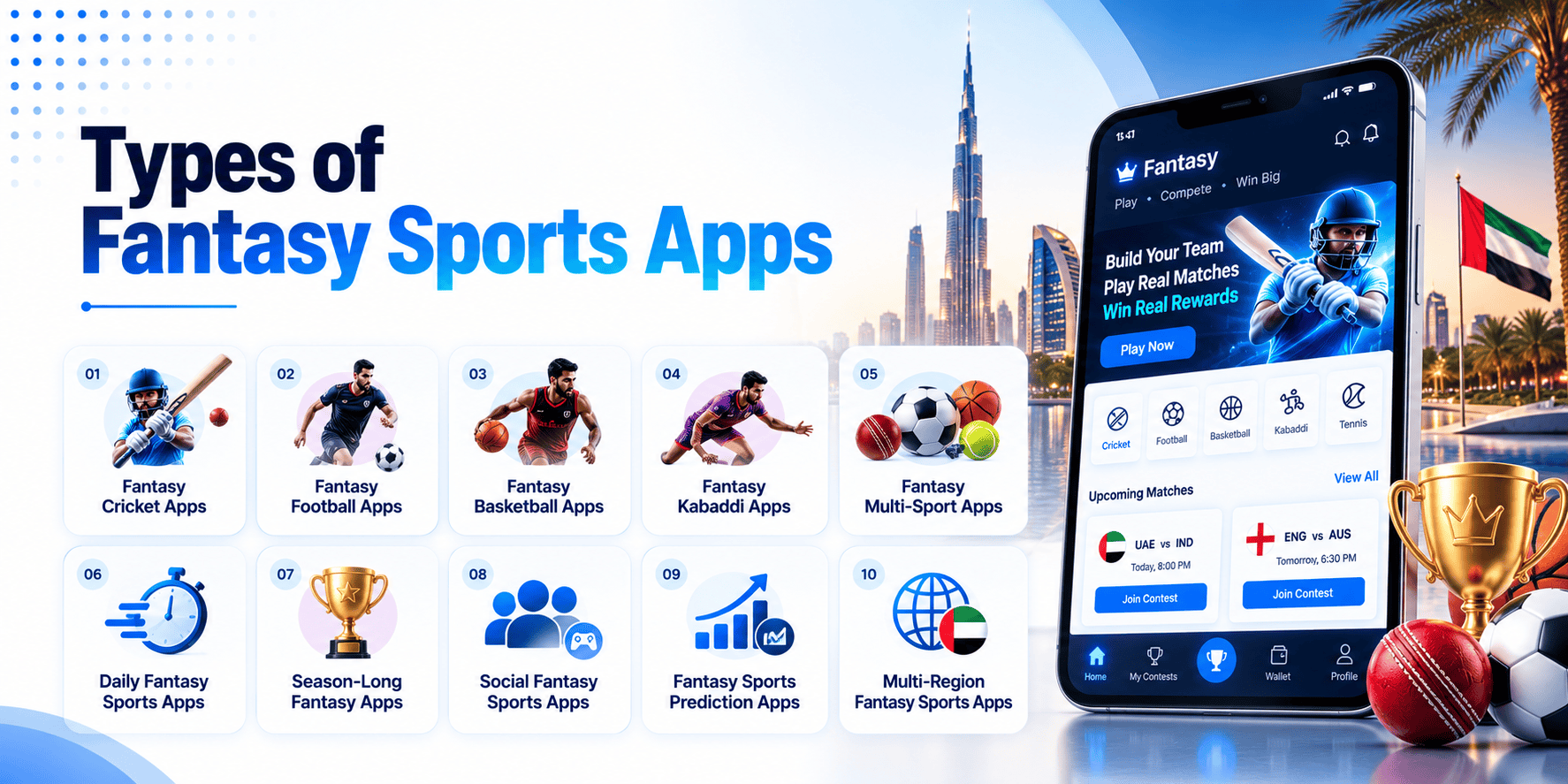
Fantasy sports platforms can be structured in several ways, depending on the sport, audience, contest format, and revenue model. The right approach is usually determined by how users are expected to play rather than by the number of features packed into the app.
Daily Fantasy Sports Apps
Daily fantasy sports apps revolve around short-duration contests, usually tied to a single match, game, or slate of fixtures. Users create a team, join a contest, and receive results once the relevant games finish. Cricket and football work particularly well with this model because matches already have clearly defined start and end points.
Season-Long Fantasy Apps
Season-long platforms let users manage their fantasy teams across an entire competition or league. Drafts, transfers, player trades, injuries, and cumulative statistics become more important than one-off contests. This model needs stronger team-management features and a backend capable of retaining player and league data throughout the season.
Peer-to-Peer Fantasy Platforms
In a peer-to-peer model, users compete directly against other participants rather than playing against the platform itself. Private leagues, head-to-head contests, and friend groups are common examples. The technology needs to handle matchmaking, contest rules, rankings, entry conditions, and settlement accurately.
Fantasy Leagues and Tournament Apps
These platforms focus on larger competitions where hundreds or thousands of users can participate in the same tournament. They require scalable contest management, real-time leaderboards, automated prize calculations, and infrastructure capable of handling sudden traffic spikes when popular matches begin.
Multi-Sport Fantasy Apps
A multi-sport platform brings several sports into one application, such as cricket, football, basketball, baseball, or esports. While this broadens the potential audience, it also makes the underlying architecture more complicated because every sport has different event types, player roles, statistics, and scoring rules.
Social Fantasy Sports Apps
Social-first fantasy apps combine team selection with features such as private leagues, friends, chat, activity feeds, referrals, and social sharing. The objective is to make the experience feel less like a standalone statistics product and more like a community built around live sports.
Why Businesses Are Building Fantasy Platforms Right Now?
Sports fans don’t just want to watch anymore, they want to participate. Fantasy apps give them a reason to check stats mid-match, argue with friends over a caption pick, and stay engaged for the full 90 minutes instead of just the highlights. That’s a stickier kind of engagement than most sports content can offer.
For operators, the mobile-first nature of this market means the real opportunity sits in the app, not a companion website. Revenue can come from several directions: subscriptions, ads, sponsorships, premium stats, paid contests where the law allows it but here’s the catch: whichever model you pick has to be decided before development starts. Operators weighing speed against control at this stage often land on white label fantasy sports software to launch faster, accepting less customisation in exchange for a working core out of the box. It shapes how the wallet system is built, how contest logic works, what compliance reporting looks like, and honestly, half the backend architecture. Get this decision wrong early and you’ll be rebuilding core modules later, which is exactly the kind of costly rework a good fantasy sports app development company in the UAE helps operators avoid from the start.
What Features Should a Fantasy Sports App Include?
A fantasy app is more than a sign-up screen and a “Create Team” button. It needs to carry a user from discovering a match, to joining a contest, to watching it live, to managing their account afterward without friction at any step.
User Registration and Profiles
Email, phone, or social sign-in should all work. Beyond that, a profile typically holds personal details, favourite sports, contest and team history, transaction records, and relevant identity verification and responsible-gaming settings.
Sports and League Discovery
The home screen needs to surface upcoming matches and live contests without making the user dig for them. Football, cricket, basketball, tennis, esports whatever’s in scope depends on your target market, data licensing, and local regulations.
Team Creation
This is the heart of the product. Users get a budget and pick players under constraints, a cap on players from one real team, position limits, a captain multiplier, that kind of thing. The interface needs to surface stats and form without turning into a spreadsheet.
Contest Management
Head-to-head matchups, small leagues, private contests among friends, large public pools, season-long formats operators need to configure all of this from the admin side, including entry rules, prize structures, and eligibility.
Live Leaderboards
This is where real-time engineering shows up. As match events come in, scores update and leaderboards shift, ideally without the user hitting refresh. Event-driven architecture and caching matter a lot here, especially during high-traffic contests.
Player Statistics
Recent form, averages, goals or wickets, injury status whatever the sport supports. What you can show depends entirely on your data provider’s feed.
Notifications
Match start times, team-lock deadlines, leaderboard shifts, results. These need to respect user preferences and, depending on the market, advertising regulations too.
Wallet and Transaction History
Where monetary contests are legally permitted, the wallet needs to clearly separate deposited funds, winnings, promotional credits, and refunds with every transaction logged and auditable.
Admin Dashboard
This is the operator’s control room, plain and simple. User management, KYC, contest creation, scoring configuration, live monitoring, wallet oversight, fraud checks, reporting if something needs watching or adjusting on the platform, it happens here.
Customer Support
FAQs and automated help cover the easy stuff. But payments, verification, and scoring disputes are the things people actually get anxious about needing a real person to step in, not another chatbot loop.
What Advanced Features Can Enhance a Fantasy Sports App?
Want To Add These Advanced Features To Your Fantasy Sports App?
Feel Free To Book An Initial Call With Our Experts!
Once the core product is stable and working, this is where a platform actually starts to stand out from the ten other fantasy apps doing the same basic thing.
AI-Based Player Analytics and Predictions
Historical stats, recent form, venue trends, matchup data AI can turn all of that into player comparisons and projected performance ranges. The key is framing it as decision support, not a guarantee. And it’s only as good as the data behind it; feed it a shaky pipeline and you’ll get confident-sounding nonsense.
Personalised Recommendations
A user who only follows football shouldn’t be getting cricket contests pushed at them. Behavioral data should quietly shape what each person sees.
Social Features
Friends lists, private leagues, chat, referral programmes these genuinely boost retention, but they need real moderation behind them, not an afterthought bolted on after launch.
Multi-Language Support
For UAE and GCC markets specifically, Arabic and English with proper RTL support isn’t a nice-to-have. It needs to be part of the foundation, not a translation pass at the end.
Crypto Wallet Integration
Worth having on the roadmap for some operators, but never worth adding just because it sounds modern. Crypto wallet integration for fantasy sports comes with real questions around custody, transaction monitoring, and especially in the UAE whether it’s even legally permitted for your model.
Which Technology Stack Should You Choose for a Fantasy Sports App?
There’s no single “correct” stack for a fantasy app; it depends on sports coverage, traffic expectations, target geography, and how many platforms you’re shipping to.
| Layer | Common choices |
| Mobile | Flutter, React Native, Swift, Kotlin |
| Web | React.js, Next.js |
| Backend | Node.js, Python, Java, .NET |
| Database | PostgreSQL, MySQL, MongoDB |
| Caching | Redis |
| Real-time layer | WebSockets, Socket.IO |
| Cloud | AWS, Azure, Google Cloud |
| AI/ML | Python, TensorFlow, PyTorch |
| DevOps | Docker, Kubernetes, GitHub Actions |
For operators launching on Android and iOS, cross-platform development with Flutter or React Native can streamline development, reduce maintenance, and speed up time to market. One codebase, faster iteration, way less maintenance headache down the line. Underneath that, the platform still needs scalable cloud architecture for gaming to handle the traffic spikes a single tournament final can bring. Native development with Swift and Kotlin still earns its place too, particularly when an app needs deep platform-specific access that cross-platform frameworks tend to fumble. Neither one wins by default. It comes down to what the product actually needs, not which framework is trending this year.
How Much Does It Cost to Build a Fantasy Sports App?
This is usually the first question and the hardest to answer with a single number, because so much depends on scope.
| App type | Estimated cost | Timeline |
| Basic MVP | $25,000–$45,000 | 3–4 months |
| Standard fantasy app | $50,000–$90,000 | 5–7 months |
| Advanced platform | $100,000–$180,000 | 7–10 months |
| Enterprise platform | $180,000–$300,000+ | 10–15+ months |
So, how much does it cost to build a fantasy app in practical terms? Fantasy Sports App Development Cost for an MVP with registration, team creation, basic contests, live data, and leaderboards on a single mobile platform generally lands in the $25,000–$45,000 range. Add Android and iOS together, multiple sports, real-time scoring at scale, advanced analytics, full payment workflows, fraud monitoring, and multilingual support, and costs move past $100,000 fairly quickly. The biggest drivers are almost always live data infrastructure, backend architecture, security, and payment functionality, not the UI, which is usually the smallest line item on the whole budget.
Roughly, development effort tends to split like this: 8–12% design, 20–30% mobile and web build, 20–25% backend, 8–12% sports API integration, 6–10% wallet and payments, and 10–15% QA and security testing, with the remainder going toward admin tooling, AI, and DevOps. An MVP can usually skip AI entirely without losing much; an enterprise build, on the other hand, tends to pour a much bigger share into analytics and infrastructure because at that scale, the data is the product.
What Are the Legal and Licensing Requirements for Fantasy Apps in the UAE?
The General Commercial Gaming Regulatory Authority (GCGRA) explicitly includes fantasy games under its definition of internet gaming, alongside other skill- and chance-based formats. Operating commercial gaming in the UAE without a valid licence is illegal under its framework, and that framework applies to both operators and gaming-related vendors.
What this means practically: legal and licensing review needs to happen before your business model is finalised, not after the app is built. A development partner can architect the technical side, but licensing and regulatory interpretation belong with qualified legal counsel.
What Are the Key Challenges in Fantasy Sports App Development?
The visible part of a fantasy platform can look deceptively straightforward. The real engineering challenges appear when live sports data, thousands of concurrent users, scoring rules, payments, and regulatory requirements all have to work together without compromising accuracy.
Handling Real-Time Sports Data
Sports feeds can arrive rapidly and occasionally contain delays, corrections, duplicates, or missing events. The platform therefore needs validation and event-processing logic before information reaches the scoring engine. Building reliable fallback and reconciliation mechanisms is particularly important during high-profile matches.
Maintaining Scoring Accuracy
Fantasy scoring is unforgiving. If a wicket, goal, assist, card, or other event is processed incorrectly, the error can affect thousands of teams simultaneously. Scoring rules should be centrally managed, version-controlled, thoroughly tested, and supported by detailed event logs.
Managing Traffic Spikes
Traffic rarely arrives evenly throughout a match. A major tournament, final, or highly anticipated fixture can produce a sharp increase in simultaneous users and API requests. Cloud auto-scaling, Redis caching, load balancing, database optimisation, and event-driven processing can help absorb these peaks.
Preventing Fraud and Abuse
Fantasy platforms can attract account sharing, automated activity, bonus abuse, payment fraud, and attempts to manipulate contests. Strong authentication, device and behaviour monitoring, rate limiting, identity verification where applicable, and transaction-level controls should be considered as part of the initial architecture.
Integrating Multiple External Services
A production fantasy platform may depend on sports data providers, payment gateways, KYC services, notification systems, analytics tools, cloud infrastructure, and other third-party services. Each dependency introduces another potential failure point, so integrations need monitoring, error handling, and clear fallback behaviour.
Supporting Multiple Sports
Adding another sport is rarely as simple as adding another item to a dropdown. Different sports have different player roles, event structures, statistics, scoring rules, and data feeds. A flexible domain model and configurable scoring engine can make future expansion considerably easier.
Balancing Performance With Feature Growth
It is tempting to keep adding chat, AI insights, social features, advanced statistics, live swaps, referrals, and other capabilities. But every new module adds infrastructure and testing requirements. A focused MVP followed by measured expansion can reduce unnecessary complexity while the core product is still being validated.
Keeping Compliance Flexible
Gaming and fantasy-sports regulations can differ between markets and may evolve over time. Building compliance-related controls as configurable modules rather than hard-coding every rule into the core application can make future changes easier to manage. For regulated markets, however, technical flexibility does not replace professional legal advice.
What Are the Steps in Fantasy Sports App Development?
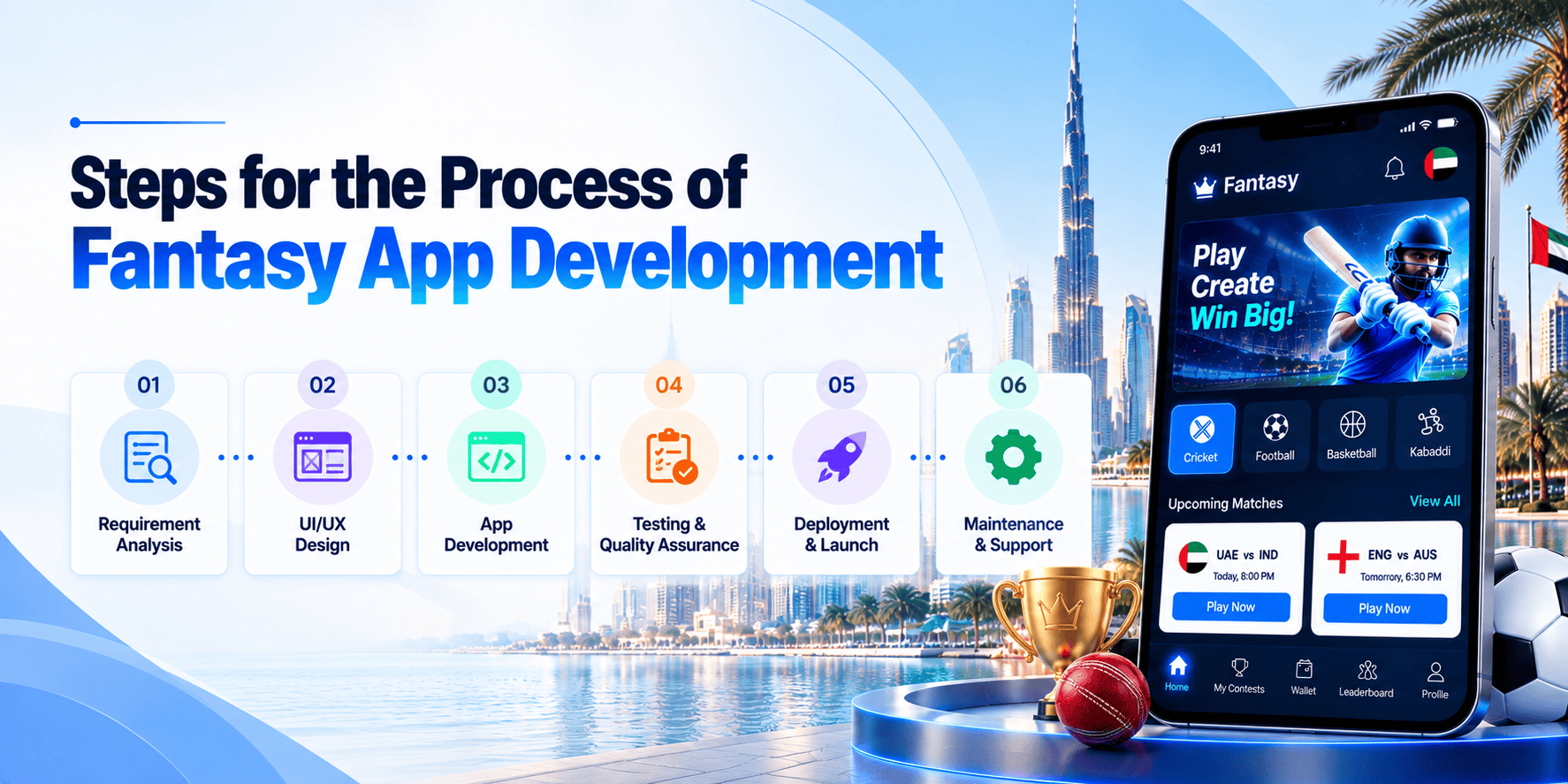
A successful fantasy sports app needs product, data infrastructure, compliance, and operations planning to move together from day one. Treating regulatory and licensing requirements as a final-stage checklist is one of the most common and expensive mistakes operators make.
Step 1: Define the Business Model
Start by clearly deciding what the platform will offer, which sports it covers, which markets it serves, and how it monetises subscriptions, ads, sponsorships, or paid contests where legally permitted. These decisions shape the required architecture, wallet design, and overall development budget.
Step 2: Map Regulatory Requirements
Identify the licensing, KYC, consumer protection, and gaming regulations that apply to the product and target market. For UAE-based platforms, requirements set by the General Commercial Gaming Regulatory Authority (GCGRA) should be assessed early, since fantasy games fall explicitly under its internet gaming framework.
Step 3: Design the UX and Architecture
Map out clear user journeys for registration, team creation, contest entry, live scoring, and payments, while defining the backend architecture, event logging, and infrastructure needed to support real-time data at scale.
Step 4: Build the MVP
Develop the minimum viable version around the core fantasy experience, not simply a reduced number of screens. A fantasy MVP typically includes registration, sports and match selection, team creation, basic contests, live scoring, a leaderboard, and a lightweight admin panel.
Step 5: Integrate Sports and Payment Services
Connect the platform to the external services its model actually depends on real-time sports API integration with a live data provider, payment gateways, KYC vendors, and fraud-monitoring tools. Which integrations are required depends heavily on the sports covered, the target market, and whether monetary contests are involved.
Step 6: Test Data Accuracy and Scoring Logic
Testing needs to cover both standard app functionality and fantasy-specific behaviour event processing, scoring accuracy, duplicate-event handling, payment flows, transaction limits, and load performance during simulated high-traffic contests. Teams should also stress-test edge cases: delayed sports feeds, failed payments, and simultaneous leaderboard updates at scale.
Step 7: Launch and Monitor
After launch, continuously monitor application performance, sports-feed health, transaction activity, fraud risk, and compliance rather than treating any of it as a one-time task. Regular patching, incident response, log analysis, and user feedback all help keep the platform reliable match after match.
How to Choose a Fantasy Sports App Development Company?
Choosing a development partner for a fantasy platform requires looking beyond portfolios filled with polished mobile interfaces. The difficult part is building the infrastructure underneath those interfaces and making sure it behaves correctly when thousands of users are watching the same match.
Experience With Real-Time Applications
Ask whether the development team has worked with products that depend on live data and continuous updates. Fantasy platforms need event processing, real-time communication, caching, and scalable infrastructure rather than a conventional request-and-response application alone.
Sports Data Integration Capabilities
The quality of the fantasy experience depends heavily on the sports data feed. Your development partner should understand API integration, event validation, player-stat synchronisation, feed failures, delayed updates, and duplicate-event handling. It is also worth confirming whether the required data can legally be licensed for your target markets.
Strong Backend and Scoring Expertise
The scoring engine is one of the most sensitive parts of the platform. A single incorrect event can affect player points, rankings, contests, and potentially financial settlements. Look for developers who can explain how they would isolate scoring logic, maintain audit trails, process events, and recover from data inconsistencies.
Security and Payment Experience
If the business model involves monetary transactions, payment architecture deserves attention from the beginning. Evaluate experience with secure payment gateways, wallet systems, transaction reconciliation, authentication, fraud monitoring, webhook verification, and audit logging.
Regulatory Understanding
Regulatory requirements vary according to the jurisdiction and the exact fantasy model being proposed. For a UAE project, the applicable General Commercial Gaming Regulatory Authority framework should be reviewed with qualified legal counsel before the business model and technical scope are finalised.
Scalable Technology Architecture
A fantasy app may perform perfectly during development and still struggle when a major tournament attracts a sudden surge of users. Ask the development company how it plans to handle concurrent users, live-score traffic, database load, caching, failover, monitoring, and cloud scaling.
Post-Launch Support
The work does not stop when the app reaches the stores. Sports APIs change, operating systems receive updates, payment providers modify integrations, and new competition formats may need to be introduced. A development partner should have a clear plan for maintenance, monitoring, security patches, and future development.
What Are the Future Trends in Fantasy Sports App Development?
Want An App Built Around AI, Real-Time Payments, and Tomorrow's Regulations?
Talk It Through With Our Team Before You Commit To Anything!
The next generation of fantasy sports platforms is likely to combine richer sports data, AI, real-time payments, and stronger security into one connected experience rather than treating each as a separate add-on.
-
AI-Powered Player Insights
AI App Development can introduce capabilities such as predictive player analytics, injury-risk modelling, weather-adjusted performance projections, and personalised contest recommendations. However, AI used in scoring-adjacent or prediction features should include data-quality controls, clear framing as decision support rather than guarantees, and ongoing monitoring for bias or drift as player data changes season to season.
-
Real-Time and Micro-Contest Formats
Season-long leagues aren’t disappearing, but shorter formats, single-innings contests, quarter-by-quarter fantasy, and live in-match team swaps are gaining ground. This shift favours platforms built on event-driven architecture, since these formats depend entirely on scores updating the moment something happens on the field.
-
Deeper Esports Integration
Esports fantasy is younger than traditional sports fantasy but growing quickly, and it requires a different data model, entirely different event types, different scoring logic, and often different data providers altogether. Platforms that plan for this early avoid rebuilding their scoring engine from scratch later.
-
Embedded Wallets and Instant Payouts
Payment Gateway Integration is moving toward instant transfers and near-immediate payout confirmation rather than delayed settlement. This supports faster cash flow for operators and a noticeably better experience for users cashing out winnings, particularly during high-stakes tournament periods.
-
Tighter Regulatory Frameworks
As markets like the UAE formalise gaming regulation, licensing and compliance requirements are likely to become more specific, not less. Platforms built with compliance flexibility from the start rather than compliance bolted on after launch will be far better positioned to adapt as GCGRA and similar frameworks evolve.
-
Stronger Platform Security
As more fantasy activity moves through mobile devices and involves real transactions, platforms need to protect user and payment data through encryption, strong authentication, fraud monitoring, and anti-tampering measures as a baseline, not an optional upgrade.
Why Choose Aarmeh for Fantasy Sports App Development?
Plenty of development shops can build a team-selection screen and call it a fantasy app. Fewer can build the parts underneath it that actually matter: the scoring engine that never miscounts a run, the architecture that holds up during a World Cup final, the payment flow that survives an audit. That’s the gap Aarmeh works in.
-
Real-Time Architecture From Day One
Fantasy apps live or die on how fast and accurately live sports data turns into scores. Our teams design the sports-feed integration and scoring engine as separate, isolated systems from the start, so a data-provider outage never takes your entire contest logic down with it.
-
UAE Regulatory Awareness Built Into Planning
Fantasy games fall under the GCGRA’s internet gaming framework, and we treat that as a planning input, not an afterthought. We help clients scope their business model with licensing in mind before development starts, so nobody’s rebuilding core modules six months in because a compliance requirement got missed.
-
Architecture Scoped to the Product, Not a Template
Whether you need a lean MVP to validate the market or enterprise fantasy sports solutions built as independently scalable services, we scope the build around your contest formats, payment model, and expected traffic not around a template we reuse for every client.
-
Security and payments Built In From the Start
Encryption, fraud monitoring, server-side payment verification, and audit logging are part of the architecture from the first sprint, because retrofitting them after launch is where most platforms run into trouble.
-
Ongoing Support After Launch
Real-time products don’t stay stable on their own. We monitor feed latency, scoring performance, and payment reliability post-launch, and use that data to guide what gets built next rather than handing over an app and disappearing.
Final Thoughts
None of this is about picking the trendiest framework. Building a fantasy sports platform comes down to one thing: keeping sports data, scoring, contests, and money synchronised in real time, without gaps and that’s the standard we hold ourselves to as a fantasy sports app development company in the UAE.
At Aarmeh, we work as a fantasy sports app development company in the UAE that helps businesses build platforms the right way, validated business model first, MVP scoped realistically, and an architecture that won’t need to be rebuilt the moment it starts scaling. Whether you’re looking to hire fantasy sports app developers for a lean MVP or need a full enterprise-grade build, get in touch and we’ll walk through what your product actually needs.
Frequently Asked Questions (FAQs)
Q. How much does it cost to build a fantasy sports app?
A fantasy sports app can cost around $25,000–$45,000 for an MVP, while advanced platforms with multiple sports, real-time scoring, payments, analytics, and scalable infrastructure can exceed $100,000.
Q. How long does it take to develop a fantasy sports app?
A basic fantasy sports MVP generally takes 3–4 months to develop. A standard platform may require 5–7 months, while an enterprise-grade product with advanced integrations and analytics can take 10–15 months or longer.
Q. What sports can be included in a fantasy sports app?
A platform can support cricket, football, basketball, baseball, hockey, tennis, golf, motorsport, esports, and other sports, depending on data availability, licensing, audience demand, and applicable regulations.
Q. What is required for real-time fantasy sports scoring?
Real-time scoring requires reliable sports data, an event-processing layer, scoring algorithms, caching, databases, and real-time communication technologies. The system must validate incoming match events before updating player scores and leaderboards.
Q. Can AI be integrated into a fantasy sports app?
Yes. AI can analyse historical player statistics, recent performance, team combinations, and other available data to generate statistical insights, player comparisons, and projected performance ranges. These outputs should not be presented as guaranteed predictions.
Q. Can a fantasy sports app support both Android and iOS?
Yes. Cross-platform frameworks such as Flutter and React Native can support Android and iOS from a shared codebase, while native development with Kotlin and Swift provides platform-specific implementation.
Q. What payment methods can be integrated into a fantasy sports app?
Depending on the market and approved business model, applications may integrate cards, bank transfers, digital wallets, and other supported payment methods. Payment workflows should include server-side verification, transaction reconciliation, encryption, and secure webhook handling.
Q. How do I choose a fantasy sports app development company in the UAE?
Evaluate the development team’s experience with real-time applications, sports APIs, scalable backend systems, payment infrastructure, security, cloud deployment, analytics, and multilingual interfaces. For UAE projects, also assess whether the team can work within the requirements established by the applicable regulatory framework.
Q. What technologies are commonly used to build fantasy sports apps?
Common technologies include Flutter or React Native for mobile development, React or Next.js for web applications, Node.js, Python, Java, or .NET for backend systems, PostgreSQL or MongoDB for databases, Redis for caching, and AWS, Azure, or Google Cloud for infrastructure.
Q. What security features should a fantasy sports app have?
Important measures include encrypted communication, secure authentication, multi-factor authentication, role-based access control, API rate limiting, secure payment processing, fraud monitoring, audit logging, vulnerability testing, backups, and disaster-recovery mechanisms.
Q. Do fantasy sports apps require licensing in the UAE?
The regulatory requirements depend on the specific business model and activities involved. The UAE General Commercial Gaming Regulatory Authority states that its regulated internet-gaming activities include fantasy games and that commercial gaming activities covered by its framework require appropriate licensing. Businesses should obtain qualified legal and regulatory advice before launch.





 Book a call




 CLUTCH VERIFIED
 Top App Developer UAE
 100% NDA Protected
 IN THE HEART OF UAE