





Table of Contents
📌 Key Takeaways
- Real estate app development starts with a clear business goal. Choose the right app model property listing, rental marketplace, CRM, or property management based on your target users and operational needs.
- Choose the right app model, such as property listing, rental marketplace, CRM or property management, based on your target users and operational needs.
- Choose a scalable technology stack. Mobile frameworks, backend systems, databases, mapping tools, payment gateways, and cloud infrastructure should support reliable performance, security, and future growth.
- Plan your budget and timeline around the project scope. Real estate app development can cost approximately $10,000 – $250,000+, depending on features, integrations, platforms, and complexity, with development timelines varying accordingly.
- Account for UAE and GCC market requirements. Broker permits, tenancy registration, data protection, local payment methods, and regional language preferences should be considered early to avoid costly changes and support expansion.
According to Gulf News, Dubai recorded 214,912 property sales in 2025, an increase of nearly 19% compared with the previous year. The total value of real estate transactions, including sales, mortgages, and gifts, reached approximately AED 919 billion, highlighting the scale of Dubai’s property market. Now think about how many of those buyers first met their property on a phone screen.
Probably most of them. Someone scrolls listings on the metro, saves three flats, forwards one to a spouse and messages an agent before lunch. The agent still closes the deal, but the app does the first hundred steps. Brokerages that understand this are no longer asking whether to build one.
The question they get stuck on is what to build first. That’s where real estate app development projects either find their footing or burn through a budget on features nobody opens. For businesses planning to launch a real estate app in Dubai, defining the target users, property categories, and essential workflows early helps keep development focused and costs under control.
So here’s what we’ll cover: where the demand is, what a property listing app is made of, which type suits your business, what to launch with, the tech underneath, the UAE rules that catch teams out, honest costs, the usual trouble spots, the build process and how to pick a partner. Effective app development for real estate starts with these decisions before the team moves into design and coding. Technical terms get explained the first time they appear.
Property app development involves more than creating a platform to browse listings. It requires reliable property data, location-based search, lead management, secure communication, and tools that help buyers, sellers, tenants, and agents complete their tasks efficiently.
Why is Dubai a Strong Market for Property Apps?
Few cities offer buyers this much choice and this much speed. Off-plan launches, resale listings, short-term rentals and freehold investment all sit in one market, and a large share of buyers are international. That mix is exactly why real estate app development in Dubai attracts so many brokerages, developers and proptech founders. A buyer in London and a tenant in Business Bay both want the same thing: fresh listings, clear prices and a quick answer.
There is also a regulatory backbone that helps product teams. Brokers are licensed, listings carry permit numbers and rental contracts are registered through a government system. For a founder, that is a checklist rather than a guessing game, and it means the product can be designed around real rules instead of assumptions.
The wider Gulf follows a similar pattern with its own flavour. Riyadh and Jeddah are being shaped by large national projects, Doha and Muscat are smaller but less crowded, and Kuwait and Bahrain are often underserved by good digital products. A well-built app for one of those cities can face far less competition than the same idea in Dubai.
What Does a Real Estate App Platform Actually Include?
Most founders begin with a screen-level question: what will the app look like? A more useful question is how many systems they’re paying for. There are three.
The customer app is the one everyone pictures, where buyers and tenants search, save and enquire. Behind it sits the agent and operations side, a dashboard and a mobile tool where listings are managed, leads are followed up and deals move forward. And underneath both is the data layer, the feeds, the media storage, the integrations and the permissions that decide who sees what.
Plenty of early budgets cover the first system well and treat the other two as an afterthought. That usually becomes clear around month four, when a team of ten agents is managing two hundred leads from a shared spreadsheet.
What Types of Real Estate Apps Can You Build?
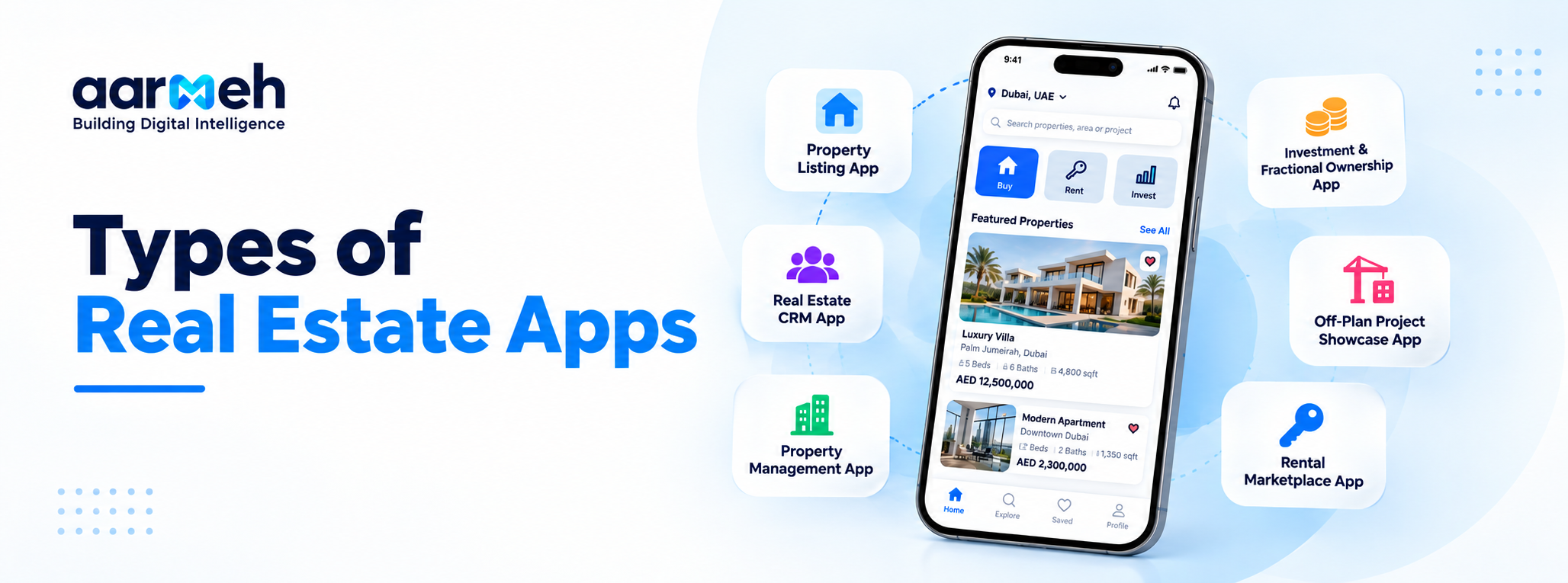
Not every property business needs the same product. The right type depends on who your users are and how they make money.
-
Property Listing App:
Most people start here, and for good reason. A property listing app is easy to explain: search, filter, save, enquire. The catch is the data. If the listings feed is out of date, no amount of good design will make the app feel useful.
-
Real Estate CRM App:
Agents don’t care how an app looks as long as it keeps their leads in order. A real estate CRM app tracks every prospect, reminds the team to follow up and shows where each deal stands. It isn’t the exciting one, but it gets opened every single day.
-
Property Management App:
Rent, repairs and contracts usually live in a mix of WhatsApp chats and spreadsheets. A property management app pulls all of that into one place for landlords, facility managers and tenants. It has to be dependable, because a missed payment or an ignored repair request quickly turns into a real problem.
-
Investment & Fractional Ownership App:
Here, people are putting real money into a share of a property, so the standard is higher. Investors need to see their portfolio, make payments and track returns, with identity checks and audit trails running underneath. Of all the types, trust and security matter most in this one.
-
Off-Plan Project Showcase App:
Buyers can’t walk through something that hasn’t been built yet. This app fills the gap with floor plans, payment plans and 3D tours. The logic behind it is simple, so most of the effort goes into making the visuals good enough to sell the project.
-
Rental Marketplace App:
Two sides need to be satisfied at once: tenants looking for a place and landlords looking for reliable tenants. A rental marketplace handles listings, digital tenancy contracts and payments, plus verification and dispute handling. It also needs to work alongside local rental registration systems, which adds to the build.
What Features Should a Real Estate App Include at Launch?
Want These Features Built Into Your Property App?
Feel free to book an initial call with our experts.
The right real estate app features depend on the platform’s target users and business model. Buyers may need property filters, saved searches, and viewing schedules, while agents require lead tracking and listing management. Admin teams also need tools to verify listings, manage user access, and monitor platform activity.
Buyers and renters need:
- Search with filters for price, area, bedrooms, property type and completion status
- A map view with neighborhood details
- Saved searches, favourites and price-drop alerts
- High-resolution photo galleries, floor plans and video or 3D walkthroughs
- A mortgage and affordability calculator
- Chat, call and WhatsApp handoff to the agent
- A viewing scheduler that syncs with the calendar
- Arabic and English from the first release, with proper right-to-left layouts
Agents and Brokerages need:
- Listing management with bulk upload and feed sync
- A lead inbox showing source, status and follow-up reminders
- A performance view covering listing views, enquiries and conversions
- Document sharing and e-signature
- Team and commission tracking
Admins need:
- Listing moderation and verification
- User and agent management with role-based access
- Analytics and reporting
- Banner and content controls
Which Advanced Features Can Enhance a Real Estate App?
Some features are worth a second look before they go into the first release.
-
AI property recommendations
This feature suggests listings based on what a user has searched, saved or viewed. It’s rarely worth building at MVP stage, because it needs user data to work well, so add it once real usage builds up.
-
AR/3D virtual tours
Virtual tours let users walk through a property remotely, which is a big help for buyers who can’t visit in person. It’s worth including for off-plan projects, where nothing physical exists yet, but optional for ready properties.
-
Voice and image search
Users can search by describing what they want aloud or by uploading a photo of a place they like. It’s a nice idea, but not an MVP priority, since standard filters already cover most search needs at launch.
-
Digital tenancy contracts
This lets landlords and tenants sign and store rental agreements inside the app. It’s worth having at MVP stage for rental apps, because the contract is the core of the transaction.
-
In-app payments
Users can pay rent, booking deposits or service fees without leaving the app. It’s a must for property management apps, where collecting money reliably is the main reason people use the product.
-
Arabic & English with RTL
A fully bilingual interface with proper right-to-left layouts, not just translated labels. It’s essential for any Gulf launch, as it directly affects how trustworthy the product feels to Arabic-speaking users.
Then comes the urge to keep adding. Loyalty points, social sharing, AI chatbots. Each one sounds sensible in a meeting. Each one also needs building, testing and maintaining, and if users ignore it, you’ve paid for nothing. We’d rather see a launch version that searches fast and captures leads cleanly than a crowded one still in testing months after the original date.
What Is the Tech Stack for Real Estate App Development?
Most property listing apps need to cover customer apps, agent tools, listing data, maps, payments and cloud hosting, and a cross-platform framework is usually what the first version gets built on. For many teams, a Flutter real estate app is the sensible default, because one codebase ships to both stores without a noticeable difference on list-and-map-heavy screens.
Mobile app development for real estate requires a technology stack that supports property searches, map-based discovery, high-resolution media, enquiries, and real-time listing updates. Flutter or React Native can support both iOS and Android through a shared codebase, while the backend, database, and cloud infrastructure should match the platform’s expected traffic and integration requirements.
| Technology Layer | Recommended Tech Stack |
| iOS App | Swift, SwiftUI |
| Android App | Kotlin, Jetpack Compose |
| Cross-Platform App | Flutter, React Native |
| Backend | Node.js, Python (Django), Laravel, .NET |
| APIs | REST, GraphQL, WebSockets |
| Database | PostgreSQL, MongoDB, Redis |
| Search | Elasticsearch, Algolia |
| Maps and Location | Google Maps Platform, Mapbox |
| 3D and AR | Matterport integrations, ARKit, ARCore, Three.js |
| Cloud Infrastructure | AWS, Microsoft Azure, Google Cloud |
| Payments | Stripe, Checkout.com, PayTabs, regional gateways |
| Authentication | OAuth 2.0, OTP, UAE PASS, Nafath |
| Push Notifications | Firebase Cloud Messaging, Apple Push Notification Service |
| Admin Dashboard | React.js, Next.js, Angular |
| Security | TLS/SSL, AES encryption, API authentication, role-based access control |
| DevOps | Docker, Kubernetes, GitHub Actions, CI/CD |
Native builds still make sense in one case: heavy AR walkthroughs or complex 3D rendering, where device-level performance matters. For everything else, the extra cost of two separate codebases is hard to justify.
What Compliance, Data and Payment Rules Apply in the UAE and Saudi Arabia?
A handful of requirements are specific to the region, and most of them touch the app design directly.
-
Broker & Advertising Rules:
In Dubai, agents need a valid broker license, and listings generally need a permit number before they can be advertised. If your app lets agents publish listings without capturing those details, your clients can end up in trouble. Build the validation early.
-
Rental Registration:
Tenancy contracts in Dubai are registered through Ejari, and Saudi Arabia uses the Ejar platform for a similar purpose. Apps that handle rentals gain a lot of trust by aligning with these systems.
-
Identity & Login:
UAE PASS in the UAE and Nafath in Saudi Arabia can cut signup friction and add credibility, especially when contracts or payments are involved.
-
Personal Data:
Both countries have personal data protection laws, and some clients will insist on hosting inside the country. Raising this at the architecture stage costs very little, while raising it after launch can cost a lot.
-
VAT & Payments:
Commercial and service fees carry VAT, and local cards, bank transfers and wallet options differ by country. Saudi users expect mada, for example, so payment design has to change per market.
-
Changing Rules:
Property regulations get updated from time to time. Confirm current requirements with the relevant authority before launch and again before expanding into a new emirate or country.
What Challenges Can Make Real Estate App Development Complex?
Search screens and detail pages are the easy part. What actually makes a property platform hard is getting data, integrations, real-time updates, payments and agent workflows to work together without breaking. A few problems appear on almost every project.
-
Listing Data Quality
An app is only as good as the listings behind it. Duplicates, outdated prices and sold properties still showing as available frustrate users faster than any design flaw. Feeds need cleaning, matching and regular refreshing.
-
Integrations
Portals, CRMs, payment gateways, e-signature tools and government systems each speak a slightly different language. Every one adds testing time, and the ones that look simplest on paper are often the ones that run over.
-
Real-Time Sync
When an agent marks a property as sold, the update must appear across all users’ screens in real time. Delays can leave buyers enquiring about unavailable units and force agents to spend time explaining outdated listings.
-
Media & Performance
High-resolution photos, video and 3D tours make listings sell, but they also slow apps down. Image compression, caching and smart loading are what separate a smooth app from a sluggish one.
-
Security & Document Handling
Property apps carry passports, Emirates IDs, contracts and payment details. That isn’t something to bolt security onto after launch. Strong authentication, encrypted storage and strict access controls belong in the design from the first sprint.
-
Agent Adoption
Plenty of well-built CRMs fail simply because agents prefer WhatsApp. If the app doesn’t make their day easier within the first week, they stop opening it. Involving agents in testing is the cheapest fix.
-
Scaling During Launch Peaks
A major off-plan launch can send thousands of buyers to the app within minutes. The backend has to hold up under that load, not just in a quiet test environment.
How Much Does Real Estate App Development Cost?
The real estate app development cost moves with scope, platform choice and integrations, so a range says more than a single figure. The AED numbers below come from typical project scopes and work as a planning guide, not a quote.
| Scope | What’s included | Approximate budget (AED) | Approximate budget (USD) | Typical timeline |
| Lean MVP | Core search, listings, accounts, enquiries, basic admin panel | 40,000 – 180,000 | 10,000 – 50,000 | 4 – 6 weeks |
| Mid-level platform | Chat, CRM features, payments, analytics, Arabic and English | 180,000 – 400,000 | 50,000 – 110,000 | 8 – 12 weeks |
| Full platform | Marketplace, multi-role portals, integrations, 3D tours, AI features | 400,000 – 900,000+ | 110,000 – 250,000+ | 16 – 20 weeks |
Note: The final cost depends on how many features, user roles and integrations are required at launch.
Cost Breakdown According to the Country:
Country matters less than most people assume. The cost to build a real estate app in UAE and the wider Gulf sits in a fairly narrow band, since serious teams work to similar standards. What changes by market are the local extras.
| Market | Indicative MVP range (USD) | Local factors that can add cost |
| UAE | 10,000 – 45,000 | Broker and permit checks, UAE PASS login, bilingual UI |
| Saudi Arabia | 12,000 – 19,000 | mada payments, Arabic-first design, data residency |
| Qatar | 15,000 – 50,000 | Arabic-first design, local registry integrations |
| Kuwait | 10,000 – 17,000 | Local gateway integrations, Arabic RTL |
| Bahrain | 15,000 – 40,000 | Smaller market, simpler integrations |
| Oman | 10,000 – 40,000 | Local payment and registry integrations |
For a regional launch, the smarter approach is one solid core product that gets localized per market, not separate apps. That reuse is where the savings come from.
What Factors Affect Real Estate App Development Costs?
A few things push the final number up faster than people expect.
-
Platform choice
Building separate native apps for iPhone and Android roughly doubles the mobile work, because you’re paying for two codebases. A cross-platform framework like Flutter trims that, which is why it suits most property apps.
-
Number of user roles
Buyers, agents, landlords and admins each need their own screens, permissions and logic. Every role you add at launch adds design, development and testing time, so start with the ones that matter most.
-
Integrations
Listing feeds, payment gateways, maps, CRM tools and e-signature each speak their own language. Every connection can add weeks, and the ones that look simplest on paper are often the ones that overrun.
-
Design depth
Standard components keep costs predictable. Custom animations, detailed visuals and one-off layouts look sharper but take noticeably longer to design and build.
-
Real-time features
Chat, live notifications and instant availability updates need extra backend work to stay in sync. If an agent marks a unit as sold, users should see it quickly, and that doesn’t come free.
-
Compliance & Security
Property apps handle IDs, contracts and payments, so data protection, audit trails and secure document storage are part of the job. Adding them early costs far less than retrofitting them after launch.
-
Post-launch support
An app isn’t finished at launch. Servers, updates and bug fixes continue, and a safe planning figure is 15 to 20% of the build cost per year.
What is the Step-by-step Process for Real Estate App Development?
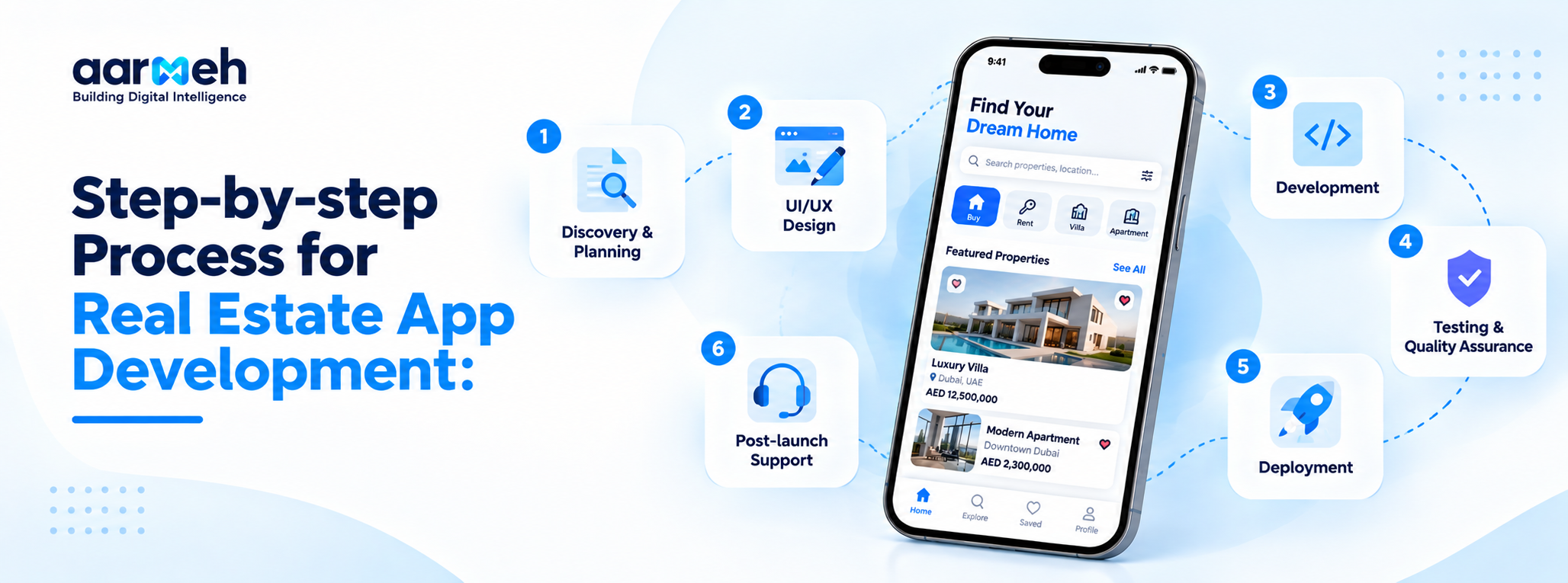
A reliable real estate app development process isn’t complicated, but skipping stages is what causes budget overruns. Here is how a well-run project usually moves.
-
Discovery & Planning
Every successful property app starts with a clear understanding of the business goals, target audience, and market. The team researches competitors, defines essential features, evaluates technical requirements, and establishes the project scope. This early planning helps prevent scope changes, unexpected costs, and delays during development.
-
UI/UX Design
A property app needs more than an attractive interface; users should be able to search listings, compare properties, and contact agents without confusion. Designers map user journeys, create wireframes, and develop interactive prototypes before finalizing the visual design. For Gulf markets, Arabic and English interfaces must also accommodate right-to-left layouts, ensuring a consistent experience across both languages.
-
Development
Development covers the backend, APIs, mobile applications, and admin panel. Work progresses in sprints, allowing stakeholders to review features and track progress throughout the project. A basic property listing app may take less time, while a full-fledged marketplace with advanced search, real-time updates, payment integrations, and agent dashboards requires a longer development cycle.
-
Testing & Quality Assurance
Before launch, the app undergoes functional, performance, compatibility, and security testing across supported devices. Property platforms may handle personal identification documents, contracts, user accounts, and payments, making data protection a key priority. Identifying and resolving issues before release helps deliver a reliable experience for buyers, sellers, and agents.
-
Deployment
Once testing is complete, the application is prepared for release on the Apple App Store and Google Play. The team configures production servers, verifies integrations, and completes the required store submission processes. Since app store reviews can take longer than expected, keeping some flexibility in the launch schedule helps avoid unnecessary pressure.
-
Post-launch Support
Launching the app is the beginning of its operational lifecycle. Ongoing support includes monitoring performance, resolving technical issues, improving security, analyzing user behaviour, and introducing new features based on feedback. Regular updates help the property platform adapt to changing market needs and maintain a smooth experience as its user base grows.
How Do You Choose a Real Estate App Development Partner?
Choosing a real estate app development company requires more than reviewing portfolio screenshots. When evaluating a real estate mobile app development company, review its experience with property listings, listing integrations, lead management, performance testing, and post-launch support. Ask how the team handles backend development, mobile applications, integrations, and quality assurance, and whether these components are managed through a coordinated process. Reliable communication and timely technical support are equally important, especially when listing feeds or other critical features fail after launch.
Check references from real estate businesses to understand how the company handles property-specific challenges. Review the project estimate carefully, too. A transparent proposal should account for the customer-facing app, agent and admin tools, backend infrastructure, and third-party integrations, giving you a clearer picture of the work involved and the costs associated with each component. Experienced real estate app developers should understand property listing workflows, agent and customer journeys, third-party integrations, and regional compliance requirements. Review their relevant portfolio, technical capabilities, testing process, and post-launch support before selecting a team.
Before rolling out the platform to a wider audience, consider testing it with a small brokerage team or a single property development project. A pilot helps identify practical issues, such as inaccurate search filters, low agent adoption, and slow image loading, before they affect more users. Track key metrics, including enquiries per listing, agent response times, app crash rates, and weekly active users, to assess performance and determine whether the product is ready to scale.
Why Choose Aarmeh for Real Estate App Development in Dubai?
As a real estate app development company in Dubai, Aarmeh combines local market understanding with technical expertise to develop property platforms around actual business workflows. Collaboration with your sales and operations teams helps align product decisions with the needs of brokers, developers, buyers, sellers, and tenants.
Aarmeh’s real estate app development services cover product planning, UI/UX design, mobile app development, backend engineering, admin dashboards, third-party integrations, testing, deployment, and ongoing maintenance. The scope is aligned with your business model, helping prioritize essential functionality before introducing advanced features.
Our real estate mobile app development services can cover customer-facing applications alongside the operational tools agents and administrators need. Connecting property listings, enquiries, user permissions, and reporting helps maintain consistent workflows as the platform expands.
Successful real estate mobile app development starts with a clear understanding of the problem the platform needs to solve. Whether the goal is to simplify property searches, improve lead management, or streamline rental operations, begin with essential features and test them with real users. A scalable architecture, reliable property data, and a well-planned development process can support future growth across the UAE and wider GCC market.
For businesses operating in the UAE, regional requirements also influence development decisions. Aarmeh considers relevant property permit verification.
What Are the Future Trends in Real Estate App Development?
The next wave of property apps is moving beyond search screens and toward automation, richer visuals and smarter data. A few directions are already visible.
-
AI-Powered Recommendations
AI is expected to make real estate apps more useful by matching property listings to user preferences, predicting market trends, and helping businesses make informed pricing and investment decisions. As property platforms collect more search and transaction data, these capabilities can improve property discovery and lead prioritisation. Explore how AI in the real estate industry is transforming property discovery, market analysis, and customer experiences.
-
Virtual Tours & Immersive Experiences
3D property walkthroughs, virtual tours, and augmented reality staging allow buyers to explore spaces remotely and visualise potential interiors. These capabilities are particularly useful for international investors, overseas buyers, and off-plan developments where physical visits may not be possible.
-
Smart Pricing & Property Valuation
Automated valuation models use historical transactions, location data, comparable listings, and market demand to estimate property values. These insights help buyers evaluate asking prices, assist sellers in setting competitive rates, and give landlords a clearer basis for rental pricing.
-
Digital Contracts & e-Signature
Digital documentation is streamlining property transactions by allowing users to review, sign, and store reservation forms, tenancy agreements, and other documents electronically. Integrated workflows can reduce paperwork and administrative delays, subject to applicable legal and regulatory requirements.
-
Fractional & Tokenised Property Ownership
Fractional ownership platforms allow investors to purchase shares in a property rather than acquire the entire asset. Blockchain-based tokenised can support digital ownership records and investment management, although these models require careful consideration of securities regulations, ownership rights, and platform security.
-
Smart Home & IoT Integration
Integration with connected locks, smart meters, access-control systems, and building sensors gives landlords and property managers greater control over remote operations. Through a single application, authorised users can manage access, monitor selected utilities, and coordinate property-related tasks.
-
Predictive Maintenance
IoT sensors and predictive analytics can identify unusual equipment behaviour, water leakage indicators, or air-conditioning performance issues before they develop into major problems. Property managers can use these alerts to schedule maintenance proactively, reduce repair costs, and minimise disruption for tenants.
-
Conversational Property Search
AI-powered chat assistants let users describe their requirements in natural language instead of relying entirely on traditional search filters. Buyers can specify a preferred neighborhood, budget, property type, or nearby amenities in Arabic or English and receive more relevant recommendations.
-
Multi-market & Regional Expansion
Real estate businesses expanding across the Gulf need platforms that accommodate different currencies, languages, property regulations, and operational workflows. A configurable backend with localized interfaces helps brokerages and developers manage multiple markets while maintaining consistent data and user experiences.
Conclusion
Successful real estate apps stand out by solving a specific problem exceptionally well. Some help buyers find properties faster, others help sales teams manage leads more effectively, while some simplify rent collection and property management. Rather than trying to serve every need at once, they focus on delivering real value through a clear, well-defined purpose.
The decisions made at the beginning shape the entire product. Choosing the right app model, reliable data sources, essential first-release features, and an experienced development partner creates a stronger foundation for long-term growth. Overlooking these decisions can lead to expensive changes, operational challenges, and a product that struggles to meet user expectations.
A practical approach is to start with a focused launch: one target market, a defined group of agents, and a specific user journey. Test the application with real users, observe how they interact with its features, and use their feedback and performance data to guide future improvements. An experienced real estate app development partner can also identify potential data, regulatory, integration, and workflow challenges before they affect the end product.
For businesses planning to enter the UAE or expand across the GCC, Aarmeh helps define the right product scope, prioritize essential features, and plan a scalable real estate platform before development begins.
Frequently Asked Questions (FAQs)
Q. How much does real estate app development cost?
Most projects fall between $10,000 and $250,000+, depending on scope. A lean MVP sits at the lower end, while a multi-role marketplace with integrations, 3D tours and AI features sits at the higher end.
Q. How long does it take to develop a real estate app?
A basic MVP usually takes 4-6 weeks. A mid-level platform takes 8-12 weeks, while a full-fledged marketplace can take 20 weeks or more.
Q. Which technology is best for real estate app development?
For most projects, Flutter or React Native for the mobile apps, Node.js, Python or .NET for the backend, PostgreSQL for the database and Google Maps or Mapbox for location. Native development is worth the extra cost mainly for heavy AR or 3D features.
Q. Can a real estate app support both Arabic and English languages?
Yes. Gulf apps should support both, including proper right-to-left layouts for Arabic. It’s far cheaper to plan this during design and architecture than to add it after launch.
Q. How do real estate apps make money?
Common models include paid listings, featured placements, agent subscriptions, lead generation fees, commissions and premium tools for investors.
Q. What regulations should I consider when launching in the UAE or Saudi Arabia?
Requirements vary by emirate and country. They can include broker licensing, advertising permits, tenancy registration, identity verification, personal data protection and VAT. Review them with the relevant authority and a legal adviser before launch.






 Book a call




 CLUTCH VERIFIED
 Top App Developer UAE
 100% NDA Protected
 IN THE HEART OF UAE