





Table of Contents
📌 Key Takeaways
- Choose your business model first, since the choice between a single store, multivendor marketplace, inventory led, hyperlocal, or subscription based app shapes your architecture, costs, and who handles stock, fulfilment, and refunds.
- Build four connected experiences, a customer app, vendor panel, delivery partner app, and admin dashboard, all sharing consistent stock, payment, and order data, with Arabic and English support and AED pricing for the UAE.
- Launch with a focused MVP covering catalogue, search, cart, checkout, stock validation, and order tracking in one service area, and add advanced analytics, loyalty, and AI features only after the core system is validated.
- Budgets and timelines scale with scope, from AED 40,000 to 80,000 over 8 to 12 weeks for a basic MVP, AED 80,000 to 180,000 over 12 to 20 weeks for a mid level marketplace, and AED 180,000 to 400,000 or more over 20 to 32 weeks or longer for an advanced platform, excluding VAT, payment fees, marketing, and delivery operations.
- Operations decide success as much as the app, because inventory accuracy, delivery delays, perishable handling, data security, and vendor and customer retention drive profitability alongside revenue from commissions, delivery fees, subscriptions, and sponsored listings.
Planning grocery delivery app development in the UAE? Then you already know it takes more than a nice storefront. The app has to pull in retailer inventory, take local payments, get orders packed and put a rider outside the customer’s door. An app like InstaShop does exactly that: you pick a store, fill a basket, pay, and the shopping turns up.
Online grocery app development UAE projects face local requirements that can make or break a launch. Shoppers expect Arabic and English, RTL layouts and AED pricing. Delivery zones in Dubai don’t look like those in Abu Dhabi, and retailers keep different hours and use different stock systems. Get those details wrong and customers notice quickly.
This guide covers how to build a grocery delivery app like InstaShop: the business models, the features worth building first, a sample architecture, a UAE launch checklist, AED cost ranges, the tech stack and a worked example of what one order earns. If you’re comparing agencies instead, our grocery delivery app development services page covers how Aarmeh works.
How Does Grocery Delivery App Development Support an InstaShop-Like Business Model?
An InstaShop-style platform connects customers with nearby stores and delivers their orders. Development turns that into four linked products: a customer app, a retailer panel, a rider app and an admin dashboard. Their job is to keep stock, payments and order status in sync
How the InstaShop Business Model Works
Online grocery shopping app development isn’t just a product list on a screen. A customer enters an address and picks a store. They fill a cart and pay. The store checks what’s actually on the shelf, packs the order and hands it to a rider. The customer gets updates until the bags arrive. For businesses exploring on demand app development, InstaShop is a useful reference for store discovery, payments, tracking and dispatch.
Four groups share the platform:
- Customers browse, order, pay and track.
- Retailers manage catalogues, prices and incoming orders.
- Delivery partners collect packed orders and bring them over.
- Administrators handle vendors, commissions, service areas, payments and complaints.
A multi-vendor marketplace can pull supermarkets, specialty shops, pharmacies and convenience stores into one app. You widen the range without owning stock or running stores yourself.
Why Businesses Use an InstaShop-Like Model?
Retailers get an online sales channel. You, as the operator, can earn through commissions, delivery fees, subscriptions and promoted placements. The model supports hyperlocal commerce, where nearby stores fulfil orders quickly, and it works best in dense cities where people would rather skip another trip to the shop. Profit still depends on average order value, delivery cost, retailer terms, acquisition spend and order density, which is why we work through a sample order later in this guide.
If you’ve done food delivery app development before, order tracking, payments and rider dispatch will feel familiar. Groceries add bigger catalogues, fast-changing stock, substitutions and perishables. If you’re planning ecommerce app development, check that your operation can support short delivery windows before you promise them. And if you’re planning quick commerce app development, remember that speed comes from stock visibility, well-placed stores, quick picking and enough riders. The app is the smaller part of it.
What Are the Different Business Models in Grocery Delivery App Development?
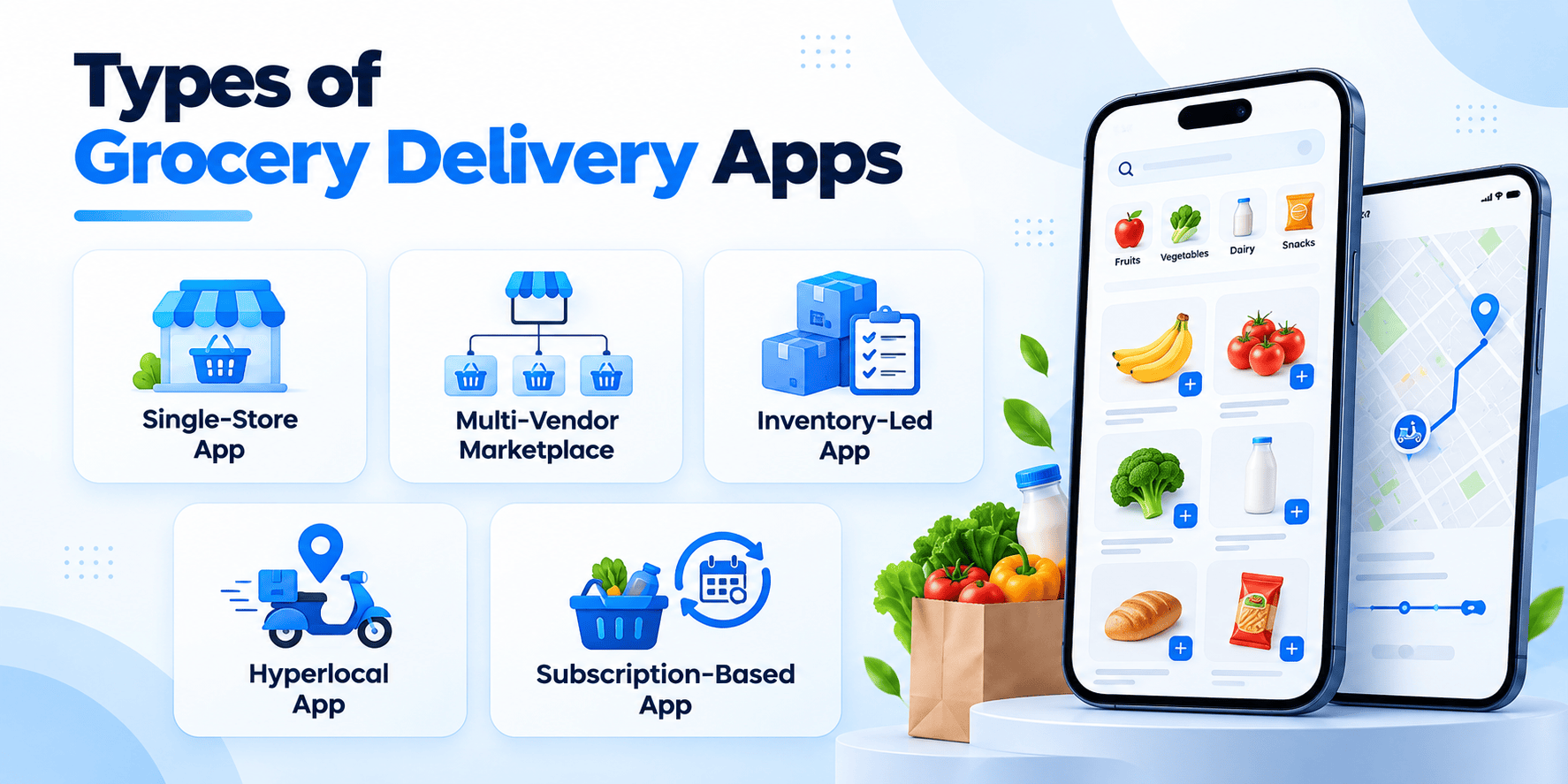
Most UAE grocery projects fall into five models: single-store, multi-vendor marketplace, inventory-led, hyperlocal and subscription-based. Choose by who owns the stock, who packs the order and who handles delivery, because those answers drive cost and architecture more than any feature does.
| App model | How it works | Best suited for | Main development consideration |
| Single-store app | One retailer sells through its own app | Supermarkets and independent grocery stores | Store inventory and order management |
| Multi-vendor marketplace | Multiple retailers sell through one platform | Grocery aggregators and marketplace operators | Vendor onboarding, commissions and separate catalogues |
| Inventory-led app | The business owns or controls the stock | Grocery chains and fulfilment operators | Warehouse operations and stock accuracy |
| Hyperlocal app | Customers order from nearby stores | Local grocery businesses | Location-based discovery and delivery zones |
| Subscription-based app | Customers pay a recurring fee for perks or repeat orders | Grocery brands and repeat-purchase businesses | Subscription billing and recurring order management |
Single-Store vs Multi-Vendor: What Changes in Scope
These two cause the most confusion, and the build effort differs more than most buyers expect.
| Scope area | Single-store app | Multi-vendor marketplace |
| Catalogue | One catalogue, one price list | Separate catalogue, pricing and stock per vendor |
| Vendor tools | Basic store admin | Full vendor panel with roles and onboarding |
| Money flow | Standard checkout | Commission calculation, vendor settlements and refunds by vendor |
| Order handling | One fulfilment process | Order splitting, vendor acceptance and per-store delivery rules |
| Integrations | One POS or inventory system | Possibly many, each with its own data format |
| Typical effort | Lower | Noticeably higher |
Inventory-Led, Hyperlocal & Subscription Models
Inventory-led platforms run stock through warehouses, dark stores or their own shops. You get steadier fulfilment, but you also take on storage, procurement and stock reconciliation.
Hyperlocal apps serve defined areas, find nearby stores & route orders by location and availability. For Dubai and Abu Dhabi neighbourhoods, that means setting zones around traffic, rider capacity & store hours.
Subscription apps trade a recurring fee for cheaper delivery, offers or repeat orders, and they can sit on a marketplace or single-store model. Check reorder rates, customer lifetime value and delivery cost before you promise perks you can’t afford.
What Features Should You Include in Grocery Delivery App Development?
Want These Features Built Into Your Grocery App?
Feel free to book an initial call with our experts.
Build four connected experiences, one each for customers, retailers, riders and admins. The essential features of grocery delivery app projects differ by model, but they all share one rule: stock, payments and order status must match across all four.
Customer App
- Sign-up by email, mobile number, OTP or social login
- Saved addresses, a map pin and a delivery-eligibility check
- Catalogue with categories, photos, prices, sizes and live availability, in Arabic and English
- Search and filters for brands, diets and price
- Cart with promo codes, then checkout showing taxes and fees upfront
- Live order tracking, notifications, ratings and in-app support for cancellations and refunds
Retailer Panel
- Product and price management, promotions and image uploads
- Stock levels with low-stock alerts
- Order accept, reject and preparation status, plus substitution suggestions
- Opening hours, service areas, sales reports and commission statements
- Staff accounts with role-based permissions
Automated inventory management can sync stock between systems and stop sold-out items being ordered. Where real-time sync isn’t possible, scheduled updates and regular stock checks keep mismatches small.
Delivery Partner App
- Registration, verification and shift management
- Order assignment, pickup and drop-off instructions, GPS navigation
- Proof of delivery, earnings summary and incident reporting
Delivery partner app integration should tie assignment, status and confirmation to the customer app and admin dashboard, so nobody has to chase updates by phone.
Admin Dashboard
- Customer, vendor and rider accounts, vendor approval and document checks
- Order monitoring and exception handling
- Commissions, refunds and payment reconciliation
- Delivery zones, service hours, coupons and campaigns
- Complaint tickets, reports and audit logs .
Good analytics show where orders run late, which products often go out of stock and which areas underperform
How Do You Build an App Through Grocery Delivery App Development?
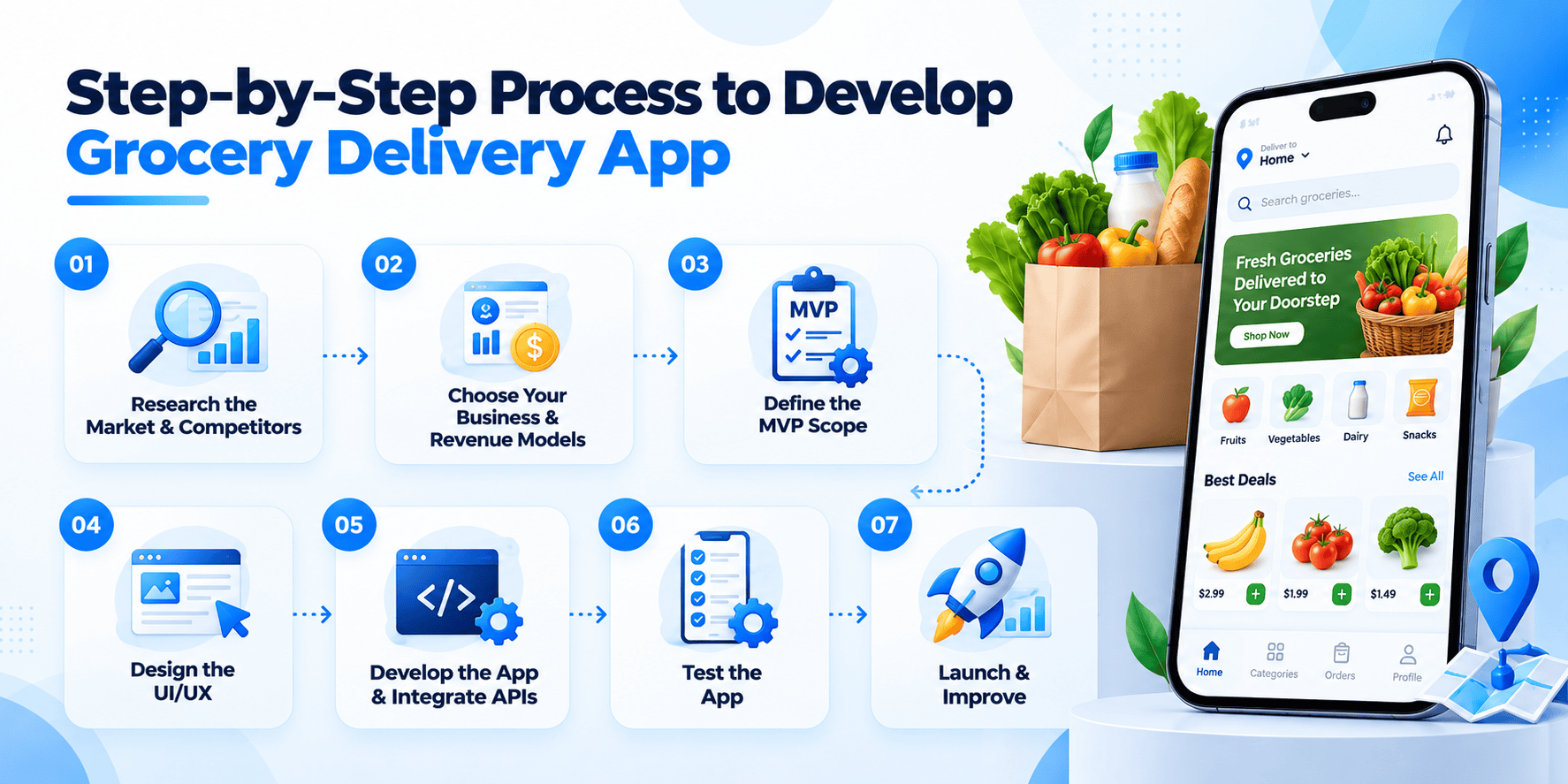
In seven steps: research, business model, MVP scope, design, development with integrations, testing and a controlled launch. Give each step a deliverable so scope stays under control and changes don’t pile up at the end.
Step 1: Research the Market & Competitors
Work out who you’re selling to, where and against whom. Check how rival apps handle discovery, minimum orders, delivery fees, substitutions and support. For a UAE launch, research each area separately, because what works in one neighbourhood can flop in the next. Look at retailer density, delivery distances and how many riders you can realistically recruit.
You should finish with a business requirements document, a rough budget, a list of operational risks and launch goals you can measure.
Step 2: Choose Your Business & Revenue Models
Pick single-store, marketplace, inventory-led or hybrid, then settle who owns stock, who packs owners, who handles refunds and who delivers. Choose revenue streams to match: commissions, delivery fees, subscriptions or sponsored listings.
Step 3: Define the MVP Scope
On-demand grocery delivery app development should prioritise the workflows that get an order paid, packed and delivered. Use the prioritisation table above: must-haves first, everything else on the roadmap. Write acceptance criteria for each must-have so nobody argues later about what “done” means.
Step 4: Design the UI/UX
Design for speed and clarity. Shoppers should find a product, see the delivery fee and pay without a pointless step. Start with wireframes for all four interfaces, move to clickable prototypes and test them with people who resemble your real users. Build Arabic and English layouts in from the start, not at the end.
Step 5: Develop the App & Integrate APIs
Engineers build the mobile apps, backend, database, admin tools and outside connections. Planning grocery delivery app development Dubai? Pin down POS, ERP and inventory integrations early, because they swing both cost and schedule more than anything else. A grocery delivery app developer should make sure payment gateways, retailer inventory systems, maps and notifications exchange data reliably.
Build secure APIs with authentication, permission checks, validation and logging, and add error handling so a failed request or late update can’t create duplicate orders or wrong stock counts.
Step 6: Test the App
Test features, integrations, full ordering journeys, security, performance and usability. Then try the nasty scenarios: two customers grab the last item at once, a retailer rejects an order, a rider loses signal mid-delivery.
| Testing type | Main objective |
| Functional | Features work as specified |
| Integration | Payments, maps, notifications and retailer systems connect correctly |
| Performance | Behaviour under expected and peak load |
| Security | Access control and data protection hold up |
| Usability | No confusing journeys or checkout friction |
| Regression | New changes don’t break old features |
| User acceptance | The app meets business needs |
Before going live, set up monitoring and an incident plan, and test backup and recovery.
Step 7: Launch & Improve
Start with one service area, a handful of retailers and a delivery operation that can keep its promises. Watch completed orders, checkout conversion, average order value, cancellations, on-time delivery, retention and contribution margin per order. Let those numbers set priorities: lots of stock cancellations means fixing inventory sync, high checkout abandonment means checking payment options and fee visibility, and late deliveries mean revisiting dispatch rules and zones.
How Much Does It Cost to Develop a Grocery Delivery App Like InstaShop?
Get a Grocery App Like InstaShop Development Estimate?
Share your business model, platform requirements and target launch date to discuss an indicative scope and budget.
A basic MVP may cost AED 40,000-80,000, a mid-level marketplace AED 80,000-180,000, and an advanced platform AED 180,000-400,000 or more. These are indicative planning ranges, not quotations. The grocery delivery app cost in AED depends on the number of interfaces, integrations, inventory workflows and testing needs.
| Development level | Typical scope | Estimated cost (AED) | Estimated timeline |
| Basic MVP | Customer app, basic catalogue, checkout, order management and admin tools | 40,000–80,000 | 8–12 weeks |
| Mid-level marketplace | Customer app, vendor panel, delivery interface, payment and maps integrations | 80,000–180,000 | 12–20 weeks |
| Advanced platform | Multi-vendor operations, advanced inventory, dispatch automation, analytics and complex integrations | 180,000–400,000+ | 20–32+ weeks |
Note: These are planning estimates, last reviewed in October 2026, not quotations. Each range assumes the scope in the table and should be validated in a discovery phase.
The cost to develop a grocery delivery platform depends on the operating model, number of interfaces, integrations and expected order volume. A single-store MVP needs only essential shopping and order-management features, whereas a marketplace adds vendor workflows, commission management and coordination between retailers and riders.
Basic Grocery Delivery App Development Cost
Basic (AED 40,000–80,000, 8–12 weeks) suits a supermarket or startup testing online ordering in a small area. Expect browsing, a cart, checkout, simple tracking and an admin interface. It usually leaves out a full vendor marketplace, advanced stock sync and automated dispatch. The app like InstaShop cost depends on the features in your first release, so confirm scope before comparing quotes.
Mid-Level Grocery Marketplace Development Cost
Mid-level (AED 80,000–180,000, 12–20 weeks) supports several retailers with vendor, rider and commission workflows. For anyone researching grocery delivery app development cost Dubai, this range is a reasonable starting point for a grocery marketplace. Linking to existing retailer systems can push it up, especially when every vendor uses different software.
Advanced Grocery Delivery App Development Cost
Advanced (AED 180,000+, 20–32+ weeks) adds multiple fulfilment locations, automated dispatch, AI recommendations and deeper analytics. Recommendations only help when the data is good and customers have consented to its use, so prioritise advanced features by measurable business value.
Factors That Affect Development Costs
| Cost factor | Effect on the budget |
| Number of interfaces | Separate customer, vendor, rider and admin apps add design and development work |
| Inventory integration | Real-time sync with POS, ERP or warehouse systems can add significant effort |
| Feature complexity | Substitutions, promotions, loyalty and automated dispatch need extra logic |
| Native vs cross-platform | Separate native apps can take more work than one shared codebase |
| Third-party APIs | Maps, payments, messaging and analytics can bring setup and usage fees |
| Security and compliance | Testing, access controls and payment requirements add engineering work |
| Maintenance | Updates, fixes and monitoring are ongoing costs |
Budget for hosting, support, payment processing, vendor acquisition, marketing and delivery operations as well. Development is only one slice of what a grocery platform costs to run.
What Technology Stack Is Best for Grocery Delivery App Development Like InstaShop?
There’s no single best stack. Pick one your team can maintain, that fits your scale and that handles stock, payments and orders without conflicts. A cross-platform framework plus a mainstream backend and a relational database covers most UAE launches.
| Layer | Options | Key consideration |
| Mobile apps | Flutter, React Native | One shared codebase for iOS and Android |
| Native apps | Swift and SwiftUI, Kotlin | Worth it only for platform-specific features or specialised performance |
| Web panels | React or Next.js | Suited to vendor and admin dashboards |
| Backend | Node.js, Python, .NET | Node.js for event-driven APIs, Python for analytics and AI, .NET for integration-heavy enterprise work |
| Database | PostgreSQL, MongoDB | PostgreSQL for transactions and structured records, MongoDB where flexible documents fit |
| Cache | Redis | Caching, temporary data and selected real-time workloads |
| Hosting | AWS, Azure, Google Cloud | Managed databases, monitoring and deployment |
Your architecture should spell out how stock changes, payment confirmations and order updates get handled. Idempotent operations, transaction controls and event handling help stop duplicate orders and messy states.
Plan for integration failures from day one. If a payment request times out, check the transaction status before retrying or charging again. Apply the same rule to stock syncs and to orders sent to retailer systems.
AI Development can support grocery platforms through demand forecasting, personalised discovery, inventory insights and delivery planning. Add it once you have real order data and a clear measurable benefit, not before.
How Does Grocery Delivery App Development Generate Revenue?
Through vendor commissions, delivery fees, subscriptions and sponsored listings. Test each against retailer margins, customer expectations and your fulfilment costs, because a stream that scares off repeat orders isn’t worth having.
- Vendor commissions: a percentage of eligible orders or a flat fee, varying by category, vendor size or fulfilment model. Example: AED 10,000 of monthly sales at a 10% commission earns AED 1,000 before costs and taxes. That’s an illustration, not a recommended rate.
- Delivery fees and service charges: based on distance, order size, speed or demand, and clearly disclosed. Charge too little and margins vanish; charge too much and customers stop reordering.
- Subscriptions: cheaper delivery, offers or recurring orders. Track renewals, perk usage and extra order frequency to be sure the discounts pay for themselves.
- Sponsored listings: paid product promotion or featured stores. Label them clearly and report paid views separately from organic ones.
Worked Example: What One Order Might Earn
Here’s one hypothetical UAE order, to show why order value and delivery cost matter so much. Every figure below is an assumption for illustration, not a benchmark.
| Line item | Assumption | AED |
| Basket value | Average order | 150.00 |
| Commission earned | 12% of basket | +18.00 |
| Delivery fee charged | Flat fee | +8.00 |
| Revenue to platform | – | 26.00 |
| Rider cost | Per delivery | −10.00 |
| Packing and handling | Per order | −3.00 |
| Payment processing | About 2.5% of AED 158 | −4.00 |
| Support allowance | Per order | −1.50 |
| Contribution per order | Before marketing, tech and overheads | 7.50 |
Payment processing is modelled on AED 158 (the basket plus the delivery fee). Actual fees depend on your payment provider, card mix and settlement structure, so replace every assumption with your own figures.
At AED 7.50 per order, a platform needs a lot of orders in each zone to cover fixed costs, and one more failed delivery or refund wipes out the margin on several orders. That’s why average order value, order density and delivery cost belong in your business plan before the first line of code.
What Are the Key Challenges in Grocery Delivery App Development?
Stock that changes by the minute, late deliveries, perishables, data security and keeping both customers and retailers happy. Building the app is the easy part by comparison.
| Challenge | Why it happens | What to do |
| Inventory and availability | In-store sales, supplier deliveries, damage and simultaneous online orders all move stock | Sync inventory, reserve stock where supported, set low-stock alerts, reconcile regularly and let retailers propose substitutions with customer approval |
| Delivery delays | Traffic, store prep time, rider availability, weather and distance | Use realistic estimates. Smaller platforms often do well with rules-based dispatch before adding AI route optimisation, which needs accurate data and real operational adoption |
| Perishable goods | Fresh, dairy and frozen items need careful picking, packing and transport | Write handling rules by product type, plus quality checks, substitution policies and a damaged-item process. Confirm riders can provide temperature-controlled transport where needed |
| Payment security and data protection | You’ll hold addresses, purchase histories and payment-related data | Use secure authentication, role-based access, encryption in transit, retention policies and monitoring. Follow the rules that apply to you and get compliance advice where your model raises extra questions |
| Retention and vendor management | Stockouts, late deliveries, unclear fees and slow complaint handling drive customers away; low volumes and confusing settlements drive retailers away | Set clear service expectations, track feedback, refunds, order accuracy and repeat purchases, and settle vendors on a predictable schedule |
How Long Does It Take to Build a Grocery Delivery App Like InstaShop?
Roughly 8–12 weeks for a basic MVP, 12–20 weeks for a mid-level marketplace and 20–32 weeks or more for an advanced platform. These are indicative planning ranges, not guaranteed delivery dates.
Development Timeline by Project Phase
The phase table below shows how long each stage takes on its own for a mid-level scope.
| Project phase | Estimated duration | Key deliverables |
| Discovery and planning | 1–2 weeks | Requirements, business model, scope and technical plan |
| UI/UX design | 2–3 weeks | Wireframes, design system and prototypes |
| Backend and database development | 3–6 weeks | APIs, data models, authentication and business logic |
| Mobile and web development | 4–8 weeks | Customer, vendor, delivery and admin interfaces as scoped |
| Third-party integrations | 1–3 weeks | Payments, maps, notifications and relevant external systems |
| Testing and refinement | 2–3 weeks | Functional, integration, security and acceptance testing |
| Deployment and launch preparation | 1–2 weeks | Production setup, monitoring and release preparation |
Why the Totals Don’t Simply Add Up
Run back to back, these phases total about 14–27 weeks. In practice the work overlaps: design finishes while backend work starts, and frontend and integration work run in parallel. The tier timelines above assume a dedicated team working that way, and the basic MVP is shorter because it has fewer interfaces and integrations. Final estimates depend on platform coverage, team allocation, third-party dependencies and acceptance requirements.
What Stretches or Shortens the Schedule
- Scope: subscriptions, AI personalisation and complex reporting add weeks.
- Platforms: separate native apps take longer than one shared codebase.
- Retailer systems: each different POS or inventory system adds a dependency.
- Content: catalogues, images, prices and categories must be ready and checked.
- Approvals: payment providers may have their own onboarding steps.
- Operations: vendor onboarding, rider recruitment and support planning must finish too.
A phased rollout lets you validate the essential workflows while advanced features get ready for later releases.
How Do You Choose a Partner for Grocery Delivery App Development?
Pick a partner with grocery-specific experience, a clear delivery process and a support plan you’ve seen in writing. General mobile app experience isn’t enough, because grocery adds stock sync, order allocation and delivery coordination.
When comparing an on demand app development company, put these questions to every candidate:
| Area | What to ask |
| Experience | Which grocery or marketplace projects have you delivered? Can I see them? |
| Hard problems | How do you handle stock mismatches, partial orders, refunds and retailer integrations? |
| Process | How do you run discovery, set MVP priorities, review code and test integrations? |
| Ownership | Who owns the source code, documentation, cloud accounts and third-party subscriptions? |
| Plan | Are deliverables, milestones, acceptance criteria and change-request rules written down? |
| Support | What does post-launch support cover, how fast do you respond and what does maintenance cost? |
| Scale | How will the platform cope with more stores, areas, categories and orders? |
| Local fit | Do you understand Arabic interfaces, AED transactions, delivery zones and UAE retailer workflows? |
Read case studies, ask for apps of similar complexity and look for a partner who points out risks before development starts instead of after.
How Can Aarmeh Support Your Grocery Delivery App Development Goals?
Aarmeh builds apps and software that connect mobile interfaces, backend systems and third-party integrations. For businesses considering grocery app development UAE, we start by scoping your audience, fulfilment model, integrations and launch budget, so the first release only includes features that serve your first business goals. For full service details, see our grocery delivery app development services.
Custom Grocery App Solutions for Your Business
Every grocery business has different requirements. A single supermarket may need catalogue management and online ordering, while a marketplace operator may require vendor onboarding, commission rules, multiple fulfillment workflows, and retailer-specific dashboards.
A custom approach allows the feature set to reflect these operational differences. The initial release can focus on core transactions, with more advanced capabilities introduced as demand and operational data become available.
Scalable Technology & Third-Party Integrations
A grocery platform must keep product information, order status, payment results, and delivery updates consistent across its connected systems. Integration planning is therefore a central part of the technical design.
The implementation can be structured around suitable APIs, database services, payment providers, maps, notification tools, and retailer systems. The selected architecture should also provide appropriate monitoring and error handling as transaction volumes grow.
User-Friendly Design & Seamless Shopping Experiences
Customers expect to find products quickly, understand prices and delivery fees, and complete purchases without confusion. Retailers and delivery partners need equally clear workflows for processing orders and reporting problems.
Design and development should account for these different user needs, including responsive layouts, accessible interfaces, language requirements, and clear order-status communication.
Ongoing Maintenance & Technical Support
After launch, ongoing support helps address defects, security updates, integration changes, and performance issues. Monitoring order failures, customer complaints, and stock discrepancies can also reveal opportunities to improve the product.
Businesses should establish a post-launch roadmap with measurable priorities, regular reviews, and a process for evaluating new features against their operational value.
Conclusion
Building a grocery delivery app like InstaShop involves coordinating a customer shopping experience with retailer operations, inventory visibility, payments, and last-mile delivery. The best starting point is a business model that fits the target market, a focused MVP, and a technology stack that can support the planned workflows.
For businesses entering the UAE market, localisation, reliable payment processing, accurate stock information, and clearly defined delivery areas should be considered early. Cost and timeline estimates should be based on a detailed feature list, integration requirements, and the complexity of the operating model.
Start with a manageable launch area, test the ordering and fulfilment process with real users, and use operational data to guide expansion. With careful planning and a reliable technical foundation, a grocery platform can evolve into a broader digital commerce business.
Frequently Asked Questions (FAQs)
Q. How Much Does It Cost to Build a Grocery Delivery App Like InstaShop?
The estimated grocery delivery app cost Dubai can range from AED 40,000–80,000 for a basic MVP to AED 80,000–180,000 for a mid-level marketplace and AED 180,000–400,000 or more for an advanced platform. These are indicative estimates; the actual budget depends on feature complexity, the number of interfaces, integrations, and development rates.
Q. How Long Does Grocery Delivery App Development Take?
A basic MVP may take approximately 8–12 weeks, a mid-level marketplace around 12–20 weeks, and an advanced platform 20–32 weeks or longer. Integration dependencies, scope changes, testing requirements, and external approvals can affect the final schedule.
Q. What Features Are Essential for a Grocery Delivery App?
Essential features include registration, location and address management, product browsing, search, cart, checkout, order tracking, notifications, and customer support. Depending on the business model, the platform may also need vendor management, delivery partner workflows, stock synchronisation, and an administration dashboard.
Q. How Does an InstaShop-Like App Make Money?
An InstaShop-style platform can generate revenue through retailer commissions, customer delivery fees, service charges, subscription plans, sponsored product placements, and commercial partnerships. The best mix depends on retailer agreements, customer behaviour, fulfilment expenses, and the platform’s competitive position.
Q. Which Technology Is Best for Grocery Delivery App Development?
Flutter and React Native are options for cross-platform mobile development, while Swift and Kotlin support native iOS and Android applications. Backend services can use Node.js, Python, or .NET, with a suitable database and cloud infrastructure selected according to the product’s requirements.
Q. Do I Need Separate Apps for Customers, Vendors, and Delivery Partners?
Not necessarily, customers may use a mobile application, while vendors and administrators use web dashboards. Delivery partners may require a dedicated mobile interface if their workflows involve frequent location updates, navigation, and delivery confirmation. The right configuration depends on operational complexity and budget.
Q. How Can I Manage Real-Time Grocery Inventory in a Delivery App?
Inventory can be managed through retailer POS or ERP integrations, stock APIs, inventory management systems, and controlled stock updates. The application should validate availability during checkout, reconcile stock changes, and support substitutions when products become unavailable. Where real-time integration is not possible, frequent synchronisation and clear stock policies can reduce discrepancies.


 Book a call



 CLUTCH VERIFIED
 Top App Developer UAE
 100% NDA Protected
 IN THE HEART OF UAE