





Table of Contents
📌 Key Takeaways
- Travel apps are becoming essential digital travel companions, helping users discover destinations, book services, manage itineraries, make payments, and access real-time travel information.
- The right app type and feature set depend on the target audience and business model, from booking and hotel apps to AI travel planners and all-in-one platforms.
- A structured process is critical: market research, MVP planning, UI/UX design, backend development, API integration, testing, deployment, and ongoing maintenance.
- Travel app development costs range from around AED 110,000–220,000 ($30,000–$60,000) for an MVP to AED 660,000–1,285,000+ ($180,000–$350,000+) for an AI-enabled platform.
- A focused MVP takes roughly 12–20 weeks, while a complex multi-service platform can take 32–64 weeks or more.
- AI, personalisation, real-time information, and connected travel experiences are shaping the next generation of travel technology.
Travel has become increasingly digital. From discovering destinations and comparing flights to booking hotels, planning itineraries, and managing payments, travellers now expect most of the journey to be handled from their smartphones.
This creates a strong opportunity for businesses to invest in travel app development. A well-designed application can bring bookings, destination discovery, personalised recommendations, payments, and customer support into one connected experience.
The opportunity is especially relevant in Dubai, which welcomed 19.59 million international overnight visitors in 2025, up about 4.6% from 18.72 million in 2024 (Dubai Department of Economy and Tourism, via the Dubai Media Office). This guide covers app types, features, process, technology, costs, timeline, monetisation, and trends, with a focus on what businesses building for the UAE need to plan for.
How Is Travel App Development Driving Tourism Growth?
UN Tourism reported approximately 1.52 billion international tourist arrivals in 2025, 4% growth over 2024, with international tourism receipts of around $1.9 trillion. Mobile is where much of that demand is researched and booked. In India, for example, mobile accounted for 65.37% of online travel bookings in 2025, according to Mordor Intelligence.
Dubai’s record 2025 included visitors from across the world: Western Europe accounted for 21% and South Asia for 15%. A customer base this varied means a UAE travel app has to work for people who speak different languages, pay in different currencies, and use different payment methods.
What Types of Travel Apps Can You Build With Travel App Development?
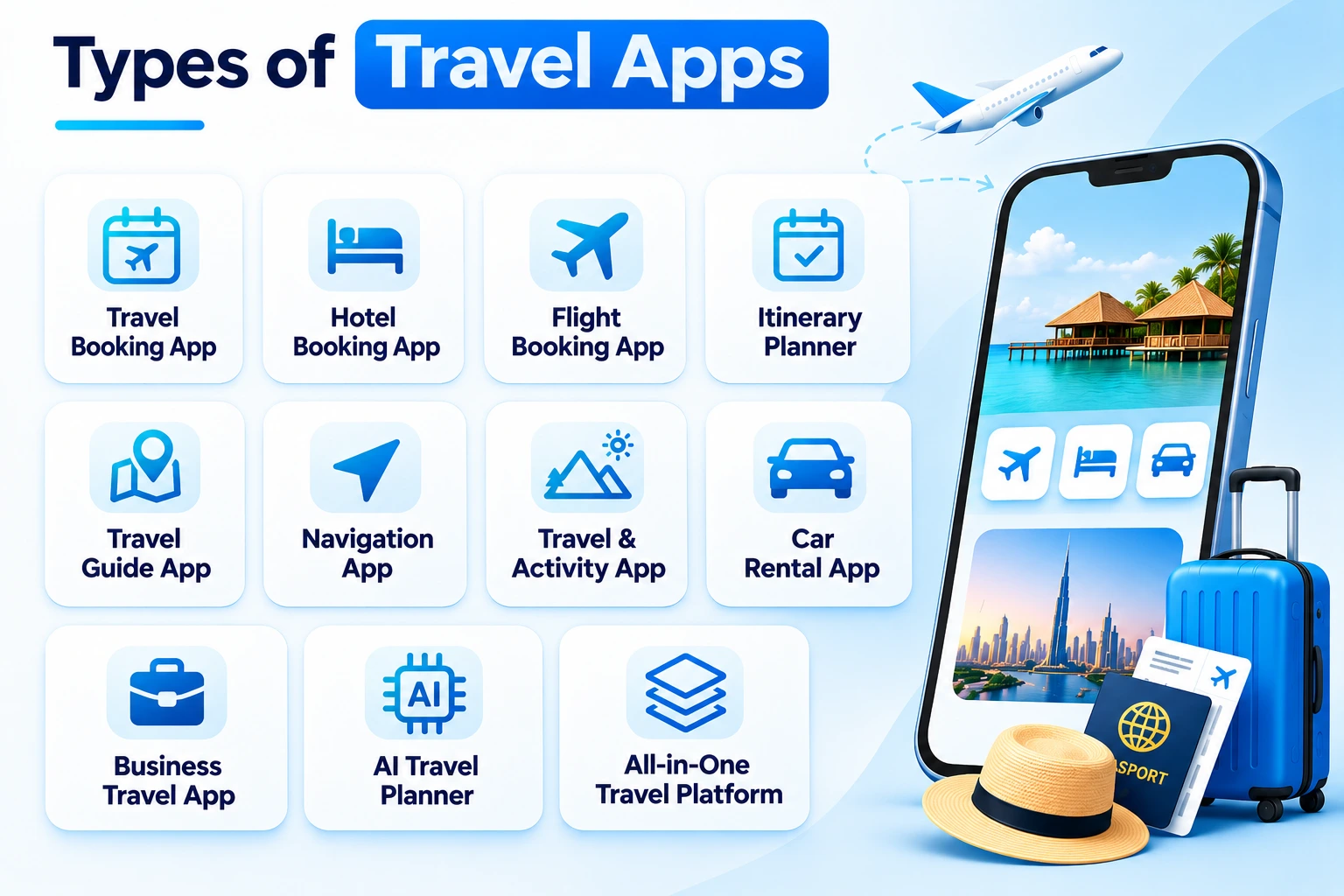
Before deciding how to build a travel app, determine the specific problem the product will solve. Common types include:
- Travel Booking App: Flights, hotels, tours, and transport from one platform, for leisure and business travellers.
- Hotel Booking App: Hotel discovery, room availability, pricing, reviews, and reservations.
- Flight Booking App: Search, comparison, and booking of flights by destination, date, and fare.
- Itinerary Planner: Schedules, bookings, and activities in one place, useful for multi-destination trips.
- Travel Guide App: Attractions, restaurants, local recommendations, and travel tips.
- Navigation App: Maps, routes, and GPS services for unfamiliar destinations.
- Travel & Activity App: Tours, excursions, and local experiences bookable in the app.
- Car Rental App: Vehicle discovery, comparison, and rental booking.
- Business Travel App: Corporate trips, policies, approvals, itineraries, and expenses.
- AI Travel Planner: Personalised destination suggestions and conversational trip planning.
- All-in-One Travel Platform: Flights, hotels, transport, activities, itineraries, and payments in one ecosystem, suited to OTAs.
The choice should be driven by the target audience, business model, and customer problem rather than the number of features you can add.
What Features Should Travel App Development Include?
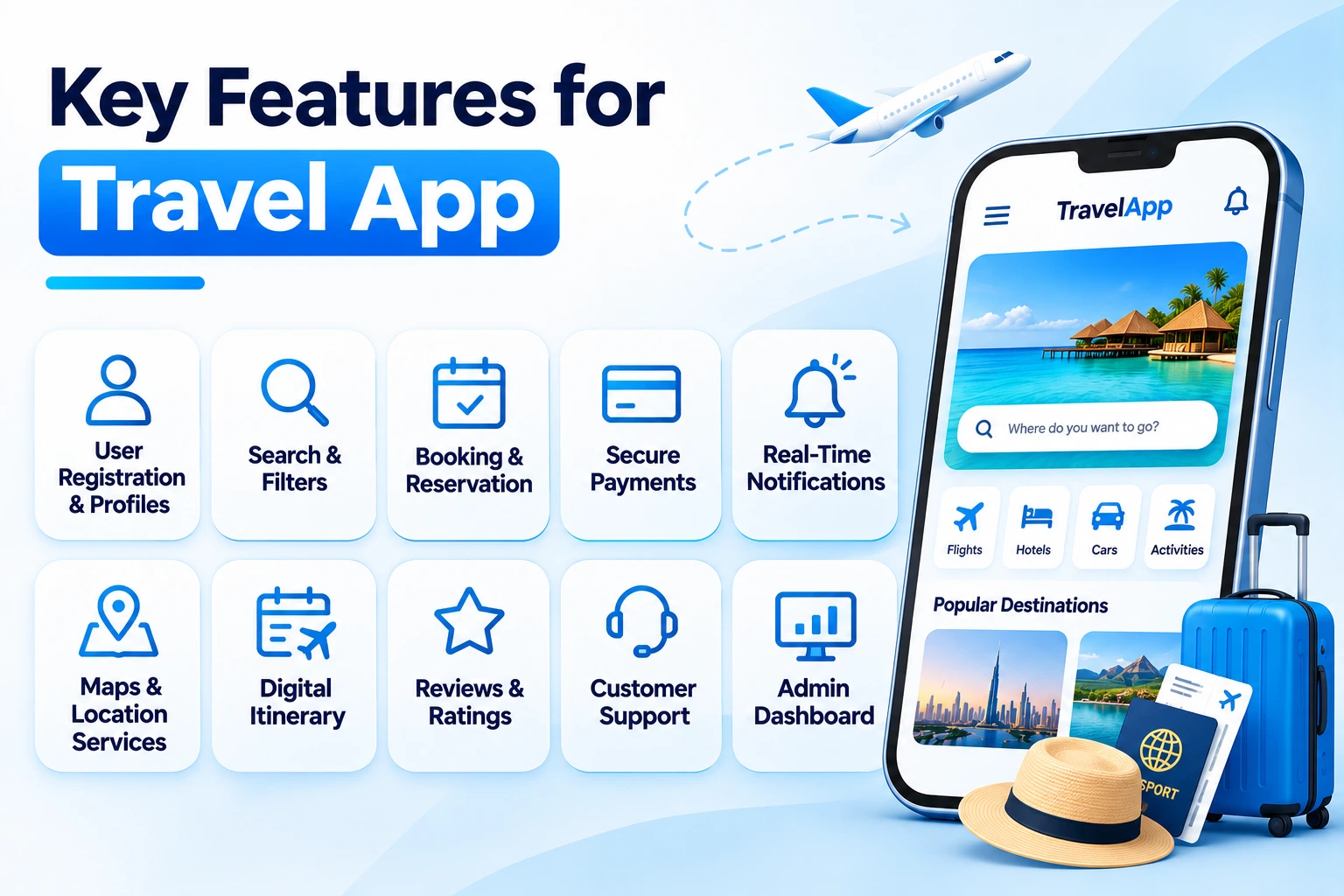
The required travel app features depend on the business model. A booking marketplace needs a different set from an AI itinerary planner.
- User Registration & Profiles: Email, phone, or social sign-in, with saved preferences, travel history, payment methods, and itineraries.
- Search & Filters: Fast search with filters for price, location, dates, ratings, amenities, property type, and cancellation policy.
- Booking & Reservation: A streamlined flow for flights, hotels, tours, car rentals, transfers, and activities.
- Secure Payments: Cards, digital wallets, and bank transfers, with confirmations, refunds, invoices, currency conversion, and fraud monitoring.
- Real-Time Notifications: Booking confirmations, flight changes, check-in reminders, and price alerts.
- Maps & Location Services: GPS navigation, nearby attractions, route planning, and location-based recommendations.
- Digital Itinerary: Flights, transfers, hotels, and tours in a single view.
- Reviews & Ratings: Trust-building feedback on accommodation, tours, and restaurants.
- Customer Support: In-app chat, AI chatbots, FAQs, and ticket management.
- Admin Dashboard: Central control over users, bookings, vendors, commissions, analytics, and review moderation.
What Advanced Features Can Enhance Travel App Development?
For a differentiated product, consider AI trip planning, personalised recommendations, voice search, multilingual support, real-time flight status, dynamic pricing, smart itinerary optimisation, currency conversion, travel document storage, digital tickets, AR destination experiences, weather-based recommendations, emergency assistance, loyalty and rewards, and travel insurance integration.
Advanced functionality should solve a specific user problem or create a measurable business advantage, not simply extend the feature list.
What UAE Requirements Should Travel App Development Consider?
An app that works in another market will not automatically work in the UAE. Plan for these from the start, because adding them after launch usually costs more.
- Arabic & right-to-left (RTL) support: Layouts, icons, navigation, and date formats must mirror correctly, alongside a clean English experience for international visitors.
- AED pricing & local payments: Show AED by default with multi-currency display. Support Apple Pay, local cards, and buy-now-pay-later options. Prices should include 5% VAT and any mandatory tourism fees, so checkout matches search results.
- Licensing & regulation: Depending on what you sell, tour operators and holiday homes in Dubai may need licensing from the Department of Economy and Tourism (DET). Payment handling can bring in PCI DSS and central bank requirements.
- Data protection & hosting: Passport and payment data fall under the UAE’s federal data protection law (PDPL), plus DIFC and ADGM rules where relevant. Many businesses use UAE-based cloud regions.
- UAE Pass sign-in: Reduces friction for residents and adds a trusted identity layer.
- Regional demand patterns: Eid, summer, school breaks, and major events create spikes. Prayer times, halal dining, and family-friendly filters are valued local touches.
What Are the Key Steps in Travel App Development?
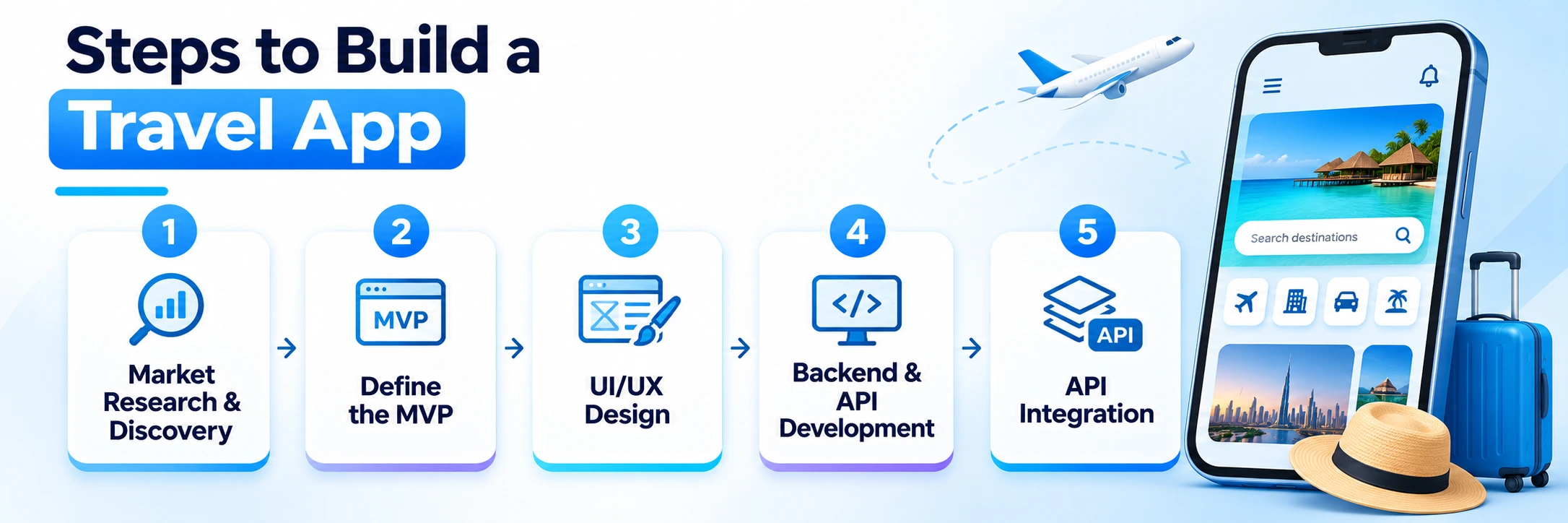
Step 1: Market Research & Discovery
Define target travellers, category, competitors, pain points, business model, required integrations, and regulatory considerations.
Step 2: Define the MVP
An MVP allows a business to validate its travel app concept without building the complete platform from the start. A booking MVP may include registration, search, filters, listings, booking, payments, notifications, user profiles, and an admin dashboard, while advanced features can be added after market validation.
Step 3: UI/UX Design
Travel app UI UX design should prioritise clarity and speed, because users decide quickly while travelling. It covers user flows, wireframes, prototypes, and usability testing.
Step 4: Backend & API Development
The backend manages users, bookings, payments, availability, pricing, and notifications. It must scale for holiday and event traffic spikes.
Step 5: API Integration
Travel app API integration connects flight, hotel, maps, payment, weather, currency, translation, notification, identity, and AI services. Evaluate each API for availability, pricing, usage limits, data quality, reliability, documentation, and commercial terms, since these shape both functionality and running costs.
Making Travel APIs Reliable
Travel data changes by the minute. A room available at search can be sold out at payment, and fares can change between results and checkout. Practical safeguards include:
-
- Vet suppliers: Get uptime history, response times, rate limits, and support terms in writing. Compare direct connections with distribution providers such as Amadeus, Sabre, Travelport, and Hotelbeds.
- Cache carefully: Cache static content such as descriptions and images, but never hold live prices or availability longer than the supplier allows.
- Plan for failure: Use timeouts, limited retries, circuit breakers, and fallback suppliers so one slow API does not stop bookings.
- Monitor continuously: Track error rates, latency, and failed bookings per supplier, with alerts.
Designing the Booking Workflow
A booking is a sequence of steps across several systems, and each can fail. A reliable flow includes:
-
- Search & availability check: Re-confirm availability and price with the supplier when the user selects an option.
- Price confirmation & hold: Flag price changes before payment and place a temporary hold where supported.
- Payment authorisation: Authorise first, capture after supplier confirmation, and use idempotency keys so a retry never double-charges.
- Supplier confirmation: Store the supplier reference next to your own booking ID.
- Voucher and notification: Send tickets or vouchers by email, push, and the digital itinerary.
- Changes & refunds: Apply fare rules and cancellation policies automatically, with an audit trail.
- Reconciliation: Match bookings, supplier invoices, and payments regularly.
Define in advance what happens when payment succeeds but the supplier booking fails. These edge cases are the biggest source of support tickets and chargebacks.
Step 6: Development
Build the frontend, backend, database, APIs, and admin dashboard. Choose native development or cross-platform tools such as Flutter and React Native.
Step 7: Testing
Cover functionality, UI, APIs, payments, security, performance, and devices, plus booking failures, duplicate transactions, cancellations, refunds, and network interruptions.
Step 8: Deployment
Prepare App Store and Google Play releases, production databases, cloud setup, monitoring, crash reporting, and security configuration.
Step 9: Maintenance & Scaling
Plan bug fixes, OS and API updates, security patches, performance work, new features, and analytics-driven improvements.
Which Technology Stack Is Best for Travel App Development?
Select the travel app development platform based on audience, performance needs, budget, and long-term strategy. There is no universal stack: a small MVP may use lean cross-platform architecture, while a large OTA may need a distributed backend.
| Layer | Technologies |
| iOS / Android | Swift, SwiftUI / Kotlin |
| Cross-platform | Flutter, React Native |
| Frontend | React, Next.js |
| Backend | Node.js, Python, .NET |
| Databases | PostgreSQL, MySQL, MongoDB |
| Cloud | AWS, Microsoft Azure, Google Cloud |
| Maps | Google Maps Platform, Mapbox |
| Payments | Stripe, Adyen, regional gateways |
| AI/ML | OpenAI APIs, TensorFlow, PyTorch |
| Analytics | Firebase, Google Analytics, Mixpanel |
| Notifications | Firebase Cloud Messaging, Apple Push Notification service |
| Security | OAuth 2.0, JWT, encryption, MFA |
Which Platform Is Right for Your Travel App Development?
Android App Development suits broad device markets. iOS App Development suits markets with high iPhone adoption and strong purchasing power. Flutter App Development and React Native App Development let one shared codebase serve both platforms, reducing duplicated effort. A product can launch on one platform and expand after validating demand.
AI Travel App Development
AI App Development adds personalised recommendations, itinerary generation, conversational assistance, predictive analytics, and automated support to modern travel platforms.
How Can Travel App Development Generate Revenue?
A clear travel app business model is essential before development.
| Monetisation model | How it works |
| Commission | Percentage of completed bookings |
| Subscription | Recurring user fee |
| Listing fees | Vendors pay to list services |
| Advertising | Paid promotional placement |
| Affiliate revenue | Earnings from partner bookings |
| Premium features | Fees for advanced functionality |
| Service fees | Transaction or convenience fee |
| B2B licensing | Platform sold to travel companies |
Commission and affiliate models suit booking platforms, while subscription or premium models suit itinerary and planning apps.
How Much Does Travel App Development Cost in Dubai?
The travel app development cost in Dubai varies with whether development is handled by an in-house team, local agency, offshore team, or hybrid team. For a Dubai-focused product, an indicative budget looks like this:
| Project Type | Estimated Budget (AED) | Estimated Budget (USD) |
| Travel App MVP | AED 110,000–220,000 | $30,000–$60,000 |
| Standard Booking Platform | AED 220,000–440,000 | $60,000–$120,000 |
| Advanced Marketplace | AED 440,000–735,000+ | $120,000–$200,000+ |
| AI-Enabled Travel Platform | AED 660,000–1,285,000+ | $180,000–$350,000+ |
The final price depends on scope rather than the number of screens. Flight and hotel inventory, payments, loyalty systems, AI, multiple vendors, and complex cancellation workflows all add effort.
Usually included: discovery and planning, UI/UX design, iOS and Android development (typically cross-platform for MVP and standard tiers), backend and admin dashboard, standard integrations such as maps, payments, and notifications, testing, and store release.
Usually billed separately: supplier and API fees, usage-based charges for maps, SMS, and AI, cloud hosting, payment gateway fees, App Store and Google Play account fees, legal and licensing costs, Arabic localisation and content, marketing, and post-launch maintenance.
Native apps on both platforms, bilingual Arabic and English from day one, several supplier integrations, and AI features push a project toward the higher end of each range.
Want to Know the Exact Cost of Your Travel App Development Project?
Feel free to book an initial call with our experts.
How Long Does Travel App Development Take?
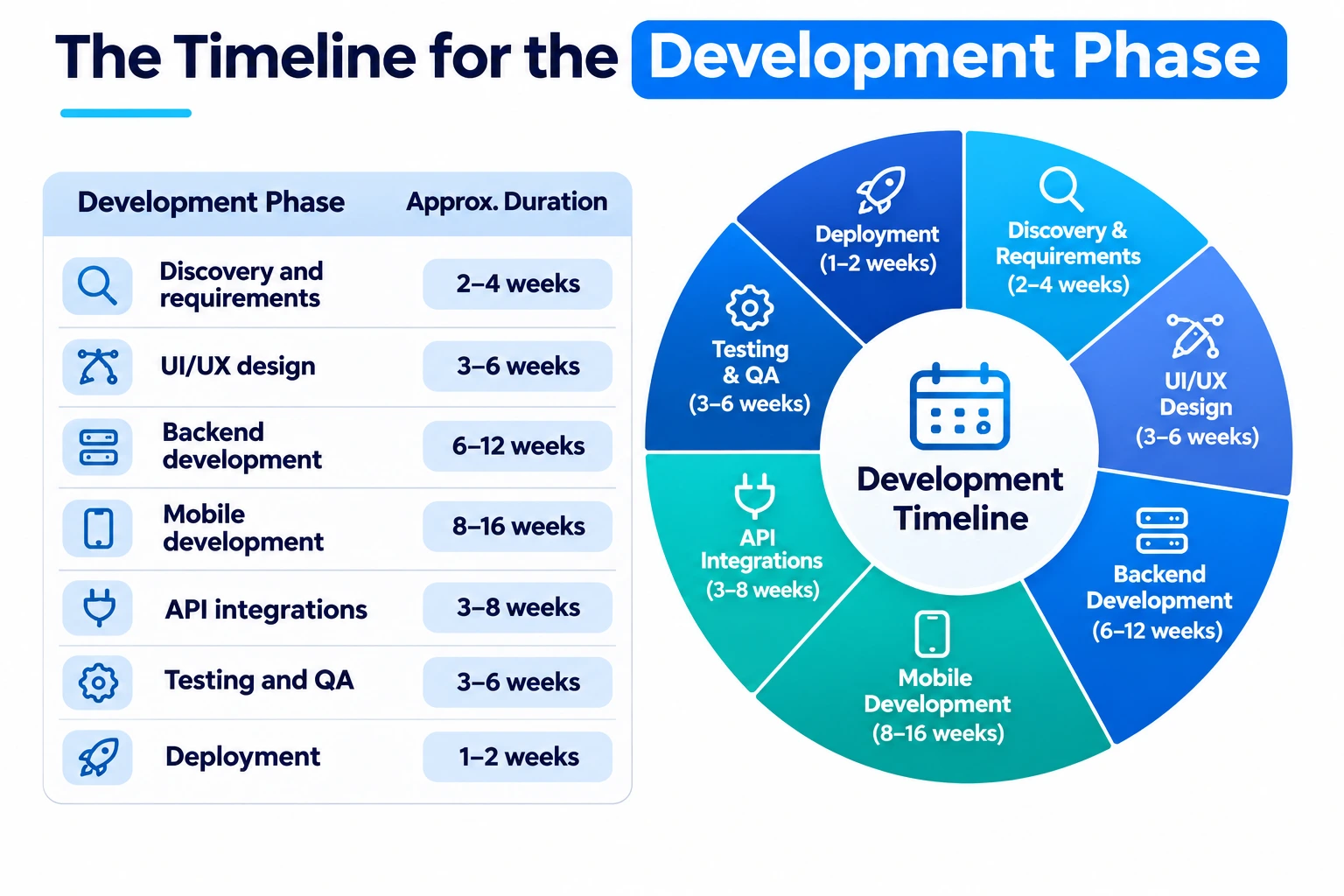
| Development phase | Approx. duration |
|---|---|
| Discovery and requirements | 2–4 weeks |
| UI/UX design | 3–6 weeks |
| Backend development | 6–12 weeks |
| Mobile development | 8–16 weeks |
| API integrations | 3–8 weeks |
| Testing and QA | 3–6 weeks |
| Deployment | 1–2 weeks |
Phases overlap, so the total is not the sum of each stage. In practice, an MVP takes 12–20 weeks, a standard booking platform 20–32 weeks, and a complex or AI-enabled platform 32–64 weeks or more.
These timelines assume that scope is agreed before design starts, approvals happen within agreed windows, supplier credentials and sandbox access arrive on time, and a dedicated team covers design, mobile, backend, and QA. Supplier and payment contracts can add several weeks if started late, and app store review time is not included.
What Trends Are Shaping Travel App Development?
- Generative AI trip planning: Travellers describe what they want in natural language instead of navigating complex search screens.
- Hyper-personalisation: History, preferences, budget, and location drive recommendations.
- AI-powered customer service: Assistants handle booking, cancellation, and itinerary questions.
- Real-time travel information: Live updates on flights, delays, weather, traffic, and availability.
- Super apps: Flights, hotels, transport, activities, payments, and support in one place.
- Voice & conversational search: Faster destination discovery and planning.
- Sustainable travel: Highlighting eco-friendly hotels, transport, and activities.
- Connected travel experiences: Booking data, tickets, maps, loyalty programmes, and support joined into one journey.
How Can You Make Travel App Development Scalable?
- Focus on an MVP: Start with the smallest feature set that validates your idea.
- Build modular architecture: Separate authentication, booking, payments, notifications, and recommendations so each can evolve independently.
- Use reliable APIs: Poor data causes wrong prices, unavailable rooms, and failed bookings.
- Prioritise security: Use encryption, secure authentication, access controls, and monitoring for personal and payment data.
- Prepare for peak demand: Cloud infrastructure and caching help absorb holiday and event spikes.
- Measure user behaviour: Analytics show where users abandon search, booking, payment, and onboarding.
How Do You Choose the Right Travel App Development Company?
The right travel app development services shape technical quality, user experience, and scalability. Look for end-to-end mobile app development expertise and proven experience in travel & hospitality workflows, API integration, payment systems, maps, AI, cloud, cybersecurity, UI/UX, and post-launch support. Ask potential partners about their approach, relevant projects, technology choices, timeline, and maintenance strategy.
For UAE businesses, a travel app development company in Dubai is likely to understand regional payment preferences, customer expectations, and local market requirements better.
Why Choose Aarmeh for Travel App Development in Dubai?
Aarmeh is a Dubai-based app development company building mobile and web products for businesses across the UAE and wider GCC. That means a team in your time zone, familiar with local payments, Arabic & English interfaces, and the regulatory questions that come with launching in the Emirates.
- Scope before code: Discovery and a defined MVP first, so you know the cost in AED and the weeks per phase before development begins.
- Travel-specific engineering: API integrations, booking and cancellation workflows, payments, and notifications planned as core architecture.
- Built for the UAE: Arabic and RTL support, AED pricing, regional gateways, and data protection from day one.
- Flexible technology: Flutter, React Native, Swift, and Kotlin, chosen to fit your audience and budget.
- Support after launch: Maintenance, API updates, security patches, and scaling.
Get a Clear Estimate for Your Travel App
Planning a booking app, AI itinerary planner, or travel marketplace in the UAE? Share your idea with the Aarmeh team and get a scoped estimate in AED, with a week-by-week timeline, in a free consultation.
Final Thoughts
Travel apps have evolved from simple booking tools into comprehensive digital travel companions. Travellers expect personalised discovery, seamless payments, real-time updates, navigation, digital itineraries, and responsive support.
A successful product needs a defined business model, reliable APIs, scalable architecture, secure payments, thoughtful travel app features, and a roadmap aligned with user needs. Starting with a focused MVP and expanding on real user data reduces unnecessary cost and builds a foundation for long-term growth.
Frequently Asked Questions (FAQs)
Q. How much does it cost to develop a travel app in the UAE?
A basic travel app MVP can cost AED 110,000–220,000 ($30,000–$60,000). A standard booking platform costs around AED 220,000–440,000, an advanced marketplace AED 440,000–735,000+, and an AI-enabled platform AED 660,000–1,285,000+. Supplier fees, hosting, and marketing are usually billed separately.
Q. How long does travel app development take?
An MVP takes around 12–20 weeks, a standard booking platform 20–32 weeks, and complex or AI-enabled solutions 32–64 weeks or longer, depending on scope, team size, and how quickly supplier agreements are in place.
Q. What are the most important travel app features?
Registration, search filters, booking, payments, notifications, maps, itinerary management, reviews, customer support, and an admin dashboard.
Q. What APIs are required for a travel app?
Flights, hotels, maps, payments, weather, currency, translation, notifications, authentication, and AI services, depending on the app. Assess each supplier’s reliability, pricing, and rate limits first.
Q. Can AI be integrated into a travel app?
Yes, AI supports personalised recommendations, itinerary generation, conversational search, customer support, review summarisation, and travel planning.
Q. What is the best monetisation model for a travel app?
Commission, affiliate revenue, subscriptions, advertising, service fees, premium features, and listing fees are common. The best fit depends on your audience and service type.
Q. What technology stack is used for travel app development?
Typically Swift or Kotlin for native apps, Flutter or React Native for cross-platform, Node.js, Python, or .NET for the backend, PostgreSQL or MongoDB for data, AWS or Azure for cloud, and AI/ML tools for intelligent features.
Q. Which payment methods should a UAE travel app support?
Major cards, Apple Pay, and AED pricing with multi-currency display. Buy-now-pay-later options and regional gateways can improve conversion.
Q. Do I need a licence to run a travel app in Dubai?
It depends on what you sell. Tour operators, holiday homes, and some tourism services may need DET licensing, and payment and data protection rules can apply. Confirm with a UAE legal adviser.
Q. How long does it take to integrate flight and hotel APIs?
Technical integration usually takes 3–8 weeks, but supplier agreements and sandbox access can add more, so start them during discovery.
Q. Why choose a Dubai-based company for travel app development?
A Dubai partner works in your time zone, understands UAE payment and language expectations and local regulations, and can meet your team in person.




 Book a call



 CLUTCH VERIFIED
 Top App Developer UAE
 100% NDA Protected
 IN THE HEART OF UAE