





Table of Contents
📌 Key Takeaways
- Choosing the right educational app development partner requires evaluating EdTech experience, technical expertise, UI/UX capabilities, security practices, scalability, communication, and post-launch support.
- Educational apps can include LMS platforms, online learning apps, tutoring marketplaces, language learning solutions, exam preparation platforms, and AI-powered learning applications.
- Educational app development costs can range from $20,000 to $300,000+, depending on app complexity, features, platforms, integrations, AI capabilities, security, and overall project scope.
- A structured education app development process is essential, covering discovery, product strategy, UI/UX design, development, testing, deployment, and ongoing monitoring and maintenance.
- Security, scalability, AI readiness, integrations, and user experience are critical when building successful educational applications, particularly for platforms serving students, institutions, teachers, and children.
Education is becoming increasingly digital, personalized, and accessible across devices. Schools, universities, coaching institutes, training providers, EdTech startups, and corporate learning organizations are investing in mobile and web-based learning platforms to deliver lessons, assessments, live classes, progress tracking, and personalized learning experiences.
Education App Development at a Glance
| Factor | What to Look For |
| Industry expertise | Experience with schools, universities, EdTech, LMS, tutoring, or online learning |
| Technology | Android, iOS, web, cloud, APIs, AI, analytics, and modern backend technologies |
| UX/UI | Simple, accessible, age-appropriate, and learner-focused interfaces |
| Scalability | Architecture capable of supporting increasing users, courses, and content |
| Security | Encryption, authentication, access controls, privacy, and secure data storage |
| Integrations | LMS, payment gateways, video, CRM, APIs, analytics, and third-party services |
| AI capabilities | Adaptive learning, AI tutors, recommendations, automated assessments, and analytics |
| Support | Post-launch maintenance, monitoring, updates, and technical support |
| Communication | Clear reporting, documentation, milestones, and project management |
| Cost transparency | Clear scope, deliverables, assumptions, and pricing structure |
Education Technology Market Trends and Growth Opportunities
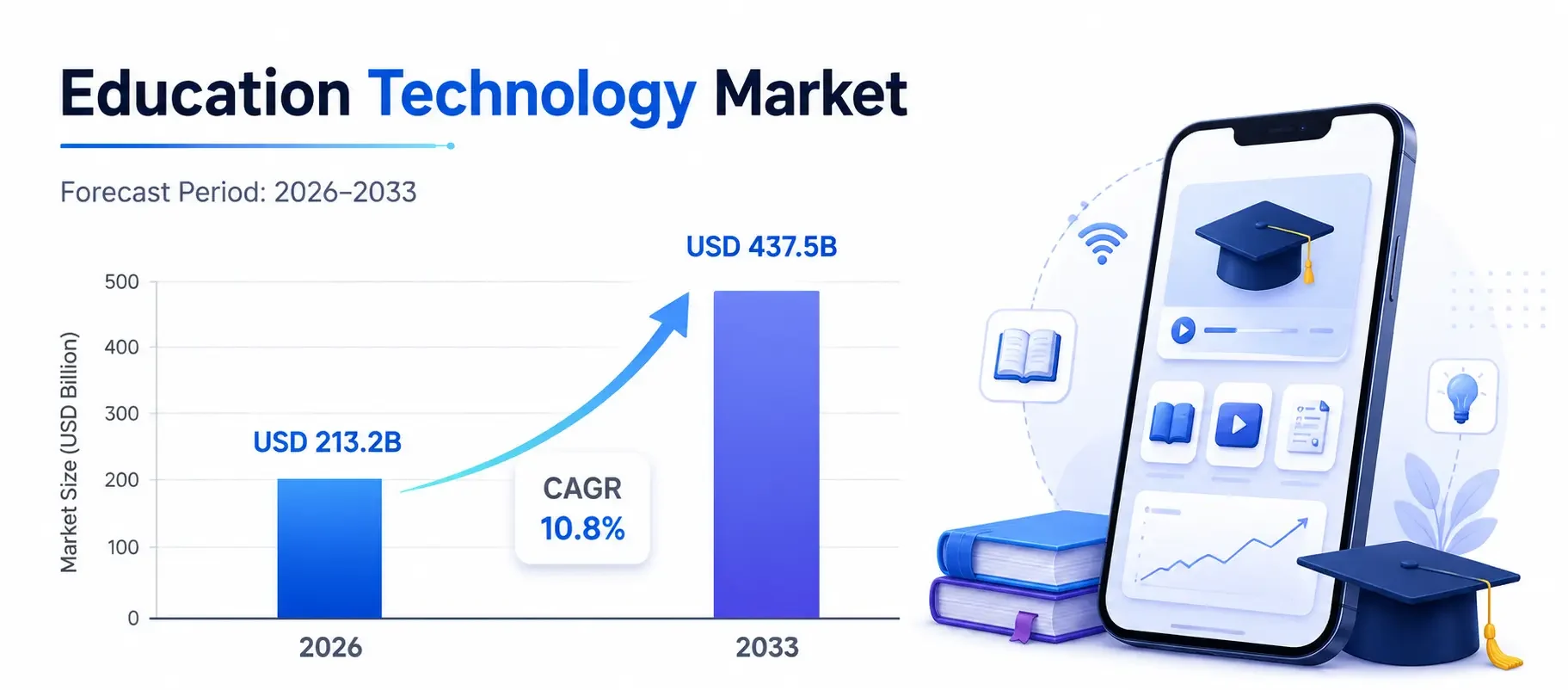
The global education technology market was valued at approximately USD 187 billion in 2025 and is projected to reach USD 437.5 billion by 2033, representing a 10.8% CAGR from 2026 to 2033, according to Grand View Research.
However, building an education application is not simply a matter of developing screens and adding video lessons. The right solution needs to combine learning design, user experience, scalable technology, data security, accessibility, analytics, and business objectives.This makes choosing the right education app development company an important strategic decision. Whether you need a tutoring marketplace, language-learning application, LMS, virtual classroom, exam preparation platform, children’s learning app, or AI-powered adaptive learning solution, the right mobile app development company can directly influence the product’s quality, cost, scalability, and long-term success.
What Types of Educational Apps Can You Build?
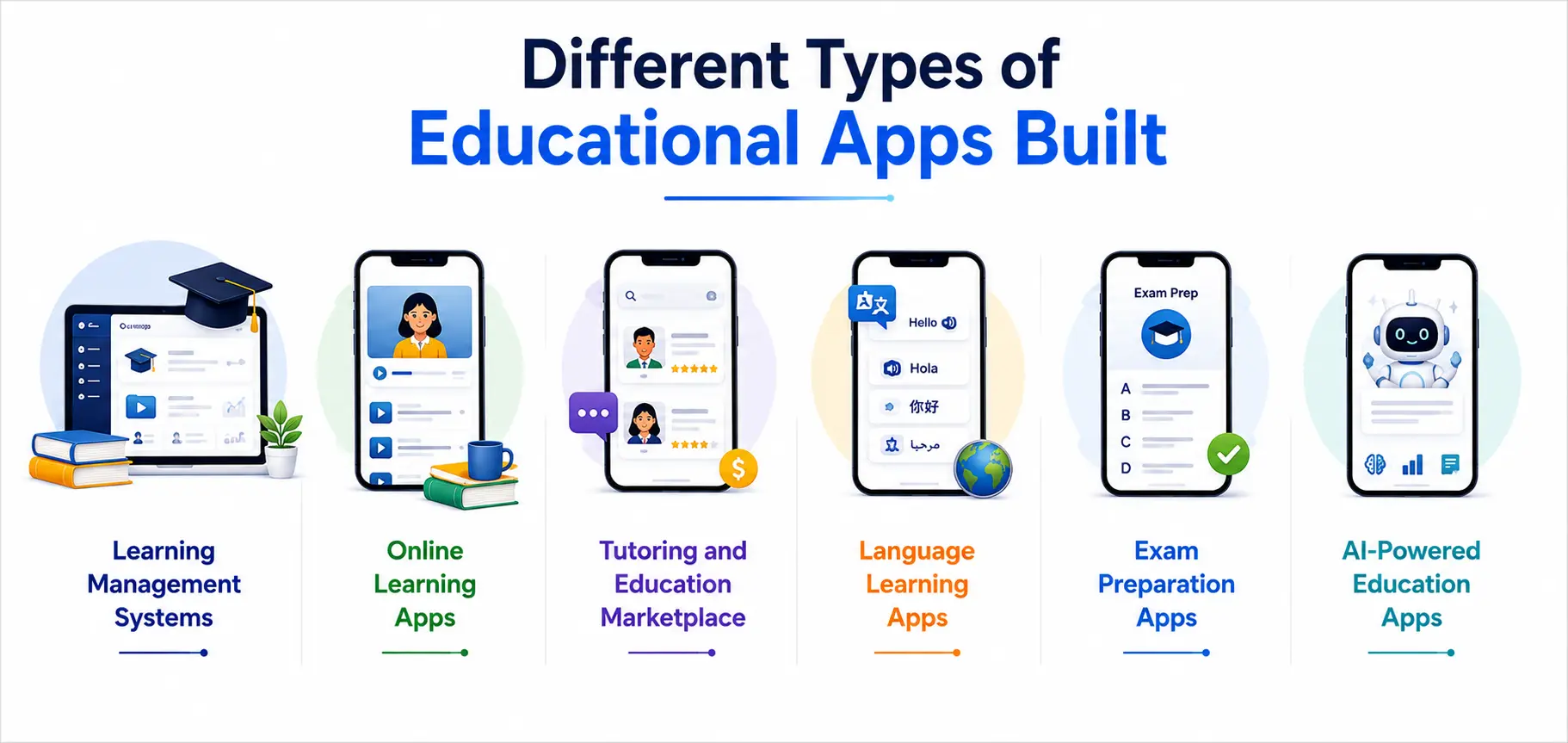
Before selecting a partner, define all types of applications you want to develop. Different education products require different architectures, features, integrations, and development expertise. Here are the most common types of educational applications:
1. Learning Management Systems
Learning Management Systems (LMS) help institutions organize and deliver structured learning experiences. They can include course management, student enrollment, video and document lessons, assignments, quizzes, exams, attendance, and progress tracking.
Advanced LMS platforms can also offer certificates, teacher dashboards, administrative reporting, learning analytics, notifications, and role-based access. These features help institutions manage both learning content and student performance from one platform.
2. Online Learning Apps
Online learning applications connect learners with structured courses, instructors, and digital educational resources. They can support subscriptions, course purchases, video streaming, live classes, assessments, discussion forums, and learning materials.
Personalized recommendations can help learners discover relevant courses based on their interests, progress, and learning history. Such platforms can serve schools, universities, professional training providers, coaching institutes, and EdTech businesses.
3. Tutoring and Education Marketplace
Tutoring platforms connect students with tutors or educational service providers through a centralized digital marketplace. Key features can include tutor profiles, search and filtering, availability calendars, booking, messaging, video sessions, ratings, and reviews.
The platform can also support online payments, package management, tutor earnings, and booking management. These capabilities make it easier for students to find suitable tutors while helping educators manage their schedules and services.
4. Language Learning Apps
Language learning applications are designed to make language acquisition interactive and engaging. They can combine lessons, quizzes, flashcards, gamification, speech recognition, and conversational exercises to support different learning styles.
Advanced applications can use AI to provide conversational practice, pronunciation feedback, personalized exercises, and adaptive learning paths. This allows learners to progress based on their performance, strengths, and areas that need improvement.
5. Exam Preparation Apps
Exam preparation applications help students practice, evaluate their knowledge, and identify areas for improvement. Common features include mock exams, question banks, timed tests, subject-wise scores, performance analytics, and detailed explanations.
Advanced platforms can provide personalized revision plans and progress comparisons to support more focused preparation. Leaderboards and achievement features can also introduce healthy competition and encourage consistent engagement.
6. AI-Powered Education Apps
AI app development can help education platforms deliver personalized learning experiences and automate several educational workflows. AI can support intelligent tutoring, personalized learning paths, automated feedback, question generation, content recommendations, intelligent search, and teacher assistance.
AI can also support speech and language analysis and student performance prediction when implemented responsibly. The technology should be aligned with specific learning objectives rather than added simply as an AI feature, with appropriate attention to safety, inclusion, privacy, and human oversight.
Key Features of an Educational App
The features required for an educational application depend on its target audience and purpose. However, a well-designed platform should provide a combination of learning, communication, management, and engagement features.
1. User registration and profiles:
Secure registration allows students, teachers, parents, tutors, and administrators to create accounts and manage relevant profile information. Social login, and secure authentication can make onboarding more convenient.
2. Course and content management:
Learners should be able to browse courses, subjects, lessons, videos, documents, and other educational resources. Administrators and teachers can use content management tools to organize and update learning materials.
3. Video and live classes:
Video lessons and live learning sessions allow students to access educational content remotely. Integration with video streaming and conferencing services can support both recorded and instructor-led learning.
4. Quizzes and assessments:
Interactive quizzes, assignments, mock tests, and examinations allow learners to evaluate their understanding. Automated scoring and instant feedback can make assessments more useful and engaging.
5. Progress tracking:
Students can monitor completed lessons, assessment scores, course progress, and learning milestones. Teachers and parents can also receive relevant performance insights where applicable.
5. Personalized learning:
Recommendation engines and adaptive learning paths can suggest courses, lessons, exercises, or revision materials based on a learner’s interests and performance.
6. Search and filtering:
Advanced search allows users to quickly find courses, tutors, lessons, subjects, instructors, or educational resources. Filters can further refine results based on categories, levels, prices, ratings, or availability.
7. Notifications and reminders:
Push notifications can inform users about upcoming classes, assignments, new courses, test schedules, booking updates, and learning reminders.
8. Payments and subscriptions:
Education apps that sell courses or services can integrate secure payment gateways, subscription management, invoices, refunds, and transaction histories.
9. Communication tools:
In-app messaging, discussion forums, comments, and teacher-student communication can help users interact and resolve learning-related questions.
10. Analytics and dashboards:
Students can view learning progress, while teachers and administrators can access performance reports, engagement metrics, course analytics, attendance, and other relevant insights.
11. Gamification:
Badges, points, achievements, streaks, challenges, and leaderboards can make learning more interactive and encourage continued participation.
12. Admin panel:
A centralized admin panel allows authorized users to manage students, teachers, courses, content, payments, subscriptions, reports, notifications, and platform settings.
13. AI-powered features:
Depending on the product, AI can support intelligent tutoring, personalized recommendations, automated feedback, question generation, content search, speech analysis, and learning assistance.
Common Challenges in Educational App Development
Educational app development involves more than building a functional mobile application. Developers need to address challenges related to user engagement, content delivery, security, scalability, accessibility, and different learning requirements.
1. Maintaining user engagement:
Students may lose interest if the application offers repetitive content or a complicated experience. Gamification, personalized learning paths, interactive assessments, progress tracking, and timely notification can help encourage consistent participation.
2. Managing different user roles:
Educational platforms often serve students, teachers, parents, tutors, and administrators. Each user requires different permissions and workflows, making role-based access control and intuitive dashboards essential.
3. Ensuring data security and privacy:
Education apps can process academic records, personal information, payment details, and children’s data. Encryption, secure authentication, access controls, consent management, and secure APIs should be incorporated into the architecture from the beginning.
4. Supporting scalability:
Growing user numbers, video content, assessments, and concurrent sessions can place significant demands on infrastructure. Cloud-based architecture, optimized databases, caching, monitoring, and scalable APIs can help maintain performance as the platform expands.
5. Integrating educational technologies:
An application may need to connect with payment gateways, video conferencing platforms, LMS systems, CRMs, analytics tools, AI services, and student information systems. Reliable API integration and data synchronization are therefore important for a connected learning ecosystem.
6. Balancing AI with human oversight:
AI can personalize learning and automate certain tasks, but generated content and recommendations still require appropriate validation. Educational applications should use AI responsibly while considering accuracy, bias, privacy, and the role of teachers and educators.
10 Factors to Consider When Choosing Educational App Developers
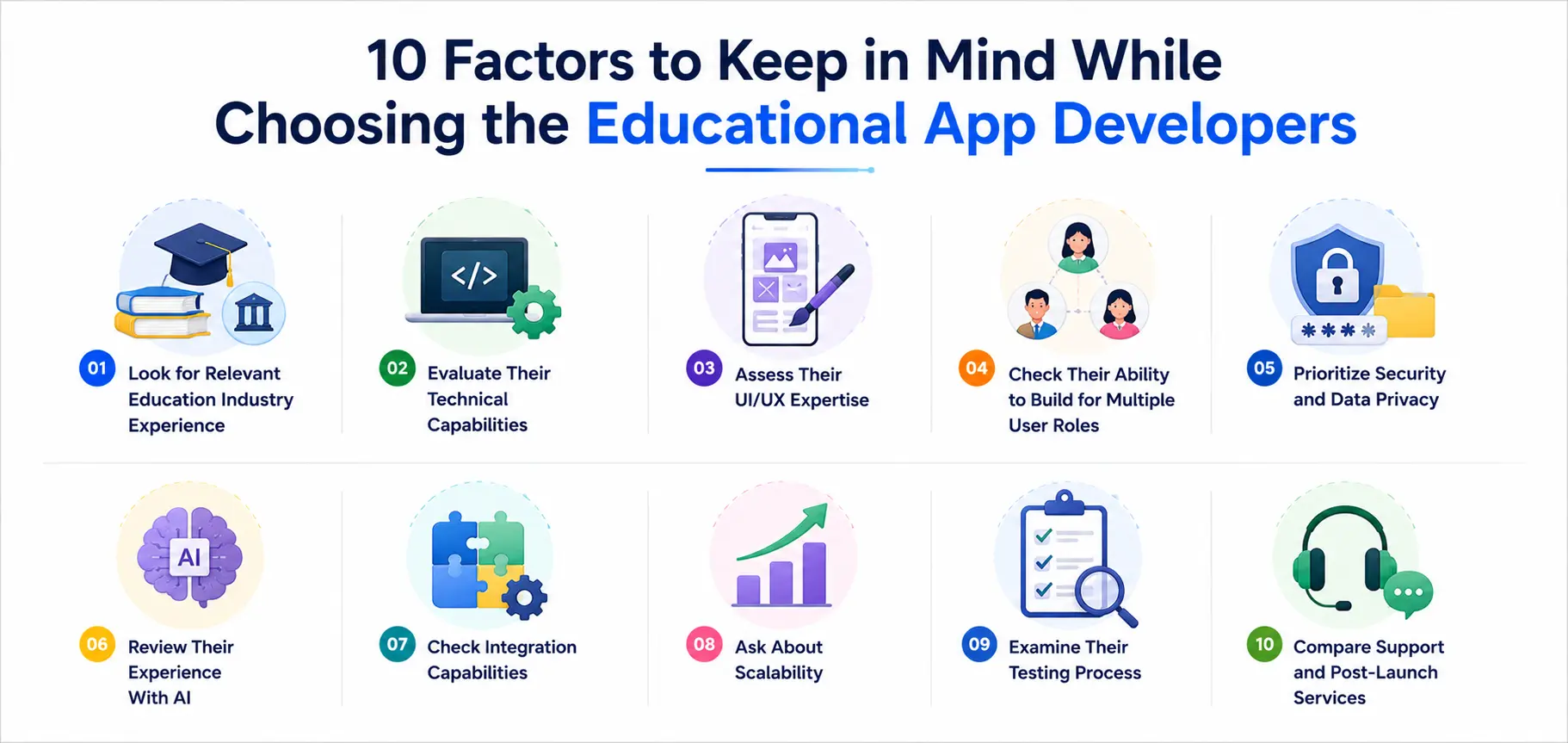
Choosing a development partner requires more than comparing quotations. Evaluate the company across technical expertise, education industry experience, security, scalability, communication, and long-term support.
1. Look for Relevant Education Industry Experience
Start by reviewing the company’s previous education projects and case studies. Check whether they have built LMS platforms, learning applications, tutoring marketplaces, assessment systems, teacher dashboards, or live-class solutions.
Relevant experience helps developers understand education-specific workflows, user expectations, and learning objectives. A strong education app development company should know how to create an engaging learning experience rather than simply deliver digital content.
2. Evaluate Their Technical Capabilities
Your development partner should have the technical expertise to build the complete product ecosystem, including Android app development, iOS app development, cross-platform applications, frontend, backend, databases, cloud infrastructure, and APIs.
Depending on your requirements, expertise in React, Flutter, React Native, Node.js, Python, .NET, PostgreSQL, MongoDB, AWS, Azure, AI, ML, NLP, and analytics may be valuable. Focus on whether the team can justify its technology choices rather than simply presenting a long technology list.
3. Assess Their UI/UX Expertise
Educational applications need interfaces that are simple, intuitive, accessible, and appropriate for their target audience. Students should be able to find lessons, understand progress, complete assessments, and resume learning without unnecessary complexity.
Ask prospective educational mobile app developers about their approach to user research, information architecture, wireframing, prototyping, usability testing, accessibility, and responsive design. The experience should also match the audience, as a children’s learning app requires a different approach from corporate training software.
4. Check Their Ability to Build for Multiple User Roles
Education platforms commonly support students, teachers, tutors, parents, administrators, and institutions, with each user requiring different functionality. Your development partner should understand how to create personalized dashboards and permissions for every role.
For example, students may need courses and progress tracking, while teachers require grading and attendance tools. Parents may need performance reports, tutors may manage bookings and earnings, and administrators may oversee users, content, payments, and analytics.
5. Prioritize Security and Data Privacy
Security should be considered during architecture and development rather than added after the application is completed. Education platforms may process student profiles, academic records, attendance, assessment results, payments, learning behavior, and children’s information.
A capable education technology app development company should address encryption, secure authentication, role-based access, API security, consent management. Audit logs, backups, data retention, and secure cloud infrastructure. If children are part of the target audience, privacy and data protection should receive even greater attention.
6. Review Their Experience With AI
AI can support educational applications through personalized recommendations, AI tutoring, automated quiz generation , essay feedback, speech evaluation, performance analysis, intelligent search, and teacher productivity tools.
However, AI should address a genuine learning or operational requirement rather than being added simply for marketing purposes. Ask developers how they manage hallucinations, bias, privacy, human oversight, model evaluation, and AI-generated content to ensure the technology delivers measurable value.
7. Check Integration Capabilities
Modern education platforms often depend on third-party services for payments, video conferencing, streaming, CRM, LMS, student information systems, email, SMS, notifications, analytics, calendars, cloud storage, and AI APIs.
Your eLearning app development company should have experience integrating these systems securely and reliably. Ask how the team handles API authentication, data synchronization, service failures, version changes, and disruptions to third-party platforms.
8. Ask About Scalability
An education application may start with a few thousand students and eventually grow to hundreds of thousands or millions of users. Your development partner should therefore design an architecture that can handle increasing users, content, transactions, and concurrent activity.
Discuss cloud infrastructure, load balancing, caching, database optimization, CDN integration, monitoring, automated deployment, backups, and API performance. Your learning app development company should also explain how the platform will handle traffic spikes, such as increased usage before major examinations.
9. Examine Their Testing Process
Testing should go beyond checking whether individual features work correctly. An education application should be evaluated for functionality, UI/UX, device compatibility, security, accessibility, API performance, load handling, video playback, notifications, and user permissions.
Testing should also cover payment flows, offline behavior, and data synchronization where applicable. Ask whether the company has dedicated QA specialists and whether testing is performed continuously throughout the app development process rather than only before launch.
10. Compare Support and Post-Launch Services
Application development does not end when the product is published. Ongoing support may be required for bug fixes, operating system updates, security patches, performance optimization, cloud management, new features, analytics, third-party API changes, and AI model updates.
A reliable educational app development partner should provide a clear post-launch support plan. Check whether they offer maintenance for Android and iOS applications, backend infrastructure, App Store and Google Play updates, security improvements, and future product enhancements.
How to Choose an Education App Development Company: A Practical Scorecard
Instead of choosing a company based solely on price, use a weighted evaluation system.
| Evaluation Area | Suggested Weight |
| Relevant EdTech experience | 15% |
| Technical capabilities | 15% |
| UI/UX expertise | 10% |
| Security and privacy | 15% |
| Scalability and architecture | 10% |
| AI and advanced technology | 10% |
| Communication and project management | 10% |
| Portfolio and references | 5% |
| Post-launch support | 5% |
| Pricing transparency | 5% |
| Total | 100% |
You can score every shortlisted company from 1 to 10 in each category and multiply the score by the corresponding weight.
This creates a more objective comparison than choosing the lowest quote.
Monetization Models for Educational Apps
Selecting the right monetization model depends on the target audience, type of educational content, business objectives, and value offered to users. An educational app development company can help determine which model best fits the product and fits the product and its expected user journey.
1. Subscription model:
Users pay monthly, quarterly, or annually to access courses, learning resources, premium features, or the complete platform. This model can provide recurring revenue for eLearning and language-learning applications.
2. Freemium model:
Core learning resources are available for free, while advanced courses, assessments, certificates, AI features, or additional learning tools require payment. This approach can help attract users before encouraging upgrades.
3. Paid courses:
Learners purchase individual courses, programs, or educational packages. This model can work well for professional training, exam preparation, skill development, and specialized learning platforms.
4. Commission model:
Tutoring marketplaces can charge a percentage or fixed fee from tutors or students for completed bookings. Revenue can be generated whenever a lesson, package, or educational service is purchased through the platform.
5. Advertising model:
Free educational applications can generate revenue by displaying relevant advertisements. However, advertising should be used carefully, particularly in applications designed for children, where privacy, safety, and user experience require greater consideration.
6. Institutional licensing:
Schools, universities, training organizations, and businesses can pay for access to an education platform for their students, employees, or members. Licensing can provide predictable revenue while allowing institutions to manage users and learning programs centrally.
How Much Does It Cost to Develop an Educational App?
The mobile app development cost for an education application varies considerably according to complexity, platform, integrations, design requirements, AI capabilities, backend architecture, security, and development location.
For initial planning, the following ranges can be used as indicative industry estimates rather than fixed quotations:
| App Type | Indicative Cost Range | Typical Timeline |
| Basic learning app | $20,000–$40,000 | 3–5 months |
| Standard eLearning platform | $40,000–$80,000 | 5–8 months |
| Advanced education marketplace | $70,000–$150,000+ | 7–11 months |
| Enterprise LMS / EdTech platform | $100,000–$250,000+ | 9–15 months |
| AI-powered learning platform | $120,000–$300,000+ | 10–18 months |
These figures are planning ranges. Actual pricing should be calculated after defining features, platforms, integrations, content requirements, security expectations, and technical architecture.
What Influences the Cost of Educational App Development?
The major cost drivers include:
1. Number of platforms
Building Android and iOS applications alongside a web-based admin portal requires more development and testing than launching a single platform.
2. Feature complexity
A basic course library costs less to develop than an application with live classes, AI tutoring, payments, assessments, analytics, gamification, and multiple user roles.
3. UI/UX requirements
Custom interactions, animations, gamification, accessibility, and extensive user testing can increase design and development effort.
4. Backend architecture
A scalable backend with complex workflows, analytics, APIs, and multiple dashboards requires more engineering than a simple content delivery system.
5. AI implementation
AI-powered recommendations, adaptive learning, speech recognition, generative AI, and intelligent tutoring require additional engineering, model/API costs, testing, and monitoring.
6. Integrations
Payment gateways, video platforms, CRMs, LMS systems, cloud services, and external APIs can increase both development and maintenance requirements.
7. Security and compliance
Applications handling children’s data, academic records, or payments require additional security controls and testing.
A Typical Education App Development Process
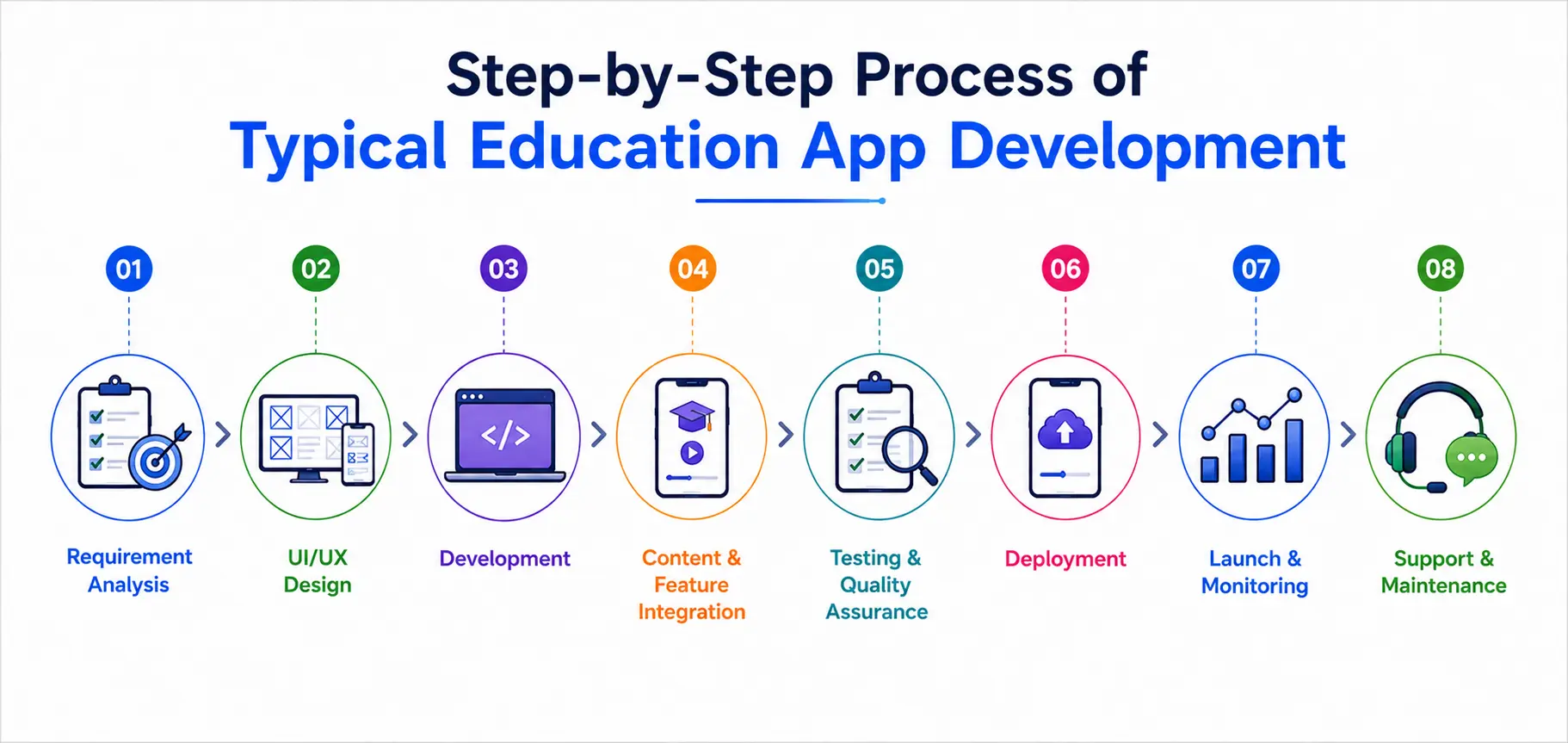
A professional development team should follow a structured app development process to turn an education app concept into a reliable, scalable, and user-friendly product. Each stage helps align the application with learning objectives, business goals, technical requirements, and user expectations.
Step 1: Discovery and Requirements
The process begins by identifying target users, learning objectives, business models, core features, user roles, competitors, technical requirements, integrations, and security expectations. This stage establishes a clear foundation for the application and helps define its overall scope.
Step 2: Product Strategy
The gathered requirements are converted into a practical product strategy covering the MVP scope, product roadmap, technical architecture, feature priorities, development plan, and expected outcomes. This helps the team establish clear priorities before development begins.
Step 3: UI/UX Design
Designers create user journeys, wireframes, prototypes, visual interfaces, and design systems based on the target audience and learning experience. The focus remains on creating intuitive navigation, accessible interfaces, consistent interactions, and engaging experiences across devices.
Step 4: Development
Developers build the mobile applications, backend, APIs, database, admin panel, integrations, and other required components. The development team connects the frontend and backend systems while implementing the functionality defined during the earlier stages.
Step 5: Testing
QA specialists evaluate the application for functionality, usability, security, performance, compatibility, and critical user workflows. Testing helps identify and resolve issues before launch while ensuring the application performs reliably across supported devices and environments.
Step 6: Deployment
Once testing is complete, the application is prepared for deployment across the App Store, Google Play, web platforms, and production infrastructure. The team manages release configurations, final checks, app submissions, hosting, and production setup.
Step 7: Monitoring and Maintenance
After launch, the team monitors application performance, user feedback, analytics, security, and system stability. Ongoing maintenance includes bug fixes, security updates, performance improvements, platform compatibility updates, and new features based on evolving user and business requirements.
Why an MVP Can Be the Better Starting Point
You do not necessarily need to launch every planned feature at once.
A learning application MVP could include:
- User registration
- Student profile
- Course catalogue
- Video lessons
- Basic quizzes
- Progress tracking
- Notifications
- Admin dashboard
Advanced features such as AI tutoring, gamification, live classes, recommendation engines, and advanced analytics can be added after validating the core product.
This approach can reduce initial investment, shorten time to market, and provide real user feedback before significant resources are allocated to advanced functionality.
What Should You Ask Before You Hire Educational App Developers?
Before signing a contract, ask prospective partners:
- How many education applications have you developed?
- Can you show relevant case studies?
- Have you worked with multiple user roles?
- What technology stack would you recommend and why?
- How will you protect student and children’s data?
- How will the application scale as users increase?
- What is included in the initial estimate?
- What is excluded?
- How do you handle third-party API integrations?
- What is your QA and testing process?
- How will you measure application performance?
- Do you provide post-launch maintenance?
- Who owns the source code and intellectual property?
- How frequently will we receive progress updates?
- What happens if the project scope changes?
The answers can reveal more than a portfolio alone.
How to Choose the Right Educational App Development Company in Dubai
Dubai’s growing education ecosystem creates opportunities for digital platforms serving schools, students, parents, universities, tutors, and training providers. According to KHDA, Dubai had 227 private schools and 387,441 students in the 2024-2025 academic year, with student enrollment growing by 6%. The sector also included 233 schools, 331 early childhood centers, and 44 higher education institutions as of August 2025.
If you are looking for an educational app development company in Dubai, start by defining your users, business model, platforms, core features, integrations, and expected launch timeline. Then shortlist 5-8 companies based on relevant education experience, technical expertise, location coverage, and case studies before narrowing the list to around three potential partners.
During the evaluation, compare their proposals, architecture recommendations, UX approach, development methodology, and communication process. A Dubai-focused partner should also understand UAE data privacy, children’s digital safety, secure payments, Arabic and English experiences, RTL requirements, local education workflows, school integrations, cloud architecture, user consent, and data transfer considerations.
Before making a final decision, conduct technical discussions around scalability, security, integrations, AI capabilities, testing, and deployment. The UAE Personal Data Protection Law and children’s digital safety requirements make privacy and responsible data handling particularly important for education platforms.
Ultimately, do not select a partner solely based on the lowest quotation. The best education app development company in Dubai should offer the right balance of EdTech expertise, technology, security, UX, scalability, communication, pricing transparency, and long-term support.
What Makes a Strong Educational App Development Partner?
A reliable education app development company should bring together product strategy, education domain knowledge, UI/UX design, Android and iOS development, backend engineering, cloud infrastructure, API development, AI and machine learning, security engineering, quality assurance, analytics, DevOps, and post-launch maintenance.
- Product strategy
- Education domain knowledge
- UI/UX design
- Android development
- iOS development
- Backend engineering
- Cloud infrastructure
- API development
- AI and machine learning
- Security engineering
- Quality assurance
- Analytics
- DevOps
- Post-launch maintenance
This is why organizations often prefer an end-to-end education mobile app development company instead of coordinating multiple vendors for design, development, backend, QA, and infrastructure.
A single experienced team can create better alignment between product strategy, UX, technology, and business goals.
Why Choosing the Right Educational App Development Partner Matters
An education application serves several stakeholders at the same time.
A student may need a simple interface for discovering courses, watching lessons, completing quizzes, and tracking progress. Teachers may need tools to upload content, manage classes, assess students, and communicate with learners. Parents may require visibility into attendance and academic performance. Administrators need dashboards, reports, payments, user management, and system controls.
Therefore, an education app development company needs to understand more than mobile application development.
It should understand how technology supports learning outcomes.
UNESCO’s 2023 Global Education Monitoring Report highlights this distinction. Although 91% of countries used online learning platforms during school closures, these platforms reached only around one-quarter of students globally. At least 500 million students, or 31% of students worldwide, could not be reached by remote learning.
This demonstrates why education applications must be designed around factors such as accessibility, connectivity, device availability, usability, and actual learning requirements.
Final Thoughts
Choosing among educational app developers should not be based solely on price, location, or the number of technologies listed on a website.The right development partner should understand the learning experience you want to create and have the technical capabilities to turn that vision into a secure, scalable, and engaging product.
Evaluate prospective partners based on education experience, portfolio quality, UX expertise, technical capabilities, scalability, security, AI readiness, integration experience, communication, pricing transparency, and post-launch support.
For organizations building an EdTech product in Dubai, local regulatory awareness should also be considered, particularly when the platform handles student or children’s data.
The strongest educational app development partner is ultimately the one that can connect technology with measurable educational and business outcomes.
Frequently Asked Questions (FAQs)
Q. How do I choose an educational app developer?
Start by evaluating relevant EdTech experience, portfolio quality, technology capabilities, UI/UX expertise, security practices, scalability, communication, pricing transparency, and post-launch support. Ask for relevant case studies and conduct a technical discussion before signing a contract.
Q. What does an educational app development company do?
An educational app development company can manage product discovery, UI/UX design, mobile and web development, backend engineering, API integration, testing, deployment, cloud infrastructure, analytics, and post-launch maintenance.
Q. How much does educational app development cost?
A basic education app may cost approximately $20,000–$40,000, while a more advanced EdTech platform can exceed $100,000. AI-powered or enterprise applications may cost $120,000–$300,000+, depending on scope and complexity.
Q. What features should an education app include?
Common features include user registration, course discovery, video lessons, quizzes, assignments, progress tracking, notifications, search, payments, teacher dashboards, student dashboards, analytics, and administrative controls. Advanced applications may add AI tutoring, adaptive learning, gamification, live classes, and personalized recommendations.
Q. Are AI features useful in educational applications?
Yes, when they address a genuine learning or operational requirement. AI can support adaptive learning, personalized recommendations, automated feedback, content generation, tutoring assistance, speech evaluation, and student analytics. However, AI should be implemented with appropriate human oversight, privacy controls, and quality evaluation.
Q. How important is security in an education app?
Security is critical because educational platforms can process student profiles, academic records, behavioral information, payment details, and children’s data. Encryption, secure authentication, access controls, privacy-by-design, secure APIs, monitoring, and appropriate data governance should be considered from the beginning.
Q. Should I hire educational app developers in Dubai for a UAE-focused product?
A Dubai-based or UAE-focused team can be useful when your product needs local market knowledge, bilingual experiences, regional integrations, or awareness of UAE data protection and children’s digital safety requirements. However, technical expertise and relevant EdTech experience should remain the primary selection criteria.
Q. How long does it take to build an educational application?
A basic application can take around 3–5 months, while a standard platform may require 5–8 months. Advanced marketplaces, enterprise LMS products, and AI-powered learning platforms can require 8–18 months or more, depending on scope, integrations, testing, and compliance requirements.
Q. What should I include in an educational app development RFP?
Include your target users, learning objectives, business model, platforms, core features, user roles, integrations, content requirements, security expectations, AI requirements, expected timeline, budget range, analytics requirements, and post-launch support expectations.
Q. What is the most important factor when selecting an education app development company?
There is no single factor. The strongest choice is usually a partner that combines relevant EdTech experience, strong engineering capabilities, user-focused design, security expertise, scalable architecture, transparent communication, and reliable long-term support.



 Book a call




 CLUTCH VERIFIED
 Top App Developer UAE
 100% NDA Protected
 IN THE HEART OF UAE