





Table of Contents
📌 Key Takeaways
- An e-scooter platform is more than a rider app; it needs three connected systems: the rider app, fleet/operations tools, and IoT hardware integration.
- UAE-specific requirements should be built in from the start, including RTA operating rules, geofencing, speed limits, rider eligibility, Arabic/English support, data protection, and 5% VAT handling.
- Core launch features should focus on reliability rather than feature overload QR/Bluetooth unlocking, live scooter maps, payments, receipts, safety alerts, fleet tracking, geofencing, battery monitoring, and maintenance management are central.
- The main technical challenges are real-time connectivity and fleet operations, particularly GPS accuracy, IoT/hardware integration, battery management, geofencing, payment logic, scalability, and security.
- Development cost depends heavily on platform scope; the source estimates approximately AED 60,000–150,000 for a lean MVP, AED 150,000–370,000 for a mid-level platform, and AED 370,000–650,000+ for a full platform, excluding the scooters themselves.
Scan a QR code, wait a second, and the scooter is yours. That is the whole experience from the rider’s side. For the company running it, that second involves an app, a controller bolted to the scooter, a location signal and a card payment, and all four have to agree before the lock lets go. After that, someone still has to track it down, get it charged, and make sure it hasn’t drifted into a no-ride zone, for as long as that scooter stays in service. That ongoing work is really what an e-scooter app development company is hired to build for, not just a map with a few pins scattered across it.
From here, we’ll get into what a scooter-sharing platform needs to function, the technology sitting underneath it, the rules specific to the UAE, roughly what a build costs, where most teams run into trouble, and how to spot a development partner worth hiring. None of it assumes an engineering background. Where a technical term shows up for the first time, we explain it on the spot.
Why Is the UAE a Strong Market for Shared E-Scooters?
Most cities are still arguing about whether scooters belong on the road. Dubai has a written framework. The RTA licenses operators, marks out where riding is allowed, caps speed by zone, and sets helmet and age requirements. For a founder, that is useful. It means e scooter app development Dubai teams work from a defined checklist rather than a moving target, and you can plan a budget without wondering whether the product will still be legal next quarter.
The use case is short trips. Think of the walk from a Metro station to an office in Business Bay that feels too far in August and too short for a taxi. Or the loop around Marina Walk that a tourist wants to do without hiring a car. Demand follows the weather, though. July and August afternoons are quiet, while November to March is when fleets earn their keep. Pricing, fleet size and maintenance staffing should all be planned around that swing.
What Does a Scooter-Sharing Platform Actually Include?
Founders often start with one question: what will the app look like? A better one is how many systems they are actually paying for. There are three.
The rider app is the easy one to picture. Then there is the operations side, a dashboard and a field app for the people who move, charge and repair scooters. And finally the link to the vehicle itself, a module on the scooter that takes commands and reports its position back through a real-time GPS tracking API. Many early budgets cover the rider app properly and gloss over the other two. It usually shows up later, when a team of three is trying to find twelve dead scooters with a spreadsheet.
What Types of E-Scooter Apps Can You Build?
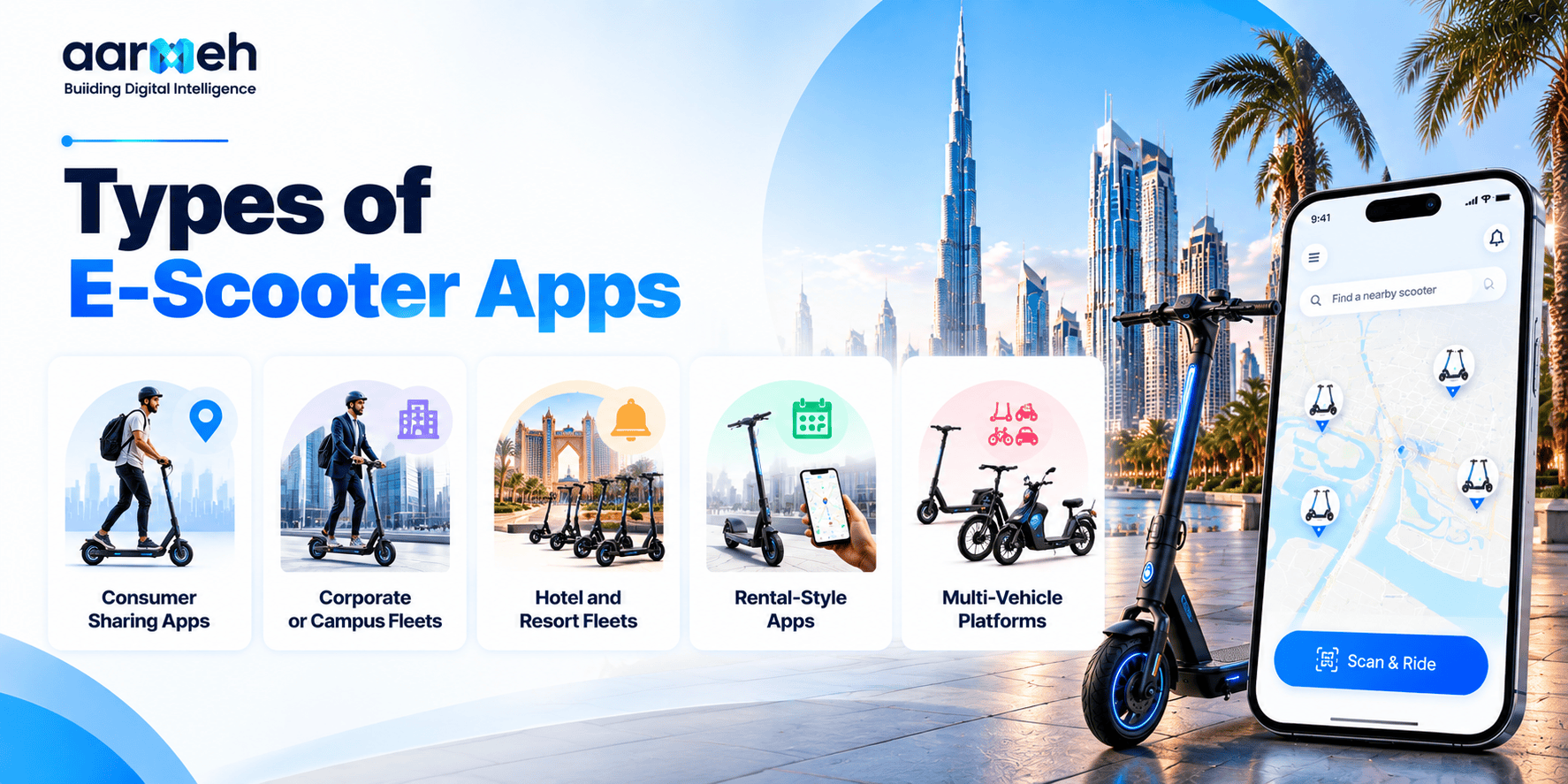
Not every scooter business needs the same product. The right type depends on who owns the fleet and who is meant to ride it.
-
Consumer Sharing Apps:
The model most people picture: scooters scattered around a city, unlocked by anyone with the app. This is what Dubai’s licensed operations run today.
-
Corporate or Campus Fleets:
A closed group of riders, such as staff on a business park or students on a university campus. Sign-up is usually tied to a company ID or a student account rather than open registration.
-
Hotel and Resort Fleets:
Scooters for guests only, often bundled into the room rate. The app can be lighter here, since payment and identity are already handled at check-in.
-
Rental-Style Apps:
A single scooter booked for hours or days rather than a short ride, closer to a car rental than a sharing platform. Pricing and the booking flow look quite different from a per-minute model.
-
Multi-Vehicle Platforms:
Scooters alongside e-bikes or mopeds in one app and one account. Riders switch vehicle type depending on the trip, and operators spread hardware and software costs across a bigger fleet.
What Features Should an E-Scooter App Include at Launch?
Want These Features Built Into Your E-Scooter App?
Feel free to book an initial call with our experts.
Ask around and you will find that lists of the features of e-scooter sharing app products run from twelve items to sixty. Most of them can wait. What has to work on day one is a much shorter list.
Riders need:
- Phone-number sign-up, with ID checks that work for tourists as well as residents
- Unlock by QR code or Bluetooth, and a map showing which scooters are nearby and charged
- Payment by card or Apple pay, in AED, with VAT calculated correctly
- Arabic and English from the first release, not as a later update
- A receipt after every ride and easy way to report a broken scooter
- Helmet reminders, speed-zone alerts and a photo of the parked scooter to end the ride
Operators need:
- A live map of the fleet with the status of each scooter
- Geofence editing that does not require a developer
- Task lists for battery swaps and repairs, driven by battery level monitoring data
- Reports on revenue, utilisation and downtime
Then comes the tendency to keep adding more features. Loyalty points, referrals, group rides. Each one sounds reasonable in a meeting. Each one also needs building, testing and maintaining, and if riders ignore it, you have paid for nothing. We would rather see a launch version that unlocks fast and charges correctly than a crowded one that is still in testing months after the original date.
What Is The Tech Stack for E-Scooter App Development?
For e-scooter app development, the tech stack usually needs to cover rider apps, fleet management, IoT communication, GPS tracking, payments, and cloud infrastructure, and React Native cross-platform development is typically what the rider and admin apps get built on first.
| Technology Layer | Recommended Tech Stack |
| iOS App | Swift, SwiftUI |
| Android App | Kotlin, Jetpack Compose |
| Cross-Platform App | Flutter, React Native |
| Backend | Node.js, Python, .NET |
| APIs | REST API, GraphQL, WebSockets |
| Database | PostgreSQL, MongoDB, Redis |
| GPS & Maps | Google Maps Platform, Mapbox |
| Geolocation | GPS, Geofencing, Location Services |
| IoT & Scooter Connectivity | Bluetooth Low Energy (BLE), Cellular (4G/5G), MQTT |
| Cloud Infrastructure | AWS, Microsoft Azure, Google Cloud |
| Payments | Stripe, Adyen, PayPal, regional payment gateways |
| Authentication | OAuth 2.0, Firebase Authentication, OTP |
| Push Notifications | Firebase Cloud Messaging, Apple Push Notification Service |
| Analytics | Google Analytics, Firebase Analytics, Mixpanel |
| Admin Dashboard | React.js, Next.js, Angular |
| Real-Time Communication | WebSockets, MQTT |
| Security | TLS/SSL, AES encryption, API authentication, role-based access control |
| DevOps | Docker, Kubernetes, GitHub Actions, CI/CD |
What Compliance, Data and Payment Rules Apply in the UAE?
A handful of requirements are specific to the UAE, and most of them touch the app design directly.
-
Operating Rules:
The RTA licenses shared scooter operators in Dubai and decides where scooters can go, how fast, and who can ride. Other emirates answer to their own authorities. Zones, speed caps, helmet prompts and minimum-age checks should be settings your team can change, not values buried in the code.
-
Rider Data:
The federal personal data protection law shapes what you collect, where it is stored and how long you keep it. Settle those questions before anyone designs the sign-up screen.
-
VAT:
Rides carry 5% VAT, so pricing and receipts need to show it properly from the first release.
-
Tourists:
Many riders will pay with cards issued abroad or sign up with a foreign phone number. Both the ID checks and the payment flow have to cope with that without friction.
-
Changing Rules:
Zones and conditions get updated from time to time. Check the current requirements with the relevant authority before launch, and again before you expand.
Building this in from the start costs less than retrofitting it.
What Challenges Can Make E-Scooter App Development Complex?
Booking and payment screens are the easy part. What actually makes a scooter platform hard to build is getting mobile apps, connected vehicles, maps, live data, payments and fleet operations to work together without falling over. A few problems show up on almost every project.
-
Real-time scooter tracking
Keeping a location accurate depends on steady GPS data and a live link between the vehicle, the backend and the app. When that link lags, riders see a scooter that has already moved, or one that has none left in an area the map still shows as full.
-
IoT and Hardware Integration
Unlocking, locking, battery readings, ride status all of it depends on the scooter talking to the app, and no two controllers handle that conversation the same way. Connectivity tends to drop at the worst possible moment, out in the field rather than on a desk, which is why IoT integration in e-scooter apps is usually the part that runs over schedule.
-
Battery and Fleet Management
Operators need a clear view of charge levels, availability, maintenance status and where scooters actually are. Get this wrong and scooters quietly disappear from the areas riders want them most, even though the fleet count looks fine on paper.
-
Geofencing and Parking Rules
The app has to enforce operating zones, no-ride areas, speed limits and parking spots, and none of that works if the underlying GPS is off by a few metres. A scooter parked correctly can still show as outside the zone, which then becomes a rider dispute.
-
Payment and Pricing Logic
Deposits, per-minute pricing, subscriptions, discounts, refunds, tax and the occasional failed payment all have to run through the same calculation on the app and the backend. Any mismatch between the two shows up as a wrong receipt, and riders notice.
-
Scalability during peak demand
A rush of riders trying to find and unlock a scooter at the same time puts a real load on authentication, payments and the unlock command all at once. The backend has to hold up under that, not just in a quiet test environment.
-
Safety and Data Security
The platform ends up holding account details, payment data, location history, ride records, everything a rider has ever done on it. That’s not something to bolt security onto after launch. Strong authentication, encrypted connections, secured APIs and proper access controls belong in the build from day one.
How Much Does an E-Scooter Platform Cost to Build?
The e scooter app development cost of any project moves with scope, so a range tells you more than a single figure. The AED numbers below come from typical builds and work as a planning guide, not a quote.
| Scope | What’s included | Approximate budget | Typical timeline |
| Lean MVP | Rider app, basic admin panel, one hardware vendor | AED 60,000–150,000 | 2 – 4 months |
| Mid-level platform | Advanced admin, geofencing, multiple payment options, analytics | AED 150,000–370,000 | 4 – 6 months |
| Full platform | Multi-vehicle support, fleet operations app, deep integrations, scale testing | AED 370,000–650,000+ | 6 – 10 months |
So, how much does it cost to develop an e scooter app in your case? It depends on how many of these pieces you need at launch. The figures leave out the scooters themselves.
A handful of things push the final e scooter app development cost up faster than people expect: the number of hardware integrations, a custom operations dashboard, Arabic and English with proper right-to-left layouts, and cloud hosting that grows with the fleet. After launch, plan on 15 to 20 percent of the build cost each year for maintenance.
What is the Step-by-Step Process for E-Scooter App Development?
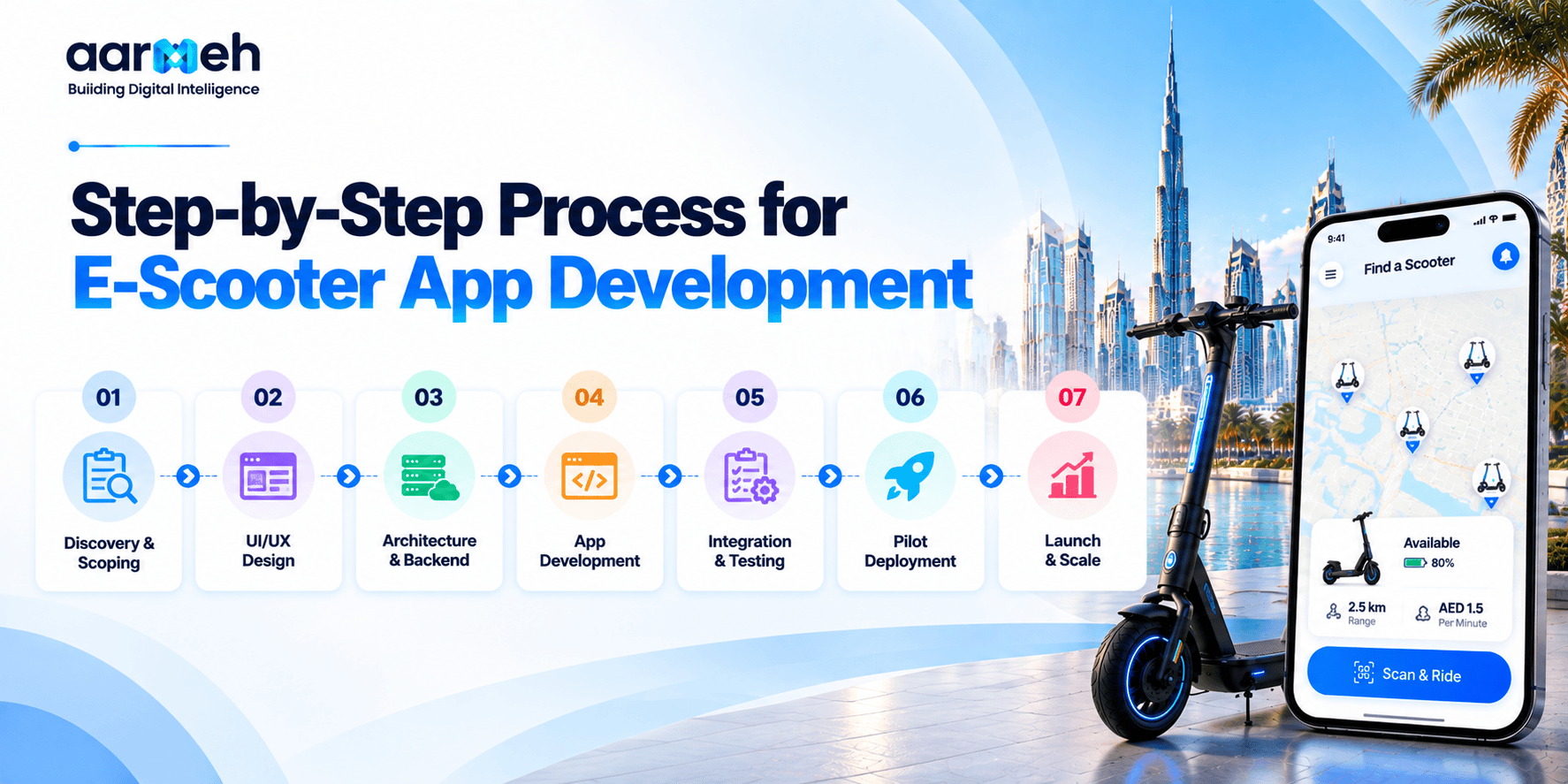
Developing an e-scooter app involves more than creating a rider-facing mobile interface. The process needs to connect the app with scooters, GPS, payments, geofencing, and fleet operations while keeping the experience reliable and secure. A typical development process moves through the following stages:
-
Discovery & Scoping
Goals, target city, fleet size, local rules and budget go on the table first, usually over a few working sessions. The output is a feature list split into what launches on day one and what waits, so nobody argues about scope halfway through.
-
UI/UX Design
Rider flows for unlock, ride, park and pay come first, followed by the operations dashboard. Arabic and English layouts, including right-to-left, are planned at this stage because retrofitting them later is slow and untidy.
-
Architecture & Backend
This is the plumbing: the database, the APIs, the admin tools and the messaging channel to the scooters. Getting it right early means the fleet can grow from fifty scooters to five hundred without a rebuild.
-
App Development
The rider app and the field app are built in short cycles, with a demo on a real scooter at the end of each one. Seeing the software work on hardware every few weeks catches problems while they are still cheap to fix.
-
Integration & Testing
Payments, maps, geofences and the controller all get connected, then tested outdoors in heat, in crowded areas and on weak signals. Lab results rarely match what happens on a hot pavement, so this step happens outside.
-
Pilot Deployment
A small zone and a small fleet, run long enough to watch real riders behave like real riders. Whatever breaks gets fixed before the next step.
-
Launch & Scale
Store release, staff training and monitoring come first, followed by new zones as the numbers justify them. Maintenance carries on from there, since a live fleet keeps throwing up small fixes.
How Do You Choose an E-Scooter App Development Partner?
If you plan to hire e-scooter app developers, in-house or through an agency, portfolio screenshots tell you very little. Find out what they have built that talks to hardware. Work out who owns the backend, the mobile app and the device testing, and whether those people work as one team. Time zone counts too, and so does being able to turn up at the test site when a scooter refuses to unlock at 9 pm.
Check references from operators, not only from consumer app clients. A team that has built a food-delivery app has solved a different problem. Look at how the quote is laid out as well. If the rider app, the operations tools and the hardware work appear as separate lines, someone has thought about all three systems.
Then comes the pilot: 30-50 scooters in a single zone, run for a few weeks before anything wider. A waterfront promenade or a campus works well, and if you can time it for the hottest part of your calendar, even better. The point of a pilot is to find out what breaks. Unlocks that fail on weak signals, batteries that drop faster than the app claims, riders who park where they should not. Track four numbers while it runs: unlock success rate, battery swaps per day, rides per scooter and repair time. Together they show whether the model can scale.
Why Choose Aarmeh for E-Scooter App Development?
As an IoT app development company UAE operators can rely on, Aarmeh works in your time zone, designs for both Arabic and English riders, and can get to a test site when a scooter needs a closer look. It sounds like a small thing until real vehicles are on the street and one stops responding on a Friday evening.
Our approach to scooter projects starts with the hardware. The software is built around the scooter and its controller, so we settle those first and work outward. From there the rider app, the operations tools and the link to the vehicle are scoped and built together, which stops any of the three from turning into an afterthought.
UAE conditions are built in from the beginning as well. Zones, speed caps, VAT and rider data handling are planned early and kept configurable, so a rule change does not mean a rewrite. New platforms are then tested on real scooters in a limited zone before the fleet grows.
On price, we quote each of the three systems on its own line, which lets the budget match what you actually need instead of arriving as one lump figure. The work does not stop at launch either. Updates, monitoring and fixes continue as the fleet grows.
If you are weighing a launch, start with a scoping conversation with Aarmeh. It will show which of those three systems your first release really needs.
What Are the Future Trends in E-Scooter App Development?
The next wave of scooter apps looks set to move past basic booking screens and toward automation, connected hardware and sharper fleet operations. A few directions are already visible.
AI-Powered Fleet Management
Feeding ride demand, battery levels, traffic and vehicle location into a model helps operators position scooters where riders actually are, and flag maintenance before it becomes downtime.
Predictive Maintenance
Data streaming off a connected scooter can point to odd battery behaviour or a failing component early, catching a problem before it takes the vehicle off the street.
Smart Pricing & Demand Forecasting
Dynamic pricing that reads demand, location, time and fleet availability lets operators nudge pricing and distribution at the same time, rather than adjusting them separately.
Connected IoT Ecosystems
More Scooters are shipping with always-on connectivity for tracking, remote diagnostics, battery monitoring and digital locking, all reporting back to the same fleet platform.
Better Battery Intelligence
More advanced battery monitoring means range estimates, charging alerts and battery-health data that riders and operators can actually trust, instead of a rough percentage.
Multimodal Mobility
Scooter apps are starting to connect with public transport, bike-sharing and taxis, so a rider can plan and pay for a whole trip, not just the scooter leg, from one screen.
Computer Vision for Safety
Camera-based features are emerging for obstacle detection, parking verification and even reading road conditions, adding a layer of automated safety monitoring on top of GPS alone.
Digital Wallets & Contactless Payment
Stored cards, subscriptions and contactless options are shortening the gap between opening the app and actually riding, which matters more than it sounds for casual and tourist riders.
Autonomous Fleet Operations
As the underlying technology matures, some of the diagnostics, redistribution and charging coordination that currently needs a person may shift toward more automated systems.
Conclusion
Beyond the branding, an e-scooter business comes down to a few important decisions made early. The level of platform ownership, the hardware the system is built around, the features included in the first release, and the development partner all shape the product’s long-term viability. Getting these foundations right makes the app easier to build, operate, and scale, while poor choices can create costly technical and operational challenges later.
Starting small can make the process more manageable. Launching in one zone with a few dozen scooters, operating through a Dubai summer, gives the team real operational data to guide the next phase of development. A capable e-scooter app development company adds value by identifying hardware, regulatory, and operational challenges before they reach the street. For businesses planning a UAE launch, Aarmeh builds mobility platforms of this kind and can help define the scope before development begins.
Frequently Asked Questions (FAQs)
Q. How much does e-scooter app development cost?
E-scooter app development can cost anywhere from $30,000 to $150,000+, depending on the number of apps, IoT integration, GPS tracking, payment features, fleet management, and platform complexity.
Q. How long does it take to develop an e-scooter app?
A basic MVP can take around 2–4 months, while a full-featured e-scooter platform with IoT, real-time tracking, payments, geofencing, and fleet management can take 6–8 months or more.
Q. What technology is used for e-scooter app development?
A typical technology stack includes React Native or Flutter for mobile apps, Node.js, Python, or .NET for backend development, PostgreSQL or MongoDB for databases, Google Maps or Mapbox for location services, and MQTT or Bluetooth for IoT communication.
Q. How does IoT work in an e-scooter app?
IoT connects the mobile application and backend with the scooter’s onboard controller. This allows the platform to send commands such as lock, unlock, or speed control while receiving information such as location, battery level, ride status, and vehicle diagnostics.
Q. Can an e-scooter app support Arabic and English?
Yes. E-scooter platforms operating in the UAE can support Arabic and English interfaces, including right-to-left layouts for Arabic. Multilingual support is best incorporated during the UI/UX and architecture stages rather than added after launch.
Q. How can an e-scooter app generate revenue?
Common models include pay-per-minute rides, unlock fees, subscriptions, ride passes, corporate plans, and promotional partnerships. Pricing can also vary by location, time, demand, or membership tier.
Q. Can an e-scooter platform be scaled to multiple cities?
Yes. A scalable backend and modular architecture can support additional fleets, service zones, users, pricing rules, and operational teams. Multi-city expansion should also account for differences in local regulations, parking requirements, payment methods, and fleet operations.
Q. What regulations should be considered when launching an e-scooter app in the UAE?
Regulatory requirements can vary by emirate and operating area. A UAE launch may require consideration of licensing, permitted riding areas, parking rules, speed restrictions, vehicle requirements, user eligibility, insurance, and data/privacy obligations. These requirements should be reviewed with the relevant local authorities and legal advisers before launch.





 Book a call




 CLUTCH VERIFIED
 Top App Developer UAE
 100% NDA Protected
 IN THE HEART OF UAE