





Table of Contents
📌 Key Takeaways
- Blockchain apps leverage decentralisation and smart contracts to create secure, transparent, and tamper-resistant decentralised applications (dApps).
- Blockchain tokens represent digital value and include fungible, non-fungible (NFTs), utility, and governance tokens, each serving different use cases.
- Blockchain app development costs typically range from AED 20,000 to AED 500,000+, depending on app complexity, features, and infrastructure requirements.
- Key cost drivers include the development team location, blockchain platform selection, smart contract complexity, UI/UX design, and security requirements.
- Essential blockchain app features include smart contracts, distributed ledger technology, strong security, wallet integration, and decentralisation.
Blockchain is certainly not a buzzword anymore. There is serious work currently going on, and it has already happened. With the advent of platforms like Coinbase and Binance, blockchain as a technology has become a revolution. However, it is not limited to trading platforms only. Many of its aspects, like decentralisation and ledger technology, are paving the way for greater innovation.
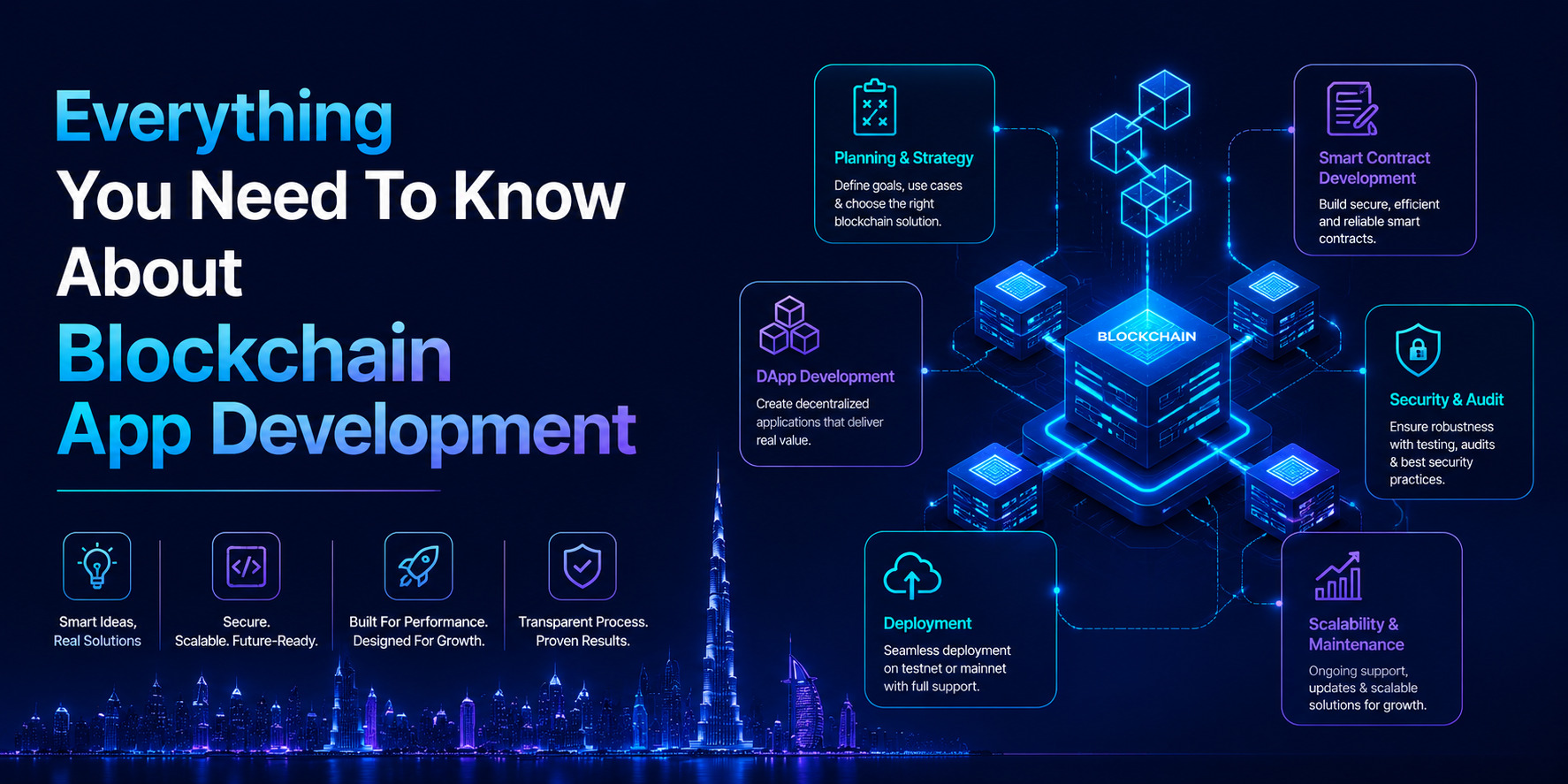
But to be a part of this blockchain app development change, it is important to know the cost, features, and other aspects that affect it. So, in this guide, we will explore everything you need to know about tokens and development costs, key features, trends, and the development process.
What Is A Token In Blockchain?
A programmable digital asset built on top of an existing blockchain network is what a token is. But do you know how it is created? A token is created using a smart contract and is represented in multiple forms of value, such as ownership, utility rights, or financial stakeholdership. Some of the very common tokens in a digital ledger consist of:
- Fungible Tokens (USDC, Tether)
- Non Fungible Tokens (Digital art or collectables)
- Utility Tokens (Chainlink, BNB, ENJ)
- Governance Tokens (UNI, AAVE)
What Is Blockchain App Development?
Building applications that are focused on decentralisation and a distributed ledger technology is what blockchain app development is. If you look at them from a different angle, they also take the help of smart contracts, which are often called dApps (Decentralised Applications). Through such a technology, it enables a secure, transparent, and immutable environment for data storage and automated operations.
Blockchain App Development Cost Breakdown
Saying a blockchain technology led app is expensive is not entirely true. The cost is divided on the basis of the type of app entrepreneurs are looking for, the features it has, what is the complexity of the platform, and many other aspects. So, the cost looks like this:
| App Type | Estimated Cost (AED) |
| Simple Blockchain App | AED 20,000 – AED 90,000 |
| Medium Complexity Blockchain App | AED 90,000 – AED 150,000 |
| High Complexity Blockchain App | AED 150,000 – AED 500,000+ |
Elements That Impact The Cost of Blockchain App Development
When you are building an application in this space, it is important to know the blockchain price and the elements that affect it. As cost is an essential factor which can make or break your app, knowing about the factors is equally important. Here, take a look at some of them:
- Development Team Location: Geographic location is the biggest element which makes your project costlier or cheaper. A team of developers based in the USA or Europe will always be expensive when compared to the UAE or India. Hence, cost arbitrage can be your friend here, which is also relevant for Android app development.
- Platform & Network Type: The type of blockchain network that you choose, public (Ethereum, Solana, etc) or private (Hyperledger, R3 Corda, etc), will certainly affect your project’s overall cost. Thus, if you are looking to cut down on costs, you can go for private networks as they generally cost less and vice versa.
- Smart Contract Complexity: It requires a lot of time and a detailed level of coding to execute customised contracts. Moreover, building dApps through the use of sophisticated features leads to more development time and raises project cost.
- UI/UX Design: When users come to your blockchain solutions, they should be easily able to navigate them. Moreover, connecting wallets and doing transactions with ease should be the aim. To create this experience, it requires the combination of custom interface design, responsive layouts, and interactive elements, which impacts the blockchain app development price.
- Security Requirements: Executing buying and selling orders or just creating an account runs the risk of user identity being exposed. Moreover, digital transactions may be interfered with by hackers and crackers. Hence, doing penetration testing and creating a secure system demands a higher cost to be paid and vice versa.
Core Features That Complete A Blockchain App
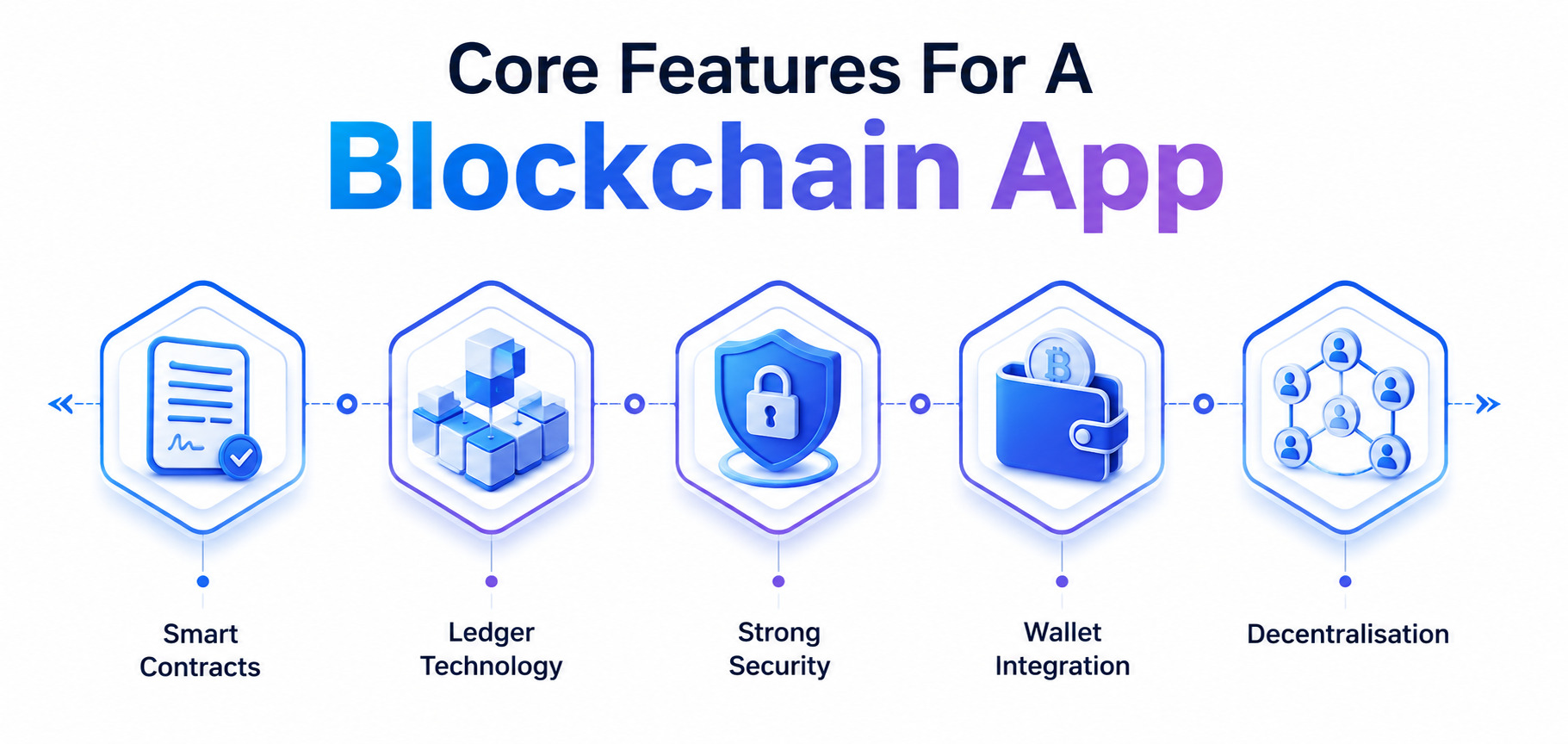
How does blockchain technology in the UAE become a success? The answer lies in the features which complete the app. However, the broader question is, “What features should you integrate into your app?” The list is given below:
Smart Contracts
Self executing contracts that are executed when the predefined conditions are met are called smart contracts. Such contracts are great for getting rid of any intermediaries, which reduces costs and improves efficiency. But here’s the twist! They cannot be modified after deployment, which is why a blockchain development company carefully tests them.
Ledger Technology
Replicated across multiple networks, the ledger technology offers the comfort of a shared database. Your app will not have to rely on a central authority for information, as each participant on the network maintains a copy of the ledger.
Strong Security
Blockchain is a connected mechanism that involves nodes and the transfer of assets digitally. So, there is always a risk of them getting stolen or manipulated. That is why the use of safety systems like cryptographic hash functions, digital signatures, proof of work, proof of stake, and others is to be applied in blockchain applications. Security is also a critical requirement for AI in mobile app development, in which Aarmeh will help you.
Wallet Integration
High performing blockchain technology applications are driven by the buying and selling of digital assets. This indicates there is involvement of money, and it needs to be stored as well as used. For this, a wallet plays a key role, and hence it needs to be integrated by a blockchain development company in Dubai.
Decentralisation
Spreading information with the help of several smaller individuals rather than a concentrated source is what decentralisation is all about. Thus, when it comes to validating the authenticity of a large volume of data and building trust, the network doesn’t have to rely on a single source. For this, you can say thanks to a blockchain app developer.
Benefits of Blockchain That Are Worth Considering
If you consider building a blockchain app with the help of blockchain companies in Dubai, then you are on the right path because:
- Building Trust: Creating any network from scratch or developing an existing one requires trust. The system of reliability and security demands time, effort, quality, speed, and efficiency. These are all the ingredients of blockchain, which help every app built on this structure.
- Enhanced Security: Data is a sensitive and crucial piece of information that drives everyday functions on the blockchain. To keep this, blockchain helps prevent information alteration and prevents it from unauthorised activities.
- Greater Transparency: Thanks to its distributed ledger, the record keeping happens in multiple locations within the network. Moreover, all the network participants with permission access can view the information, which leads to greater transparency.
- Instant Traceability: Blockchain has an audit trail that tracks assets along each step of the way. Traceability proves to be a critical aspect where consumers are mindful of the impact.
- Increased Efficiency & Speed: When building businesses and scaling, speed is important. Moreover, it’s easy to store documents along the blockchain, which eliminates the need for traditional paperwork.
Step By Step Blockchain App Development Process
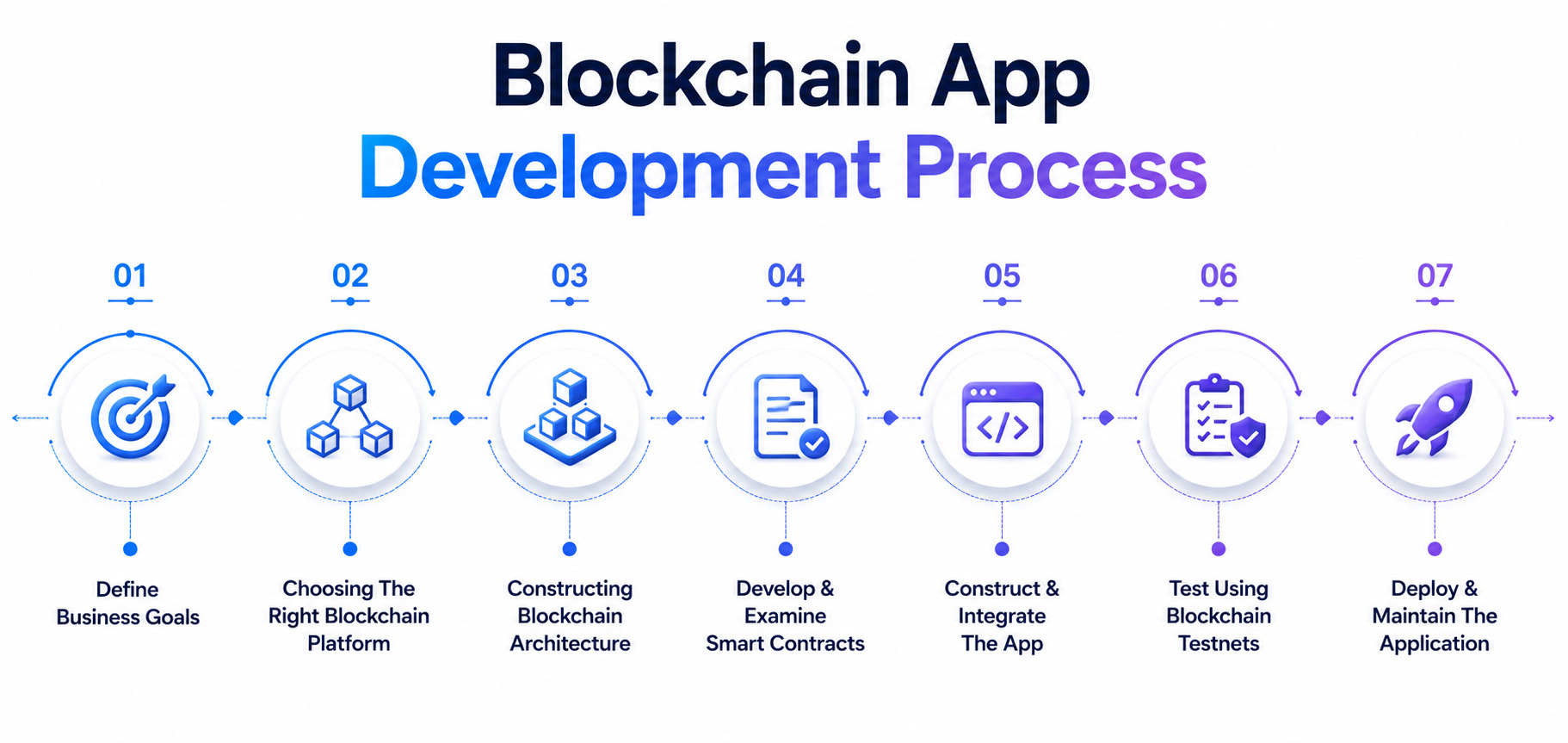
The blockchain app development process is a thorough one and requires the expert assistance of blockchain app developers. To understand this in a much better and more effective manner, here are the development stages:
Define Your Business Goal & Use Case
Identifying the problem and how the blockchain app will solve it is the right method to move in this direction. A sense of clarity and the gap in the market are what make successful blockchain applications. Moreover, defining the aims and what is the use case is a critical aspect of an successful business app.
Choose The Right Blockchain Platform
Like Bitcoin is used as a store of value and peer to peer digital money, Solana is utilised for crypto trading. Every blockchain has its own purpose. Therefore, choosing a platform based on the app’s features, security needs, and budget is a necessary part of the process.
Constructing Blockchain Architecture
Here, the user interface, data handling mechanisms, and how they interact with the blockchain network are planned out. You will also have to define hashes, proofs, state updates (on chain) and large files, heavy business login, and compliance data (off chain).
Develop & Examine Smart Contracts
Now the part of interacting with the blockchain comes. You know who does it? It is a smart contract. So, to make this happen, the mobile app development company in Dubai codes the main logic with languages like Solid or Rust.
Construct & Integrate The Application
When you come to this stage, the actual development starts to take place. It includes developing and integrating a user interface along with blockchain infrastructure and smart contracts. Moreover, this phase also includes both backend and frontend components while integrating wallets, APIs, blockchain nodes, and smart contracts.
Test Using Blockchain Testnets
After the app has been developed and everything has been put into place, testing even the smallest element is necessary. Doing tests is important to get rid of any bugs, security vulnerabilities, performance bottlenecks and more. And this is what blockchain consulting services do.
Deploy & Maintain The Application
Once the testing has been done, launching the application and maintaining it is the final step. But you might think, why maintain it? Isn’t this a long term process? Yes, it is, and maintenance of the app enables it to integrate new functions, user feedback, and get rid of non existent functions.
Future Trends In Blockchain App Development
Keeping up with the changing technologies is always a good thing; some might lead to disruptions, isn’t it? So, leveraging these blockchain trends can really enhance performance and deliver better returns.
Real World Asset (RWA) Tokenisation
There is a separate section of physical and traditional financial assets that are blockchain based digital tokens. These are called real world asset tokenisation, and some of the assets under this category include commodities, equities, bonds, credit, and intellectual property.
Cross Chain Interoperability
Sharing of data, transferring value, and the ability of different blockchain networks to communicate are what is called cross chain interoperability. Here, the multiple systems are not working in isolation like they used to in the early internet age. This suits perfectly well for a blockchain app because it is core to Web3.
Layer 2 Scaling
Boosting the efficiency and utility of Layer 1 blockchains, Layer 2 scaling solutions are used in some of the blockchain based projects. This is typically helpful in reducing the transaction fees which were paid in the Layer 1 scaling solutions. If you are wondering, these are built on top of existing blockchains like Bitcoin and Ethereum.
Decentralised Identity (DID)
Without the need to rely on a central authority, people can own, manage, and control their personal identity. In other words, you can say it is an identity which is completely decentralised. Hence, the name, decentralised identity. In a typical world, governments of various nations issue such identities and overlook them, which is not the case here.
Why Choose Aarmeh?
If you are on the quest to make the best blockchain application that solves a real world problem, then you just might need the help of experts.
These should be people who possess relevant experience not only in app development but blockchain specific.
So, if you are looking for a blockchain in the UAE, then Aarmeh will help you out.
The Final Word
The blockchain technology is really shaping the world of business and how businesses perceive it. Such systems are becoming the core of transparency, security, and scalable business ventures. But to work on it, you may first consider what the development cost is, factors that impact the cost of development, important features that make up the app, and many more. Therefore, to do all this, along with the development of a blockchain application, you need to partner with a reliable developer. And in this process, Aarmeh will help you out.
FAQs
Q) How much does blockchain app development cost?
Ans) Blockchain app development cost ranges between AED 20,000 to AED 500,000+. This range is due to the complexity of the app, which arises during development.
Q) Why do I need a blockchain app development company in Dubai?
Ans) Blockchain app developers are a real help when you need an expert to do wallet integration, build the app when it comes to backend and frontend coding, and solve issues after launch.
Q) What are the future trends for blockchain technology?
Ans) Real world asset tokenisation, cross chain interoperability, Layer 2 scaling, and decentralised identity are some of the future trends of blockchain technology.
Q) How does AI affect blockchain app development?
Ans) AI is important when it comes to improving security & fraud detection, enabling and enhancing smart contracts, and analysing the trends using predictive analytics.


 Book a call




 CLUTCH VERIFIED
 Top App Developer UAE
 100% NDA Protected
 IN THE HEART OF UAE