





Table of Contents
Just by looking at the market for Islamic mobile applications, you will come across many of them. Some focus on areas like smart alerts for Quran recitation, AI-based applications for faith-based question answering, and many more offer significant value, which is changing the DNA of such platforms. In a fast-paced world, this is a challenging yet promising aspect that entrepreneurs like you should target, which can be great for frequent travellers. This is why the role of AI in Islamic apps warrants study.
Market Size of AI Islamic Apps
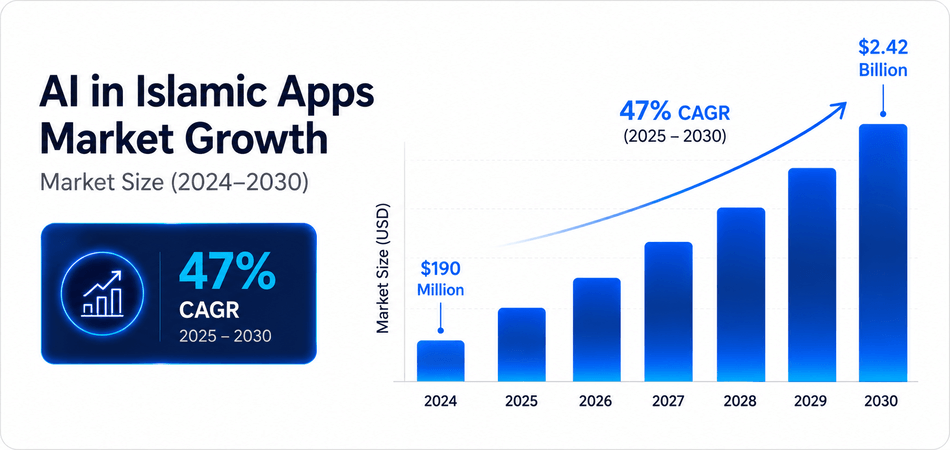
The market size of AI Islamic apps in the Middle East & Africa has reached around $190 Million in 2024. However, this number is expected to reach the market size of $2.42 Billion by 2030. This shows a massive compounded annual growth rate (CAGR) of 47% between 2025 and 2030. If we go through the Saudi Arabia market alone, this market will jump from $51.6 Million in 2024 to $703.6 Million by the end of 2030. This is a great opportunity for business owners to partner with an AI app development company in UAE, like Aarmeh.
What Is The Role of AI in Islamic Apps?
If you look at Islamic mobile applications like WeMuslim and how it has integrated into the lives of people in the UAE, you will witness a massive lifestyle change. From timely Quran recitations to offering an in-depth timetable on what is the next process, the Islamic mobile applications have changed the landscape. However, some of the other roles these applications fulfil include:
Personalised Islamic Learning
Each follower of Islam goes through a distinct path, which is integral to each one of them. Some are in the beginning stages of following Islam and must understand the fundamentals, like learning the Arabic script, commitment to memorising the Quran, word-for-word, and many more. Hence, by 2026, numerous Islamic platforms must leverage AI, leading to advancement in the understanding of the holy text.
Smarter Quran Recitation & Tajweed Assistance
In the recent past, people have been limited to hearing reciters and repeating after them. While this is useful, there is no accurate feedback system which enables users to opt for corrections if any mistakes are found. But thanks to artificial intelligence in Islam, users can easily and promptly correct such mistakes in an instant, keeping them in a constant loop.
- Pronunciation Mistakes
- Pausing Errors
- Tone Inconsistencies
Interactive Islamic Chatbots
A highly discussed innovation in 2026 is the multifold growth of Islamic AI chatbots. This virtual help is built to address routine religious questions in an easy and dialogue-based manner. Individuals can inquire about matters such as:
- Can I combine prayers while travelling?
- What duas should I read during anxiety?
- How much zakat do I need to pay?
- What breaks a fast?
Instead of searching through long topics, users receive organised and understandable responses within seconds.
Spiritual & Mental Wellbeing Support
An equally compelling function of AI in Islamic apps involves giving emotional and spiritual help. Discussions regarding mental well-being within Muslim circles have grown more frank in recent times. Understanding the profound link between faith and emotional health for many individuals is necessary at this point. Thus, some of the features that cover this in detail consist of:
- Person-centric duas based on emotional well-being.
- Prompts for journalling.
- Islamic teachings that will help with stress management.
Effective For Elderly & Disabled Users
Many elderly Muslims faced difficulties with small font sizes, complex interfaces, or challenging navigation in previous applications. In 2026, voice-command-enabled Islamic apps are far more widespread. Users can now just state commands like:
- Play Surah Yaseen
- What time is Maghrib?
- Read today’s hadith
- Open morning duas
 5 Real World Examples of AI-Powered Islamic Apps
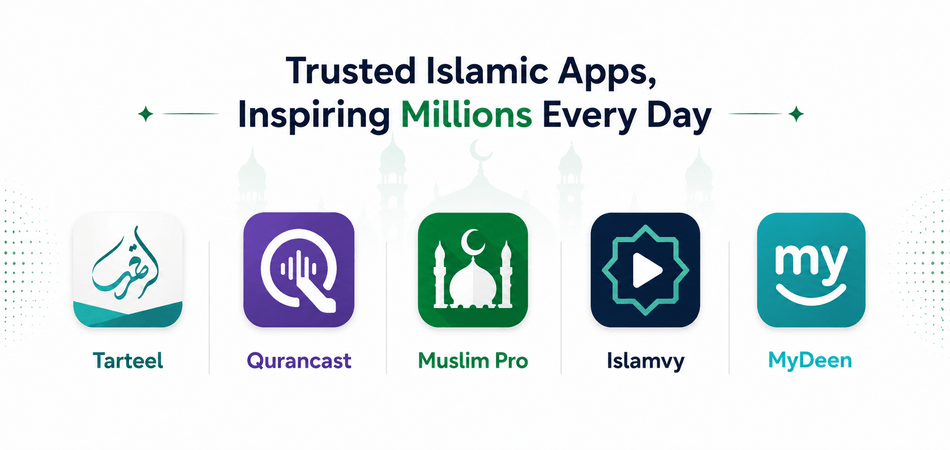
Artificial intelligence in Islam has influenced the rise of many applications, which have positively affected the lives of many individuals. From providing feedback to giving reminders of prayers to millions of people, these AI-powered Islamic apps have contributed in one way or another. Thus, 5 of the real-world examples include:
Tarteel
Tarteel is an artificial intelligence-driven Quran application helping users improve their recitation and memorisation abilities. The application helps in Quran recitations instantly, spotting errors through sophisticated speech-recognition methods. It is widely used in the UAE by students and Huffaz for daily Quran practice and tajweed correction.
Qurancast
Qurancast is an AI Quran education platform established in the UAE, created to render Quran learning more engaging and tailored. It delivers AI-produced critiques on pronunciation, tajweed adherence, and progress in memorisation. The application is becoming favoured among young Muslims in the UAE due to its contemporary and intuitive learning journey.
Muslim Pro
Muslim Pro stands as one of the most frequently used Islamic lifestyle applications spanning the UAE and the broader Middle East. It integrates AI-supported functionalities with prayer schedules, Quran listening, Qibla direction finding, and Islamic notifications. This app assists Muslims in maintaining their spiritual connection through customised devotional material and daily direction.
Islamvy
Islamvy is an Islamic application leveraging AI, providing tools like dream analysis, dhikr tallying, and Quran utilities. The app utilises artificial intelligence to deliver customised Islamic insights and spiritual suggestions based on individual user engagement. It is particularly well-liked by newer generations of Muslims seeking a current digital Islamic encounter.
MyDeen
MyDeen is a complete Islamic application featuring an AI helper named “Nur” to address Islamic inquiries. The application additionally provides access to Quran and Hadith collections, halal product checking, locale services for mosques, and memorisation help. Within the UAE, it is valued for consolidating various Islamic services onto a single smart platform.
Benefits of Islamic Mobile Applications In 2026
By 2026, Muslim mobile apps will have turned into a fundamental element of the everyday routine for countless Muslims globally. What began as basic utilities for prayer schedules and knowing the Qibla’s bearing has now matured into sophisticated digital environments aiding devotion, education, daily living, and spiritual health.
Easier Access To Daily Workshop Guidance
A core advantage of Islamic applications lies in the streamlined access to daily devotionals. If we look at the Muslim apps 2026, some of the many aspects covered include:
- Accurate prayer times based on location.
- Qibla direction using smart sensors.
- Customisation options along with adhan notification.
- Reminders for fasting with Ramadan schedules.
Platforms such as Muslim Pro and others now make it easy for Muslims residing in non-Muslim nations or bustling city settings to follow their prayer schedule without complication.
AI-Powered Quran Learning & Recitation Support
A key development forecast for 2026 involves AI-supported Quran study. To solidify this, Muslim apps 2026 offer:
- Tajweed correction through voice recognition.
- Personalised memorisation plans.
- For Hifz learners, audio repetition tools.
Applications like Quran Majeed and comparable services have incorporated smart learning modules that adjust to the individual’s speed.
Strengthening Connection With Islamic Knowledge
Furthermore, mobile Islamic software serves as a potent instrument for acquiring Islamic learning beyond just the Quran. Users can explore:
- Hadith Collections
- Daily Islamic reminders
- Stories of Prophets
- Fiqh-based guidance
Rather than sifting through numerous websites or texts, individuals can find authenticated Islamic insights centralised in a single location.
Personalised Spiritual Experience
A major shift anticipated in 2026 is customisation. Islamic software now interprets user habits and tailors its offerings. For example:
- Someone who regularly reads the Quran at night receives evening reminders.
- A user focused on Ramadan gets fasting-focused content.
- Someone learning Arabic gets grammar-based lessons.
Enhancement In Mental & Emotional Wellbeing
Islamic mobile platforms are being used for more emotional and spiritual well-being. Some of the AI-powered Islamic apps now feature:
- Duas for anxiety and stress.
- Guided dhikr sessions.
- Soothing Quran recitations.
- Reflection journaling features.
- Daily motivational Islamic content.
Support For Ramadan & Hajj Experience
Islamic applications have notably enhanced how Muslims observe and prepare themselves for Ramadan and Hajj. Throughout Ramadan, users benefit from:
- Reminders about Iftar and Sehri.
- Fasting trackers that are personalised.
- Quran completion goals.
You Need To Navigate Through These Challenges
In the process of developing AI Muslim apps 2026, you will encounter serious challenges. Some may be related to data, overall functionality of the application, or other issues that are not in your control. However, if you are planning to solve them, which you will, you will need the help of a mobile app development company. Besides, some of the challenges include:
Dealing With Incomplete Digital Knowledge
Not only Islamic mobile applications but even general apps have been challenging to navigate, especially for the older generation. This is due to the complicated interface, features that are diverse, and step-by-step tutorials which are not thorough, to say the least.
Tackling Issues Related To Private User Information
Every mobile application, whether it is made for Android or iOS, will ask users’ consent to collect personal information. If you are an entrepreneur who doesn’t have an understanding of such matters, it is best to partner with an AI app development company in UAE. Hence, details like permission procedures, following regional data protection laws, and others will be easily tackled.
Maintaining User Confidence
If someone doesn’t know your brand or doesn’t believe you on face value, then maintaining user confidence can be a challenging task. There are plenty of mobile applications out there. “Why would someone trust your platform?” is the question that you should ask. Thus, if your focus is to build a platform that integrates services from religious scholars, then the user confidence slightly enhances for such platforms.
Diverse Language Is A Challenge
Sometimes, understanding the various dialects of Arabic can be a problem for even Muslims. User interfaces and training AI models on large, regionally relevant linguistic datasets can be improved with the help of AI in Arabic-language Quran apps.
Accuracy In Religion Is Essential
AI is a technological medium which can display some inaccurate information about religious texts. This is a major issue which can be seen as deceptive, even though your intention might not be. Doing this hurts the customer’s sentiments and will take away the integrity factor. Therefore, engagement in AI in Islamic apps will plummet significantly.
How To Use AI-Powered Islamic Apps? The 5 Use Cases
Till now, all the talk has been about the features of Islamic mobile applications, the benefits of such platforms, and the role of AI-based Islamic platforms. Now, the question arises, how such platforms can be utilised, leading to multiple use cases which include:
AI-Powered Prayers & Mosque Assistance
- Based on the UAE location, accurate prayer timings are given.
- Taking help of AI navigation and GPS, the Qibla direction can be found out.
- Recommending nearby mosques with prayer schedules.
- Jummah and smart prayer reminders.
- Query support in Arabic and English, leading to voice-based offers.
Personalised Quran Learning & Tafsir
- Utilising AI speech recognition to correct Quran pronunciation.
- Provides personalised Quran learning plans.
- Explains verses with simplified AI-generated Tafsir.
- For expats in the UAE, a platform supporting multiple languages.
- Recitation progress and tracking memorisation.
Smart Zakar & Charity Management
- Calculates Zakat figures automatically from wealth and income.
- Presents reputed UAE charitable groups for contributions.
- Keeps a record of past transactions and charitable giving.
- Suggestions and issue alerts for Ramadan charity.
- Following the Sharia law, guidance on Islamic finance is provided.
Islamic Lifestyle & Halal Recommendation Engine
- Gives you the location of the nearby dining spots and coffee shops that are halal.
- Highlighting group get-togethers and local Islamic functions in the UAE.
- Offers modest fashion and recommended halal products.
- Generates suitable entertainment ideas for families during Islamic holidays.
- According to individual preferences and locations, customised solutions are provided.
Family Guidance & AI-Islamic Counselling
- Offers Islamic advice for marriage and relationships.
- Rooted in Islamic principles, offering guidance on how to raise children.
- Supports mental well-being with faith-based motivation.
- Responds to day-to-day queries concerning the Islamic way of life and morals.
- Connects users with religious scholars for more in-depth support.
Aarmeh: Your AI App Development Company In UAE
Whether it is a Quran recitation platform, an AI-based chatbot, an AI-based voice recognition platform, finding Qibla locations with AR & VR capabilities, tracking habits based on the Quranic habits and goals, and many more, can be developed from scratch with the help of an AI app development company in UAE. And for this, you can take the help of Aarmeh because we have:
- 1400+ Mobile Apps Developed From Scratch
- 800+ Happy Clients
- 750+ Websites Developed
- 200+ Developers
- 50+ AI Solutions
- 869M+ Raised Through Developed Apps
So, taking the next step in the world of AI-based Islamic applications should be with a trusted and experienced team, and Aarmeh ticks both the checkboxes. Then why wait? Connect with us Now!
The Final Word
In 2026, the AI in Islamic apps are reshaping the ways Muslims engage with their faith, routine devotions, and religious education. On this front, some of the functionalities, such as intelligent prayer alerts, Quran study featuring Tajweed refinement, AI chatbot agents, Zakat calculation, and suggestions for halal options, are representations of these apps that are invaluable, particularly across the UAE and the broader Middle East. Moreover, these digital services enable psychological and spiritual wellness through tailored advice and support for diverse languages. Hence, partnering with a mobile app development company like Aarmeh is the solution to such problems.
FAQs
Q) Why are Islamic apps becoming increasingly popular in the UAE?
Ans) These apps offer convenience, multilingual support, personalised Islamic teachings, and smart features that fit the fast-paced lifestyle of users in the UAE.
Q) What is the market size for AI Islamic apps?
Ans) $190 Million was the market size of the AI Islamic application in the Middle East & Africa. However, this number is estimated to grow to $2.42 Billion by 2030.
Q) Do AI applications provide accurate prayer timings?
Ans) Yes, these apps use GPS and location-based services to provide accurate prayer schedules and Qibla direction.
Q) How do Islamic AI chatbots help users?
Ans) Islamic AI chatbots answer common religious questions related to prayers, fasting, Zakat, duas, and Islamic lifestyle guidance instantly.
Q) Which is the best AI app development company in UAE?
Ans) The best AI app development company in UAE is by far Aarmeh. By helping 800+ clients and making them happy through 1400+ mobile applications developed from scratch, we have helped businesses raise 869M+ from mobile software developed. Therefore, it is fair to call Aarmeh the best in the business.




 Book a call




 CLUTCH VERIFIED
 Top App Developer UAE
 100% NDA Protected
 IN THE HEART OF UAE